
Recent CPU Developments and Trends 2026: Intel Panther Lake, AMD X3D & Zen Roadmaps, and the AI Race Heating Up
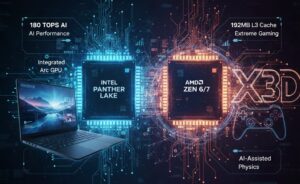
As 2025 comes to a close, the CPU landscape is heating up with exciting recent developments and emerging trends for 2026. Intel and AMD are both preparing their next-generation processors, including Intel’s Panther Lake lineup with high-performance cores, integrated Arc GPUs, and AI acceleration, as well as AMD’s X3D gaming CPUs and Zen 6/Zen 7 roadmap, which combine extreme gaming performance with advanced AI capabilities.
From AI integration and Neural Processing Units (NPUs) to chiplet innovations and hybrid CPU architectures, the next wave of processors is redefining what laptops, desktops, and workstations can do. This article provides a comprehensive look at the latest CPU developments, highlighting performance benchmarks, architectural improvements, and the key trends shaping AI-powered computing in 2026.
Intel Panther Lake: High Clocks and AI-Powered Laptops
Intel’s next-generation Panther Lake CPUs are shaping up to redefine laptop performance, combining high clock speeds with unprecedented AI capabilities. Leaked benchmarks, including a Geekbench appearance of the Core Ultra X9 388H, suggest a maximum turbo frequency around 5.1 GHz, delivering a modest CPU performance uplift over current laptops. However, the real story lies in its graphics and AI enhancements, which promise to elevate laptops into the era of “AI PCs.”
These new processors feature a hybrid core configuration with up to 16 CPU cores—including 4 performance cores, 8 efficiency cores, and 4 low-power efficiency cores—paired with 12 Xe3 GPU cores. The integrated GPU is a significant leap forward, enabling smoother gaming and better content creation without relying on discrete graphics cards.
What sets Panther Lake apart is its AI architecture. These chips incorporate powerful Neural Processing Units (NPUs) and a dedicated Image Processing Unit (IPU), enabling tasks such as AI-based noise reduction, real-time tone mapping, and other on-device AI enhancements. These chips are expected to deliver significant AI acceleration through integrated NPUs and an IPU, enabling advanced on-device AI workloads that were previously limited to discrete GPUs.
Intel is already working with laptop makers to showcase this technology. Acer has teased the Swift 16 AI running a Panther Lake chip, while other brands like Dell and MSI are expected to release models around the official launch. The company is targeting CES 2026 in January for the full unveiling, where we can anticipate detailed specifications and demonstrations of both gaming and AI capabilities.
Why it matters: Panther Lake signals Intel’s intent to merge high-end CPU performance, capable integrated graphics, and powerful on-device AI into mainstream laptops. For consumers and professionals alike, this means devices that are not only faster for traditional tasks but also capable of accelerating AI-driven workflows, multimedia processing, and creative applications.
Further Reading: Intel’s Panther Lake Geekbench Leak and Laptop Preview – Tom’s Guide
AMD X3D & Zen Roadmaps: Gaming Performance Meets AI Vision
AMD is positioning itself for a dominant 2026 with three key CPU offerings, each targeting a distinct performance segment while integrating advanced AI capabilities.
The upcoming Ryzen 9 9950X3D2 and 9850X3D are rumored to be gaming powerhouses. Leaks suggest they could feature massive 192MB of L3 cache—a significant increase over the previous 5950X3D—potentially allowing games and latency-sensitive applications to access data faster, reducing stutters and improving frame rates. Boost clocks are also rumored to reach up to 5.6 GHz, which could deliver strong single-threaded performance for competitive gaming and high-performance creative workloads. Early reports indicate that the X3D series might be optimized for AI-assisted gaming engines, leveraging large caches and refined core layouts to enhance real-time AI features like dynamic lighting and physics computations.
Zen 6, expected in 2026, represents a refined architectural step forward. Compared to Zen 5, Zen 6 offers:
-
Potentially Higher core counts and improved multi-thread scaling for content creation and workstation tasks.
-
Integrated AI acceleration, which could enable faster inference and AI-enhanced applications directly on the CPU.
-
Better power efficiency, thanks to likely process optimizations and improved chiplet integration.
Finally, Zen 7, projected for 2027 and built on 2nm process technology, targets next-generation efficiency and AI performance. Its key improvements over Zen 6 include:
-
Extreme performance-per-watt, which may make it ideal for high-core-count desktops and AI workstations.
-
Enhanced AI acceleration, possibly enabling larger models and more complex on-device workloads.
-
Smarter chiplet scaling, allowing configurable combinations of cache, cores, and AI units for both consumer and professional applications.
AMD’s strategy is clear: massive caches, high clock speeds, and AI acceleration work together to solidify gaming supremacy while preparing for a broader AI-driven computing era. The continued refinement of chiplet designs enables flexible scaling of cores, cache, and AI units, allowing AMD to optimize performance across both consumer and professional workloads.
Why it matters: Each product serves a unique purpose:
-
X3D CPUs push gaming performance and AI-assisted gameplay to the next level.
-
Zen 6 balances efficiency, AI integration, and multi-threaded performance for desktop and workstation users.
-
Zen 7 sets the stage for extreme AI-heavy workloads, maximizing efficiency, performance, and scalability.
By clearly differentiating these products, AMD is signaling a future where gaming, professional computing, and AI acceleration converge, giving users CPUs that are not just faster, but smarter.
Further Reading: AMD X3D CPU, AMD Zen 6, and AMD Zen 7.
Broader CPU Trends Shaping 2026: AI, Chiplets, and Hybrid Performance
As we approach 2026, the CPU industry is no longer just about raw clock speeds or core counts. The next generation of processors is defined by smarter architectures, AI acceleration, and modular designs that reshape how computing power is delivered to both consumers and professionals.
AI Integration Becomes Standard
On-device AI is rapidly moving from niche to mainstream. Modern CPUs are increasingly incorporating Neural Processing Units (NPUs) and dedicated accelerators, enabling tasks such as real-time language translation, AI upscaling, image noise reduction, and generative AI applications directly on the CPU. Intel’s Panther Lake and AMD’s Zen 6/7 roadmap demonstrate this trend, while platforms like Arm’s Mobius100 show how AI integration is becoming a cross-platform standard. By 2026, AI integration is expected to become a standard feature for both professional and mainstream CPUs, enabling more AI workloads to run efficiently on-device.
Chiplet Technology Drives Performance and Efficiency
The evolution of modular chiplets is transforming CPU design. By combining cores, cache, and specialized accelerators in discrete tiles, manufacturers can optimize power efficiency, yields, and scalability. Chiplet designs allow higher core counts without the thermal and manufacturing limitations of monolithic dies. Both Intel and AMD are doubling down on this approach, ensuring future CPUs can deliver maximum performance for gaming, content creation, and AI workloads.
Hybrid Architectures and Platform Synergy
Next-generation CPUs are no longer isolated components—they are part of holistic computing platforms. High-performance cores, efficiency cores, integrated GPUs, and AI accelerators must work in concert with faster memory and smarter scheduling. This hybrid architecture approach enables laptops, desktops, and workstations to tackle complex AI models, high-fidelity gaming, and productivity tasks simultaneously, with minimal energy overhead.
What to Watch in 2026
-
CES 2026: Intel’s Panther Lake launch and potential AMD announcements for X3D and Zen 6 will set the stage for the year. Expect demos highlighting AI acceleration, hybrid performance, and next-gen gaming.
-
The AI Hardware Race: Intel, AMD, and ARM-based platforms are competing to integrate high-performance AI units on-chip, making AI acceleration a key differentiator for consumers and professionals alike.
-
Gaming and Productivity Leap: Larger caches, faster clocks, and smarter AI processing promise tangible gains in gaming FPS, content creation workloads, and AI model inference—showing that CPUs are now as much about intelligence as speed.
Why it matters: 2026 will mark a turning point where CPUs are intelligent, modular, and AI-aware, shifting the focus from traditional performance metrics to smarter, task-adaptive computing. Consumers and professionals alike will benefit from CPUs that are not just faster, but capable of accelerating AI workloads and optimizing system efficiency in ways never seen before.
Conclusion
As 2025 comes to a close, it’s clear that the CPU industry is entering a transformative era. Intel’s Panther Lake brings high clock speeds, integrated Arc GPUs, and AI acceleration to mainstream laptops, while AMD’s X3D CPUs and Zen 6/Zen 7 roadmap combine extreme gaming performance with on-chip AI capabilities and modular chiplet designs.
The broader trends—AI integration, chiplet architecture, and hybrid CPU platforms—are reshaping the very definition of what a processor can do. No longer just a raw performance engine, the modern CPU is becoming an intelligent, adaptable hub, capable of accelerating AI workloads, optimizing power efficiency, and delivering enhanced experiences for gamers, creators, and professionals alike.
Looking ahead to 2026, CES will be a major milestone, showcasing how Intel and AMD plan to push AI-aware computing to the next level. The coming generation of CPUs promises not only higher clocks and larger caches but also smarter systems that can handle AI-driven tasks, gaming, content creation, and professional workloads with unprecedented efficiency.
For anyone following the evolution of computing hardware, 2026 marks the beginning of a new era where performance, intelligence, and adaptability converge, setting the stage for devices that are faster, smarter, and more capable than ever before.
If you’re upgrading to one of the new Intel Panther Lake or AMD X3D CPUs in 2026, you can sell your old CPU to BuySellRam.com to maximize its value for your business.