
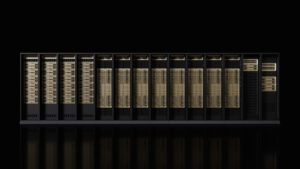
NVIDIA Rubin Platform (Image from NVIDIA)
At CES 2026, NVIDIA CEO Jensen Huang delivered one of the most consequential keynotes in the company’s history. What stood out was not what was launched—but what wasn’t. There was no new consumer GPU, no RTX announcement, and no performance charts aimed at gamers. Instead, NVIDIA introduced Vera Rubin, a next-generation AI supercomputing platform that reframes how artificial intelligence infrastructure is designed, deployed, and scaled.
The message from the stage was clear: AI’s bottleneck is no longer individual chip performance, but system-level efficiency, cost, and scalability. Rubin is NVIDIA’s answer to that challenge.
Rubin Is Not a GPU Launch — It’s a Platform Transition
Unlike previous NVIDIA generations—Hopper, Blackwell, or earlier architectures—Rubin is not defined by a single chip. Instead, it is a rack-scale AI computing platform, built from the ground up as a unified system.
NVIDIA positions Rubin as an AI supercomputer architecture, not a component upgrade. The platform integrates six purpose-built technologies that are co-designed to operate as a single AI engine:
-
Rubin GPU
The core accelerator, featuring a new generation Transformer Engine optimized for large-scale inference and training workloads. -
Vera CPU
A new CPU designed specifically for AI reasoning and data orchestration, tightly coupled to the GPU via high-bandwidth links. -
NVLink 6 Switch
NVIDIA’s latest interconnect technology, enabling massive GPU-to-GPU bandwidth and near-linear scaling across racks. -
ConnectX-9 SuperNIC
High-performance networking optimized for AI clusters and low-latency communication. -
BlueField-4 DPU
A data processing unit that offloads networking, storage, and security tasks, while enabling AI-native memory and context management. -
Spectrum-6 Ethernet Switch
High-capacity Ethernet switching for hyperscale AI environments.
This six-component design reflects a fundamental shift: AI performance is now determined by how well compute, memory, networking, and security work together, not by raw GPU throughput alone.
From “Stacking GPUs” to Building AI Factories
In his CES keynote, Jensen Huang emphasized that the industry can no longer rely on simply adding more GPUs to solve AI’s scaling problems. Model sizes are growing into the hundreds of billions and trillions of parameters, and inference workloads increasingly involve long-context reasoning, agentic AI, and persistent memory.
Rubin addresses these challenges by treating the entire data center as a single AI computer.
The Rubin NVL72 System
One of the most striking demonstrations at CES was the Rubin NVL72 rack:
-
72 Rubin GPUs
-
36 Vera CPUs
-
Fully interconnected via NVLink 6
-
Aggregate bandwidth of up to 260 TB/s
-
Designed to behave like one massive logical GPU
This level of integration allows NVIDIA to dramatically reduce communication overhead, one of the largest inefficiencies in large-scale AI training and inference.
Rather than GPUs waiting on data, or CPUs idling while accelerators compute, Rubin coordinates the entire system so that compute, memory, and data movement remain continuously active.
Performance Gains That Redefine Economics
NVIDIA’s official figures—presented both on stage and in its press materials—highlight why Rubin represents more than an incremental upgrade.
Compared to Blackwell, Rubin Delivers:
-
Up to 5× improvement in inference performance
-
Up to 3.5× improvement in training performance
-
Up to 10× reduction in inference cost per token
-
Up to 4× reduction in the number of GPUs required for large MoE models
These gains are not achieved through brute-force compute alone. Instead, they result from:
-
Improved interconnect bandwidth via NVLink 6
-
Better CPU–GPU task coordination
-
Offloading of networking and storage overhead to DPUs
-
AI-native memory hierarchies designed for KV cache and long-context inference
The result is a platform that lowers the cost barrier for deploying large-scale AI, making advanced reasoning models economically viable for more organizations.
Memory, Context, and the Rise of AI-Native Storage
One of the less flashy—but arguably most important—elements of Rubin is how it addresses context memory.
As AI models evolve from short prompts to million-token contexts, traditional memory hierarchies struggle to keep up. GPU HBM is fast but expensive and limited in capacity, while traditional storage introduces unacceptable latency.
Rubin introduces a new approach by leveraging BlueField-4 DPUs to create an intermediate “context memory layer” between GPU memory and conventional storage. This enables:
-
Faster access to large KV caches
-
More efficient long-running inference sessions
-
Higher token throughput without linear increases in GPU memory
This architecture is particularly relevant for agentic AI, enterprise workflows, and applications that require persistent reasoning across long time horizons.
DGX SuperPOD and Rack-Scale AI Deployment
Beyond individual racks, NVIDIA also unveiled the next generation of DGX SuperPOD, built using Rubin NVL72 systems.
A single SuperPOD configuration includes:
-
8 Rubin NVL72 racks
-
576 GPUs total
-
Integrated networking, storage, and security
-
Designed to support:
-
Thousands of AI agents
-
Millions of tokens of active context
-
Large-scale training and inference simultaneously
-
The key takeaway is that NVIDIA is no longer selling “clusters” as a collection of servers. It is delivering pre-engineered AI infrastructure, ready for deployment at hyperscale.
Security Enters the AI Core
Another industry-significant announcement is Rubin’s support for third-generation confidential computing.
This capability ensures that:
-
Model weights
-
Inference data
-
User requests
are encrypted end-to-end, even from cloud operators themselves.
For industries such as finance, healthcare, government, and enterprise AI, this addresses one of the most persistent barriers to cloud adoption: trust.
Confidential computing positions Rubin not just as a performance platform, but as a compliance-ready AI infrastructure.
Industry Adoption and Deployment Timeline
According to NVIDIA’s official roadmap, Rubin is not a distant concept or a research prototype—it is already in production. NVIDIA confirmed that the first Rubin-based systems will be deployed with leading cloud and AI organizations, including AWS, Microsoft Azure, Google Cloud, Meta, OpenAI, and other major infrastructure providers.
These early deployments mark the beginning of Rubin’s transition from flagship architecture to real-world AI infrastructure. NVIDIA expects broad commercial availability in the second half of 2026, positioning Rubin as the foundation for the industry’s next deployment cycle.
Why Rubin Matters
-
Shift from GPUs to platforms
Rubin is not a faster standalone GPU but a fully co-designed AI platform integrating compute, networking, memory, storage, and security at the rack scale. -
System-level performance gains
Performance improvements come from coordinated architecture across GPUs, CPUs, interconnects, and networking, rather than isolated component upgrades. -
Changing unit of value in AI hardware
Integrated systems, racks, and interconnect architectures are becoming as important as individual GPUs in how AI infrastructure is evaluated and deployed. -
Economics drive adoption
NVIDIA projects up to 10× lower inference cost per token and fewer GPUs required for large MoE models, directly addressing AI’s cost-scaling constraints. -
Enabling production-scale AI
Lower costs make long-context reasoning, agentic AI, and enterprise-grade inference practical beyond experimental deployments. -
Competition shifts to infrastructure
By delivering an end-to-end platform, NVIDIA moves competition from the chip level to the infrastructure level, where integration, software, and ecosystem depth are harder to replicate.
Implications for the Secondhand Hardware Market
Systems Become the Primary Asset
As AI infrastructure becomes more integrated, secondary markets can no longer treat GPUs as standalone commodities. Server configurations, interconnects, DPUs, and memory bandwidth increasingly determine real-world performance and resale value. Pricing and demand will reflect system context, not just accelerator model.
Earlier Generations Enter a New Phase
With Rubin entering production and broader deployment expected in the second half of 2026, platforms such as Blackwell and Hopper will gradually shift from frontline roles to secondary and niche use cases. These systems are likely to remain viable for cost-sensitive inference, hybrid deployments, and research workloads, creating renewed activity in secondary markets as assets are redeployed rather than retired.
Clear Timelines Enable Market Planning
NVIDIA’s stated deployment plans—beginning with major cloud providers in late 2026—provide rare visibility into the next infrastructure cycle. This predictability allows enterprises and data center operators to plan upgrades and divestments more deliberately, aligning primary adoption with secondary market supply.
A Broader Transition
Rubin signals that AI hardware is entering a more industrialized phase, where integration, efficiency, and lifecycle management matter as much as raw compute. In this environment, the ability to strategically sell GPUs and systems becomes part of infrastructure planning, not merely an end-of-life consideration. The shift from component-centric to system-centric AI infrastructure will shape both primary deployments and secondary market dynamics for years to come.
A Defining Moment for AI Infrastructure
CES 2026 made one thing unmistakably clear: the era of AI as a collection of GPUs is over.
With Vera Rubin, NVIDIA has drawn a line between past and future—between experimental scale-up and industrial-scale AI deployment. By integrating compute, memory, networking, storage, and security into a single platform, Rubin transforms AI from a resource-intensive experiment into a scalable, cost-controlled infrastructure.
The implications will ripple across cloud computing, enterprise IT, data center design, and global hardware markets for years to come.
AI is no longer just about faster chips. It’s about building systems that think at scale.