
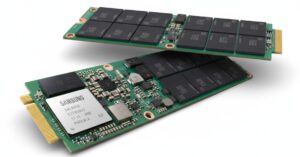
Samsung NAND Prices Jump 100% in Q1 2026
Samsung’s reported 100% increase in NAND Flash contract prices in Q1 2026 confirms the trend we forecasted in our previous market outlook report: AI data center demand is driving a sustained upcycle in memory pricing. DRAM prices have already been rising continuously due to AI workload growth and capacity constraints, and NAND is now following the same structural logic.
As AI deployments move into production—especially RAG and agent-based systems—storage demand grows in both volume and performance requirements. This has shifted NAND from a commodity component to a strategic infrastructure asset. The Q1 2026 NAND price surge therefore signals a multi-year, AI-driven pricing regime, where supply remains tight, demand continues to expand, and contract prices are expected to stay elevated.
1. Samsung’s Q1 2026 NAND Price Adjustment: What Happened
In late 2025, Samsung Electronics completed negotiations for NAND supply contracts with major customers and implemented a new pricing framework beginning in January 2026. The reported contract price increase for Q1 is up to 100% quarter-over-quarter, following an earlier ~70% increase in DRAM contract pricing. This is not a short-lived spike but appears to be part of a broader repricing cycle, as Samsung has already initiated Q2 negotiations.
What this means in practice: Samsung is exerting pricing power from a position of structural supply control, not merely reacting to short-term volatility. The market interpretation is that Samsung’s move reflects deeper constraints across the NAND supply chain and rising demand from AI infrastructure.
Key highlights:
-
Q1 2026 NAND contract prices reportedly increased up to 100% QoQ per market trackers.
-
Samsung began Q2 pricing negotiations immediately after Q1 pricing took effect, suggesting ongoing upward pressure.
-
The adjustment follows a previous ~70% DRAM price increase in late 2025.
2. A Structural Price Cycle, Not a Seasonal Rebound
The current storage upcycle is distinct from historical memory market cycles. In the past, price movements were often driven by seasonal consumer demand, device refresh cycles, or short-term inventory restocking. Those cycles typically ended once supply adjusted. The current trend, however, reflects persistent structural tightness, with upstream suppliers regaining pricing authority. This is consistent with industry analyses showing that NAND Flash and DRAM contract prices have shifted away from traditional volatility patterns toward sustained supplier-led pricing strategies.
Downstream buyers are now forced to make strategic trade-offs, balancing price increases against performance requirements and procurement timelines. Some buyers are passing on costs, while others are reducing system configurations or locking long-term contracts to secure supply.
Observed market behavior:
-
Upstream suppliers regain pricing authority
-
Buyers face decisions between:
-
passing on higher prices
-
reducing capacity configurations
-
locking long-term contracts early
-
pre-emptive inventory stockpiling
-
This pattern is characteristic of strategic resource scarcity rather than cyclical recovery.
3. AI as the Primary Demand Multiplier for NAND Flash
AI innovation has driven a structural transformation in the memory market. Modern AI workloads generate enormous data volumes and require frequent access, meaning that DRAM alone cannot support the full stack. Large model parameter access, long-sequence inference, and multi-task parallel execution all demand high-speed storage. As a result, NAND Flash has become a foundational component of AI data pipelines.
In the modern AI stack, DRAM functions as a real-time computation buffer, while NAND Flash acts as a persistent, high-throughput data movement layer. Storage has shifted from a supporting role to a strategic bottleneck. Market research indicates that AI-driven demand dynamics are reshaping contract pricing and demand patterns across both DRAM and NAND Flash markets.
Core drivers of AI-driven NAND demand:
-
AI workloads increase data access frequency and volume
-
DRAM alone cannot support large model parameter access and long inference sequences
-
NAND Flash is essential for high-throughput data movement
4. NVIDIA, RAG, and the Explosion of Enterprise SSD Demand
At CES 2026, NVIDIA emphasized that AI is reshaping the entire computing stack. As generative AI evolves into agent-based systems with long-term reasoning, workloads increasingly rely on vector databases and retrieval-augmented generation (RAG). These workloads involve massive datasets and highly random access patterns, directly increasing demand for high-performance enterprise SSDs and NAND Flash.
4.1 Rise of AI Agents and RAG Workloads
The shift to AI agents and RAG workloads has driven demand for:
-
Large-scale vector databases
-
High-IOPS enterprise SSDs
-
Low-latency storage systems
These systems require large-capacity NAND deployments and sustained read/write endurance. Market projections on memory revenue growth reinforce that these AI-driven demands are a central driver of storage sector expansion in 2026 and beyond.
4.2 Impact on NAND Pricing
Market research suggests that industry-average NAND Flash prices in Q1 2026 may rise 55%–60% QoQ, with the upward trend expected to continue through year-end. Samsung’s reported 100% QoQ increase represents a high-end contract outcome, which is consistent with the broader trend of rising pricing power in the NAND market. This surge is accompanied by a dramatic increase in revenue, with NAND Flash industry revenue projected to grow 112% YoY in 2026, reaching USD 147.3 billion. These figures are part of a broader forecast for memory revenue growth driven by AI, with total memory market revenue expected to expand substantially in 2026 and 2027.
5. Storage Industry Revenue Outlook: A Multi-Year Expansion
The storage market is entering a multi-year expansion phase driven by AI infrastructure. Market forecasts indicate that total storage industry revenue will reach USD 551.6 billion in 2026, and surge to USD 842.7 billion in 2027, representing a 53% YoY increase. This includes NAND Flash, SSDs, enterprise-focused DRAM, and AI-oriented storage subsystems. These figures are based on industry revenue projections that incorporate both AI demand and constrained supply effects.
Market forecast:
| Year | Total Storage Industry Revenue |
|---|---|
| 2026 | USD 551.6 billion |
| 2027 | USD 842.7 billion (+53% YoY) |
This forecast, combined with persistent supply constraints, supports the expectation that pricing power will remain with suppliers through 2027.
6. Why Supply Cannot Catch Up Quickly
Despite rising prices, supply constraints are unlikely to ease quickly. NAND capacity expansion is limited due to the capital intensity of fabs and the complexity of scaling production, as described in reports on wafer supply tightening and pricing pressure. Manufacturers are also prioritizing higher-margin products such as HBM and advanced DRAM, which further restricts NAND supply, and these strategic allocations have been noted as contributing to the current tightness. Process transitions and yield constraints add another layer of limitation, meaning output growth cannot accelerate quickly enough to match demand.
As a result, contract pricing power remains firmly on the supplier side.
7. Outlook Through 2027: Pricing Power Persists
AI adoption is still accelerating, and the entire computing stack is evolving simultaneously—from hardware to system architecture to software. Storage is now a core, non-optional resource in AI infrastructure. Under sustained demand from AI servers, high-performance computing, and enterprise cloud storage, both DRAM and NAND Flash contract prices are expected to continue rising through 2027, with the overall market revenue expansion maintaining momentum.
Forward outlook:
-
AI demand continues to grow through 2027
-
DRAM and NAND Flash contract prices remain elevated
-
Storage remains a strategic bottleneck for AI infrastructure
Strategic Implications for the Market
For Enterprises
SSD pricing volatility directly affects AI project budgets, infrastructure ROI, and total cost of ownership. Enterprises will need to incorporate storage pricing risk into long-term AI planning, and may prioritize workload consolidation, storage tiering, and cost optimization strategies to reduce exposure to sudden price increases.
For Consumer Prices and End Users
As NAND and SSD costs rise, the price pressure can propagate downstream into consumer electronics. Devices such as laptops, gaming consoles, and mobile products that rely on NAND-based storage may experience higher retail prices, reduced storage configurations in base models, or slower refresh cycles. End users may also see higher costs for cloud storage services and subscription-based applications that rely on large-scale storage infrastructures.
For Secondary & Used Hardware Markets
Rising NAND prices increase the value of existing enterprise SSD inventories. Secondary markets become an effective cost-containment mechanism, especially for organizations seeking to upgrade without absorbing full new-market price inflation. This trend also increases the attractiveness of refurbished storage solutions, creating opportunities for ITAD and reuse-focused businesses.
If you have surplus SSDs or other storage assets, you can request a quote through our service pages: Sell SSD or Sell RAM.