
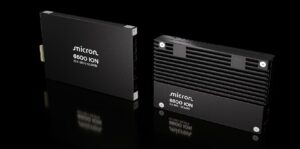
Enterprise SSD Demand Reshapes Supply (Image credit: Micron)
The NAND flash market in 2026 is undergoing a dramatic transformation as AI infrastructure drives unprecedented demand for enterprise SSDs. The semiconductor industry is no stranger to “boom and bust” cycles, but the shift currently rocking the NAND Flash market is far more than a cyclical recovery—it is a fundamental structural transformation. For years, NAND was viewed as the “utility player” of storage: an essential component, but one often plagued by oversupply and margins that struggled to cover even basic manufacturing “cash costs.”
Those days are definitively in the rearview mirror. According to March 2026 sector analysis from Macquarie Equity Research, the industry has transitioned into a “Seller’s Absolute Pricing” era. Driven by a massive pivot from AI training to AI inference, the demand for high-density enterprise SSDs has effectively decoupled from the rest of the storage market.
The data confirms the intensity of this shift: Counterpoint Research recently tracked a staggering 90% price surge in NAND contract prices in Q1 2026 alone. As manufacturers like Samsung and SK Hynix reallocate wafer capacity to high-margin AI infrastructure, they aren’t just raising prices—they are reshaping the financial rules of procurement. For data center architects and hardware procurement officers, the “Cash-for-Capacity” shift is no longer a prediction; it is the new baseline for 2026.
1. The Era of Record Profitability
For much of 2023 and 2024, NAND manufacturers were bleeding cash. Today, the landscape is unrecognizable, giving rise to what some industry insiders are dubbing the “DRAMpocalypse” and “Rampocalypse” due to extreme price hikes across all memory tiers. Analysts have sharply raised profit forecasts to reflect this tightening grip on supply:
-
Samsung & SK Hynix: Both titans are projected to hit record-high NAND margins. SK Hynix is tracking toward operating profit margins in the 62% range in early 2026. Samsung’s NAND prices alone are projected to grow by 111% year-over-year as they target unprecedented operating profits.
-
Segment Outperformance: In a historic shift, operating margins for specific high-performance categories, such as server-grade DRAM and high-density eSSDs, are reportedly touching the 60% range. In some instances, these margins are officially surpassing those of HBM (High Bandwidth Memory), signaling that the “storage bottleneck” is now the industry’s most profitable pain point.
This is a Value Re-rating. NAND is no longer being priced as a commodity; it is being priced as a critical AI enabler, gaining strategic dominance in the global data pipeline.
2. The Engine: AI Inference and the 1,152TB Server
The primary driver of this demand acceleration is the evolution of AI infrastructure. While “Training” requires massive GPU compute, “Inference”—deploying and running those models for end-users—requires massive, high-speed data retrieval.
The Inference Bottleneck
Ahead of the upcoming GTC 2026, industry estimates for the next generation of AI supercomputers—such as NVIDIA’s highly anticipated Rubin platform—suggest a massive storage scaling requirement. Analysts at Citi Research and Wccftech have identified a new critical tier: Inference Memory Context Storage (ICMS).
-
High-Density Requirements: Architecture projections indicate that a single high-end AI GPU may need to be paired with roughly 16TB of TLC/QLC SSD storage to keep inference pipelines fed and manage the massive key-value caches required for agentic AI.
-
The 1,152TB Rack: A standard NVL72 rack configuration (72 GPUs) is now projected to require a total NAND capacity of 1,152TB per system to manage massive-scale model inference and KV cache reuse.
To meet this, manufacturers are prioritizing process conversions—upgrading existing production lines to ultra-high-stack technologies—rather than building entirely new factories (Greenfield expansion). SK Hynix, for instance, has moved into mass production of its 321-layer 2Tb QLC NAND, the industry’s first implementation of 300+ layers.
This disciplined approach increases bit density for high-capacity eSSDs but keeps the total physical wafer output constrained. By focusing on these ultra-high-density modules for AI hyperscalers, suppliers are ensuring the supply-demand gap remains wide for the rest of the enterprise market.
3. The Death of Credit: The “Cash-Lock” Model
Perhaps the most shocking shift for procurement teams in Q1 2026 is the death of traditional “Net 30” credit-based trading. The financial barrier is the new weapon of choice for Tier-1 manufacturers. They are no longer just asking for purchase orders; they are demanding financial lock-in.
-
SanDisk & Kioxia: Reports from the supply chain indicate that SanDisk’s 2026 manufacturing supply is effectively sold out. To secure any remaining allocations for 2027 and beyond, Tier-1 customers are increasingly being forced into 100% cash prepayments and multi-year Long-Term Agreements (LTAs). This “upfront-only” model is a stark reversal from the flexible credit lines of the previous decade.
-
Phison’s Pivot: As raw material costs have skyrocketed, controller giant Phison Electronics has officially notified customers that it is seeking advance payments or significantly shortened settlement windows. Phison CEO K.S. Pua has warned that this requirement—driven by foundries demanding as much as three years of cash payment upfront—could lead to a “massive die-off” of smaller electronics firms unable to finance their inventory.
By demanding cash upfront, manufacturers are shifting the financial burden of market volatility directly onto the mid-stream module makers and downstream OEMs. In this environment, liquidity is no longer just a financial metric; it is the only way to ensure you have a product to sell in 2027.
4. Why 2026 is the Year of “Supply Anxiety”
The disparity between manufacturer profits and capacity growth is creating a “Supply Wall” that is expected to last until at least late 2027.
The Impact on Consumer Tech
The surge is so severe that it is threatening the viability of consumer electronics. Memory now accounts for roughly 35% of a PC’s Bill of Materials (BOM), up from just 15%–18% a year ago. This “double whammy” of rising costs and weakened consumer power was recently highlighted by HP’s interim CEO in their Q1 2026 earnings call, where he noted that memory and storage costs are expected to remain at these elevated levels through the fiscal year.
-
The End of the Entry-Level PC: Analysts at Gartner suggest that the sub-$500 entry-level laptop market may effectively disappear by 2028. As manufacturers prioritize the 40%–50% margins found in AI servers, the capacity for low-margin consumer modules is being structurally diverted.
-
Shipment Contraction: Due to these “unprecedented” price hikes, Gartner has forecasted a 10.4% decline in global PC shipments for 2026. Rather than paying the “AI tax” on new hardware, both enterprise and consumer buyers are opting to “sweat their assets,” extending device lifespans by up to 20%.
For procurement officers, this confirms that waiting for a price “correction” in 2026 is a losing strategy. The supply is not just tight; it has been fundamentally re-architected to serve the data center first.
5. A Strategic Pivot for the Secondary Market
While this is a grim landscape for buyers of new equipment, it has inadvertently created a “Silicon Goldmine” for those managing existing assets. In a market where supply is severely capped, the secondary market has become the industry’s critical safety valve. These new-market hikes are driving up the value of refurbished and pull-out components, making it a definitive “Seller’s Market” for decommissioned data center gear.
The value of decommissioned server memory and refurbished modules is no longer depreciating; in many cases, it is actively appreciating. For IT asset managers, the price surge has turned “e-waste” into high-liquidity capital. Businesses that previously only bought brand-new hardware are now looking to sell SSDs in bulk and source high-quality, tested secondary market modules to bypass the “Price but No Stock” bottleneck at the OEM level.
If you have been sitting on decommissioned data center gear or legacy enterprise storage, the market value of your pulled assets has never been higher. Whether you need to free up capital for new prepayments or simply want to capture the peak of the current cycle, now is the time to sell memory that is no longer in active use.
Final Thoughts: The Structural Re-Rating
The storage market has definitively moved from “Quarterly Haggling” to “Strategic Alliance.” For top-tier foundries, the goal is clear: utilize the AI inference boom to permanently raise the industry’s pricing floor.
The supercycle of 2026 isn’t just about higher prices; it’s about a structural shift in how memory is valued in the global computing stack. In this cash-locked environment, liquidity, asset recovery, and long-term vision are the only ways to guarantee a spot in the AI revolution.
We Can Help You Navigate the Supercycle
At BuySellRAM.com, we specialize in helping companies manage the complexities of the enterprise memory and storage market. Whether you need to liquidate excess inventory to free up capital for new prepayments or you are looking for a strategic partner for NIST-compliant asset disposal, we provide the expertise needed to turn your hardware into a competitive advantage.
Contact our procurement team today for a market appraisal of your current inventory.