
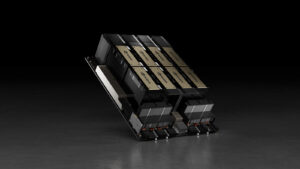
When to Liquidate H100, H200 and Blackwell Assets ( Image Credit: NVIDIA)
NVIDIA’s GTC 2026 keynote (March 16–18) marked a definitive pivot from simple generative models to the era of Agentic AI. The centerpiece of the event was the unveiling of the full Vera Rubin platform—a rack-scale ecosystem engineered for autonomous AI agents. This new architecture is built around the Rubin GPU, the revolutionary Vera CPU (featuring 88 custom Olympus ARM cores), NVLink 6, ConnectX-9 SuperNIC, BlueField-4 DPU, and native integration for the Groq 3 LPU to handle ultra-low latency inference.
Rubin systems have already entered production and are slated for broad availability in the second half of 2026. During his presentation, Jensen Huang emphasized that inference demand is exploding as agentic workloads move from experimental labs to massive production fleets. While this suggests continued high demand for AI infrastructure through 2027, it creates a specific “exit window” for current-gen hardware. Secondary-market demand for H100, H200, and Blackwell accelerators is currently peaking due to immediate capacity needs, but valuations are expected to face significant downward pressure once Rubin supply hits the channel in volume.
The Inference Boom Is Driving Strong (But Temporary) Secondary-Market Demand
While the Rubin architecture promises staggering leaps—up to 50 PFLOPS of FP4 inference per GPU (roughly 3.3–5× the performance of Blackwell in specific low-precision workloads) and 10× better throughput-per-watt at the rack scale—the market is currently facing a “readiness gap.” Hyperscalers, Tier-2 cloud providers, and enterprise labs cannot wait until late 2026 for more compute; they need deployable capacity today to stay competitive in the agentic race.
Hopper (H100/H200) and early Blackwell GPUs are the primary workhorses filling this gap. This urgent need for “right-now” silicon has kept secondary-market liquidity remarkably healthy for H100/H200 and Blackwell clusters.
Current secondary-market pricing (April 2026 Market Report):
-
Lightly used / certified H100 SXM GPUs: These are currently trading between $17,000–$28,000. Units found on general marketplaces like eBay often sit at the lower end ($17k–$22k), while professionally tested, enterprise-grade units with full service records command a significant premium.
-
H200 NVL variants (141 GB HBM3e): These continue to carry a 15–40% premium over the H100. Their massive memory buffer makes them highly desirable for Large Language Model (LLM) inference where HBM capacity is the primary bottleneck.
-
Blackwell (B200) boards: Inventory remains tight, keeping prices firm in the $30,000–$40,000 range for new or near-new units. However, as the first wave of Rubin early-access units arrives at top-tier labs, we are beginning to see the first significant Blackwell inventory entering the secondary market.
These prices reflect a mature but elevated market. Refurbished and certified units routinely retain 70–85% of their contemporaneous new pricing, provided the hardware has been properly maintained and certified.
Why Liquidating Now Beats Waiting for Rubin Availability
The technical specs of Rubin are hard to ignore: HBM4 memory providing up to 22 TB/s of bandwidth and a “memory-first” architecture that nearly eliminates the latency overhead between the Vera CPU and the Rubin GPU. However, meaningful high-volume shipments won’t arrive until very late in 2026, and lead times for the top-tier Vera Rubin NVL72 racks are already stretching into mid-2027.
If your organization holds onto current-generation fleets too long, you risk falling into several traps:
-
The Supply-Induced Depreciation Cliff: Once Rubin supply begins to ease the global GPU crunch, the “scarcity premium” currently applied to used GPUs will vanish.
-
Opportunity Cost of Capital: Keeping capital tied up in underutilized server processors or high-capacity RAM prevents you from reinvesting in the Rubin-optimized clusters your competitors are already ordering.
-
Technical Debt in Architecture: The most demanding agentic and reinforcement-learning (RLHF) workloads are being optimized for the Vera-Rubin “unified memory” architecture. Hopper-based systems will soon face performance ceilings that software optimization cannot fix.
Historical data from the Blackwell ramp-up shows that H100 values dipped temporarily before stabilizing. We are seeing a more aggressive version of that dynamic today as the industry prepares for the leap to HBM4 and custom ARM-based compute.
Your Step-by-Step GPU Liquidation Playbook for Maximum ROI
To achieve the highest possible return on your aging AI assets, professional disposition is required. Following this playbook ensures you don’t leave money on the table.
1. Inventory & Technical Benchmarking
Transparent records command the highest prices. Before listing, document utilization hours, run NVIDIA DCGM diagnostics, and perform MLPerf Inference benchmarks. Logging thermal history and ECC error data proves to buyers that the silicon has not been excessively throttled or damaged.
2. Secure Data Erasure
GPU VRAM can retain sensitive model weights or proprietary training data residues. Use certified NIST 800-88 or IEEE 2883-compliant wiping processes. If you are liquidating an entire cluster, ensure you also wipe enterprise SSDs using auditable reports, which are essential for corporate compliance.
3. Certify & Grade the Hardware
Refurbished-grade units—those that have been professionally cleaned, tested, and repackaged—consistently achieve 15–20% higher resale values than “as-is” units. Third-party certification reduces buyer risk and dramatically speeds up the closing of the transaction.
4. Choose the Right Sales Channel
Avoid the volatility and logistical hurdles of consumer marketplaces like eBay or the protracted timelines of traditional hardware brokers. For high-value AI accelerators such as the H100, H200, or Blackwell, the most efficient path is partnering with specialized IT Asset Disposition (ITAD) firms that focus specifically on the secondary market for high-density compute. This approach provides professional, data-backed valuations based on current secondary-market indices, handles the complexities of white-glove logistics for heavy GPU server clusters, and ensures accelerated payment cycles—often within 24–48 hours—to maximize capital velocity for your next-gen Rubin deployment.
5. Time the Market
Q2–Q3 2026 is the “sweet spot.” Rubin production is confirmed, creating the urgency to upgrade, but widespread deployment is still months away. This keeps demand for immediate Hopper and Blackwell capacity at an all-time high.
Real-World ROI Example: The 64× H100 Cluster Case Study
A mid-sized North American AI lab recently utilized our network to liquidate a 64× H100 SXM cluster. After professional testing and certified secure wiping, they recovered approximately 70–80% of their original acquisition cost.
The entire process—from the initial quote to the wire transfer hitting their account—took under two weeks. By acting in April 2026, they avoided the projected 30–50% value erosion that analysts expect to hit Hopper and early Blackwell assets once the Rubin Ultra platform reaches full scale in 2027.
Strategic Timing: Why the Post-GTC Window is Unique
We are currently in a “Value Bubble” for current-gen silicon. The demand for immediate inference capacity has artificially propped up H100 and B200 prices, but history shows this is temporary. Once the Vera Rubin NVL72 racks begin shipping in volume later this year, the secondary market will see a significant supply influx.
Organizations that liquidate during this Q2-Q3 2026 window will capture a “scarcity premium” that likely won’t exist by 2027. BuySellRam.com offers the global reach and B2B network to move entire server clusters at top-market rates before the Rubin ramp-up begins.
Lock in Today’s Peak Market Pricing →