
Samsung reportedly raised prices for some new 4nm foundry orders in July. Reuters reported increases of 10% to 15% for customers in the United States and China, with customers in Taiwan seeing increases of 5% to 10%. Samsung declined to comment on the pricing.
At first glance, this looks like another consequence of constrained TSMC capacity pushing customers toward alternative foundries.
That is part of the story. But Samsung’s own disclosures point to another source of pressure inside its fabs: HBM4 is consuming 4nm logic-foundry capacity too.
Samsung had already begun initial shipments of 4nm HBM base dies in late 2025. By the second quarter of 2026, the company said HBM base-die demand was contributing directly to improved foundry earnings and that it planned to expand 4nm base-die production further in the second half.
That changes where the AI memory bottleneck can appear.
A 7% foundry can still have pricing power
Samsung held 7% of global pure-play foundry revenue in the first quarter of 2026, according to Counterpoint Research. TSMC held 73%.
Judged only by aggregate market share, Samsung does not look like a company with much room to dictate higher prices.
But aggregate share is the wrong denominator for this question.
Foundry capacity is specific to manufacturing processes, fabs and qualified products. A supplier does not need to dominate the overall market to gain leverage when the particular production capacity its customers need is already heavily utilized.
Reuters reports that Samsung’s SF4 production line at Pyeongtaek has operated at full capacity since late 2025. That line serves external logic customers while also producing base dies for Samsung’s HBM products.
Samsung independently confirms the HBM side of the equation. In its second-quarter results, the company said foundry earnings improved significantly before incentive-related provisions, driven by HBM base-die demand and strong U.S. customer orders. It also said it plans to expand 4nm LPU and base-die products during the second half of 2026.
So the reported price increase is not simply a story about customers looking for spare capacity outside TSMC.
Samsung’s own memory business is one of the workloads consuming its 4nm foundry capacity.
HBM4 needs foundry capacity, not just DRAM wafers
Our previous analysis of the current memory cycle focused on how HBM consumes substantially more DRAM wafer supply per bit than conventional DDR5, reducing the capacity available for mainstream memory.
HBM4 adds another manufacturing constraint.
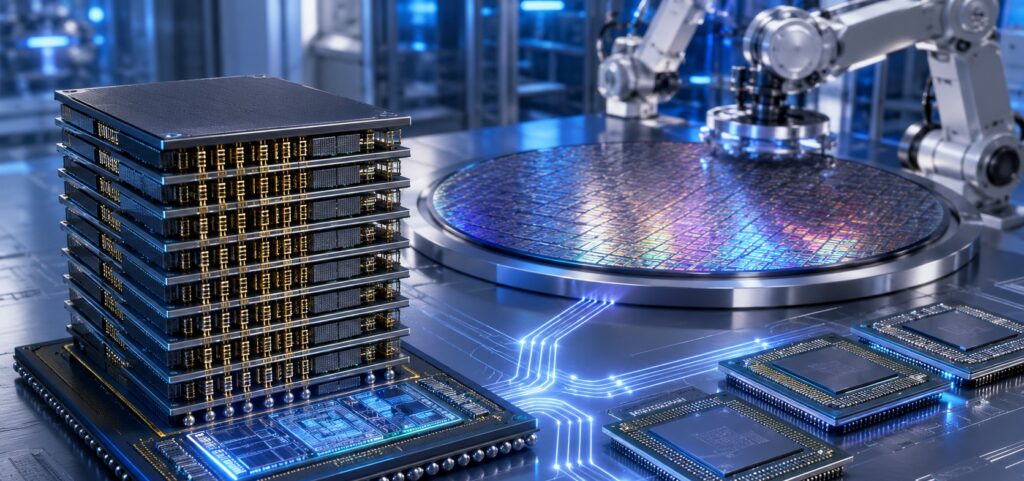
Samsung’s commercial HBM4 combines its 1c DRAM technology with a 4nm logic base die. The company announced mass production and commercial shipments of the product earlier in 2026.
The important distinction is that the base die is logic silicon fabricated through Samsung Foundry’s 4nm process. It is not another DRAM die.
That means increasing HBM4 production can increase demand on foundry infrastructure as well as memory-fab and advanced-packaging capacity.
The tradeoff should not be interpreted as a simple one-for-one substitution. Different chip designs have different masks, qualification requirements, cycle times and production flows. Capacity cannot be moved instantly from one product to another.
But at the manufacturing-planning level, the implication is straightforward: HBM4 gives Samsung another internal customer for its 4nm process.
Samsung’s regulatory reporting made that connection explicit before the current price story. In its first-quarter 2026 interim report, the company said advanced-node foundry revenue was expected to benefit from demand including 4nm HBM base dies, while it prepared a broader ramp of 4nm products for AI and HPC.
TSMC still matters, but it is not the whole explanation
None of this removes TSMC from the picture.
Counterpoint says TSMC’s N4/N5 utilization remained high in the first quarter of 2026 because of AI GPU demand. It also expects order migration caused by TSMC capacity adjustments to continue supporting utilization and wafer shipments at other foundries.
Reuters similarly reports that limited TSMC capacity is prompting some customers to consider Samsung and Intel.
Samsung therefore has two demand forces acting on its 4nm capacity.
The first is external: customers looking for manufacturing capacity outside TSMC.
The second is internal: Samsung’s HBM business needs 4nm base dies of its own.
That second mechanism is important because Samsung does not need to capture a huge amount of TSMC’s overall market share before a particular Samsung production line becomes constrained.
A foundry with 7% global share can still have pricing leverage on a specific node when that node is full.
This is not yet a Samsung foundry comeback
The reported price increases should not be confused with evidence that Samsung has closed the competitive gap with TSMC.
Counterpoint still puts TSMC’s pure-play foundry share at 73% against Samsung’s 7%. It also says Samsung continues working to improve yields on its newer SF2 and SF2P processes.
Strong demand for an established 4nm platform therefore tells us relatively little about Samsung’s eventual competitiveness at 2nm.
There is another important limitation: Samsung has not publicly confirmed the Reuters pricing figures. The reported 10% to 15% increases come from industry sources, not a published Samsung price schedule.
What Samsung has confirmed is narrower but still significant: HBM base-die demand is benefiting its foundry business, it is expanding 4nm base-die production, and it is targeting double-digit foundry revenue growth in the second half of 2026.
That is evidence of stronger utilization and demand. It is not evidence by itself that Samsung has solved its broader foundry challenges.
The capacity pressure reaches beyond HBM
The practical implication is wider than one Samsung wafer-price change.
Samsung expects demand for server DRAM, enterprise SSDs and HBM to accelerate during the second half of 2026 and says supply constraints should persist despite efforts to increase production. DDR5 is among the high-value products the company says it will prioritize.
That matters at both ends of a hardware refresh.
Buyers have to consider the cost and availability of new memory. At the same time, operators replacing servers may be retiring components whose secondary-market economics have changed substantially during the current memory cycle. Our broader analysis of 2026 component pricing found DDR4 and DDR5 moving sharply higher rather than following the normal assumption of steady depreciation.
For organizations left with surplus DIMMs after an upgrade, that creates a reasonable valuation point before equipment is warehoused or recycled. BuySellRam.com works with organizations looking to sell RAM in bulk, including server memory, and has a dedicated option for businesses looking to sell DDR5 RAM.
The relevance here is not that Samsung’s foundry price increase directly determines used-memory prices. It does not.
The connection is that the same AI infrastructure expansion is creating constraints at multiple stages of the semiconductor supply chain, while hardware refreshes simultaneously release previous-generation equipment into the secondary market.
AI’s semiconductor capacity map is getting wider
The larger lesson is that AI semiconductor demand can no longer be divided neatly into “GPU wafers” and “memory wafers.”
HBM already consumes disproportionate DRAM wafer capacity. HBM4 adds advanced logic manufacturing to the equation because its base die is fabricated using a foundry process.
Samsung makes this interaction unusually visible because its memory and foundry operations sit inside the same company. Growing HBM4 output can therefore contribute directly to utilization of Samsung’s 4nm foundry capacity while external customers compete for that capacity as well.
That is also why moving the industry’s leading edge toward 2nm does not automatically make 4nm plentiful. Existing 4nm infrastructure can remain strategically important when new AI products find additional uses for it.
The evidence test from here is relatively clear.
If Samsung’s SF4 utilization and pricing remain firm as HBM4 volumes rise, even as alternative foundry capacity expands, that would strengthen the argument that HBM base dies have created a durable new source of 4nm demand.
If pricing eases substantially as external foundry capacity becomes easier to obtain, today’s reported increase will look more like a temporary consequence of the broader capacity shortage.
For now, the reported price hike says less about Samsung catching TSMC than about something more immediate:
AI memory is beginning to compete for logic-foundry capacity of its own.