
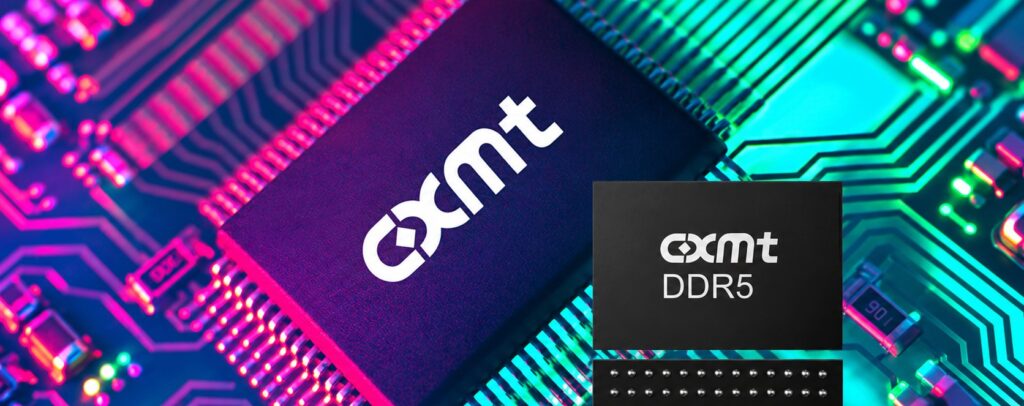
TL;DR: CXMT aims to introduce DDR5 server modules using its 4F² DRAM technology by the end of 2026. TrendForce put its global DRAM revenue share at 9.5% in Q2 2026. If qualified shipments scale, the new modules could help ease the server RAM shortage and slow price increases. Growing demand would limit the scope for price cuts.
ChangXin Memory Technologies (CXMT) aims to introduce DDR5 registered DIMMs using its 4F² DRAM technology by the end of 2026, president Cao Kanyu said at the Integrated Circuits and Chiplet Conference in Shanghai on October 10. Registered DIMMs, or RDIMMs, are memory modules used in servers.
TrendForce expects server DRAM to remain undersupplied in the fourth quarter of 2026. How much CXMT can help depends on the number of chips it can produce reliably and the modules server makers approve.
Smaller cells offer a way to produce more memory from each wafer. More working bits from the same silicon can lower manufacturing cost per gigabyte and give server buyers another source of supply.
What 4F² changes
A conventional DRAM cell has one transistor and one capacitor. The capacitor stores electrical charge representing a bit; the transistor is the switch controlling access to it. These cells form the chip’s memory array.
F represents the minimum manufacturing feature size. A 4F² cell occupies 2F by 2F, compared with a common 6F² layout. Working from those labels gives the following comparison, assuming the same F and array area:
| Equal-F comparison | 6F² layout | 4F² layout |
|---|---|---|
| Cell area relative to 6F² | 100% | About 67% |
| Ideal cells per equal array area | 1× | 1.5× |
The arithmetic is 4/6 for relative area and 6/4 for relative cell count. Separately, a MyDrivers estimate relayed by TrendForce puts the potential density improvement at 30%-50% within the same area. The table is an ideal array calculation, and the reported range is an estimate; neither is a measured CXMT product result.
A whole chip also needs circuitry to select, read, and control its cells. That supporting area shapes how much of the array’s density gain reaches the complete chip. Producing more working memory bits per wafer can add supply without an entirely new factory and potentially lower cost per gigabyte.
Why it’s hard to build
CXMT describes its approach as Vertical Surrounded Gate, or VSG. A gate surrounds a vertical transistor channel, aiming to improve switching control and limit leakage while occupying a compact footprint.
Researchers from Chang Xin Memory Technologies and the Beijing Superstring Academy of Memory Technology described a fabricated vertical-channel transistor and capacitor combination at IEDM 2023. CXMT has been working on the design since at least 2023.
Stored charge escapes, so DRAM needs periodic refresh to retain data. Better transistor control addresses part of that problem. Retention and power consumption also depend on operating conditions and the complete design.
Manufacturing yield is the proportion of chips that pass testing. If too many dense chips fail, production losses can consume the gain from smaller cells. Reliable fabrication and testing decide whether the process produces more usable memory at a competitive cost.
Early reporting raises the possibility of partial adoption in the first modules. Their specifications and production ramp will show how quickly the design delivers useful output. SK hynix also presented a 4F² roadmap in 2025, making this an area of competition among suppliers.
The global server RAM market
TrendForce’s September outlook projects conventional DRAM contract prices to rise 10%-15% quarter over quarter in the fourth quarter of 2026. Suppliers are also constrained by component shortages, packaging and testing capacity, and limited production flexibility.
The data put CXMT’s global DRAM revenue share at 9.5% in the second quarter of 2026, fourth behind Samsung, SK hynix, and Micron.
A July report citing an unnamed source familiar with China’s server supply chain said Tencent and ByteDance had begun placing advanced DDR5 server-memory orders after customer validation. Those reported orders concern existing DDR5 products, not proof of adoption of the proposed 4F² modules.
One route to global relief is substitution. If qualified CXMT modules replace memory Chinese buyers would otherwise purchase from the three largest suppliers, some incumbent output could serve other customers. If new Chinese demand absorbs the production instead, less supply would be released elsewhere. Suppliers would still need to match those parts to the capacities and speeds other server buyers require.
Packaging and testing remain potential bottlenecks even with denser chips. The long-term pricing agreements cause some suppliers’ increases to lag the market. As qualified shipments scale, CXMT can add supply and temper price increases. Continued demand growth would absorb some of that extra supply and limit the scope for price cuts.
US defense procurement adds a separate boundary. CXMT has been listed under Section 1260H since January 2025 and is suing to be removed. Defense rules prohibit direct contracts with listed companies from June 30, 2026, and procurement of goods or services incorporating their products or services from June 30, 2027, subject to applicable rules and waivers. These are defense-procurement restrictions, not a blanket prohibition on US memory sales.
How New Supply Reaches the Used RAM Market
If CXMT scales qualified DDR5 shipments and production savings reach module prices, buyers could gain a cheaper alternative to used modules. That would put pressure on comparable used DDR5 prices. DDR4 would respond less directly: its buyers need memory for older servers, and DDR5 cannot replace it in those systems.
Server approval determines which modules compete. Lenovo’s ThinkSystem SR850 V3 guide states: “Mixing of DRAM technology (16Gb, 24Gb, 32Gb) is not supported.” These are chip densities, not DIMM capacities. A CXMT module would need the right density, capacity, speed, and platform support to become a substitute.
For inventory owners, CXMT’s launch becomes relevant when its modules reach the platforms their stock serves. BuySellRam’s guide to reading server RAM labels and part numbers helps identify those parts. Keep maintenance spares that remain necessary. For unused modules, compare a quote for selling surplus RAM with the cost and availability of supported replacements as CXMT’s shipments grow.
Signals to watch
- The chip densities and specifications of CXMT’s first RDIMMs.
- Repeatable commercial shipments of the new modules.
- Their appearance on a major server maker’s qualified memory list.
- Changes in TrendForce’s next server DRAM supply forecast.