
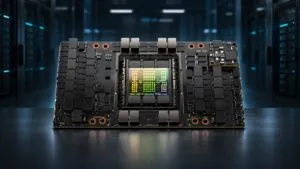
What 1,330 price points show for buyers, investors, ITAD firms, data center operators and GPU renters. Data as of November 26, 2026.
TL;DR: This AI GPU market update covers Nvidia’s data center GPUs, with AMD and Google TPUs treated only as competition. Nvidia’s data center revenue reached a record $107.6 billion last quarter, yet renting an H100, a chip first shipped in 2022, costs more now than a year ago. The update follows that gap through new supply, rental prices and the used market, using 1,330 dated price points. In our eBay sample, used H100 SXM modules sold at a median of $21,275 across 16 sales. Across the sales trackers, broker quotes and server prices checked, a used H100 SXM is priced at about $14,000 to $31,000 per GPU, depending on whether it is a loose module or part of a whole server, and whether the figure is a completed sale or an asking price. At Silicon Data’s November 24 rate of $2.81 an hour for a one-year H100 rental, gross rent would cover the price of a used 8-GPU H100 server in about 17 to 20 months at 70% billable utilization, if the rate holds and before operating costs.
Key findings
Rent is rising across generations. Silicon Data’s H100 neocloud index averaged 29.6% more in the third quarter of 2026 than a year earlier and read $3.10 per GPU-hour on November 24. Nvidia says Hopper GPUs have been re-contracted at up to twice their original price.
Used prices depend on what is sold and whether money changed hands. Completed sales of a loose H100 SXM module, from three samples, ran from $14,250 to $21,275, while whole used 8-GPU servers were valued, sold or offered at about $24,000 to $31,000 per GPU. Dealer asks for loose cards often run far above sales: a California refurbisher listed used H100 NVL cards at about twice their eBay median.
Form factor changes the price as much as the model. An A100 80GB PCIe card sold for about twice an A100 80GB SXM module, because a loose SXM module only works on a matching HGX board.
Some used H200 servers are priced near new quotes, and on China’s grey market an 8-GPU H200 server was offered at about $900,000.
The binding limits are memory, packaging and powered buildings, and the main risks are financing and customer concentration. The five groups that make decisions about this hardware are covered in section 6.
1. Record revenue, tight supply
Nvidia’s quarter ended October 25 brought revenue of $115.8 billion, up 103% from a year earlier, and data center revenue of $107.6 billion, up 110%. Data center revenue includes networking as well as GPUs, so it measures the business, not GPU units shipped. The company guided to $130 billion for the current quarter without counting any China data center compute. Vera Rubin, its newest platform, brought in nearly $20 billion in its first quarter of production shipments, which began in August.
Even so, Colette Kress, Nvidia’s CFO, told analysts that demand still exceeds supply and named wafers, substrates and advanced packaging as limits. She also said the outlook takes into account whether customers’ data centers are ready, which points to buildings and power as well as chips. Kress spoke as interim CEO: Jensen Huang resigned on November 11, and the board reinstated him as CEO on November 22, announcing it the next day.
Memory is the other limit. SK hynix says its DRAM and HBM are effectively sold out through 2029, Samsung says its 2027 HBM is sold out, and TrendForce expects DRAM to stay tight through 2027. Nvidia’s purchase commitments rose to $390 billion from $279 billion; the company said the earlier jump, in August, came mainly from multi-year memory deals. Memory costs are also why Nvidia expects its gross margin to bottom at 71–72% this quarter, and why it is raising its own prices: Kress said in August that the increases take effect in its fiscal first quarter of 2028, which starts in late January 2027. Server makers have already repriced. The Financial Times reported increases of up to 45% after contracts were signed, with GPU servers up 20–30%, and Nvidia’s own store raised the RTX PRO 6000 card from $13,250 in June to $16,000 by mid-August.
China has dropped out of the numbers. Nvidia sold $2.4 billion of licensed Hopper products there in the quarter and has since stopped shipping them. A US export rule published in the Federal Register on November 19 added license requirements for exports, reexports and in-country transfers of certain advanced computing items, including to five more countries and to data centers that supply more than 12 million aggregate TPP of computing to companies headquartered in China, Macau or other restricted countries.
2. Who is buying, and whether it pays
Microsoft, Alphabet, Amazon and Meta spent $201.9 billion on capital expenditure in the third quarter, up 108% from a year earlier. Hyperscalers accounted for about $60 billion of Nvidia’s data center revenue. AI clouds, industrial and enterprise customers accounted for about $47 billion, nearly triple a year earlier, and that second group carries more credit risk.
The backlog looks large. Kress put the cloud industry’s backlog at $2.5 trillion, and CoreWeave alone reports $132.5 billion. High rents and financial pressure on neoclouds can exist at the same time: Gartner forecast in October that over 80% of neoclouds will stop operating independently by 2030, a forecast an earlier article examined in what Gartner’s neocloud warning means for used data center GPU value. Token prices fell nearly 60% since May, according to Kress, while GPU rents rose, which suggests cheaper AI is drawing more use.
Competition is growing at the edges. Google began delivering TPUs to customers’ own data centers in the second quarter, and AMD said in July that its Helios racks would start shipping at the end of the third quarter, with commitments from Anthropic, OpenAI and Meta. Both could limit Nvidia’s pricing in 2027 and 2028.
3. Rent: older GPUs are earning more
Rent is where the shortage shows most clearly. As posted on the providers’ own pricing pages on November 23 to 25 and read on November 25, median on-demand prices per GPU-hour were:
| GPU | Neoclouds | AWS, Azure, Google, Oracle |
|---|---|---|
| A100 80GB | $2.08 (12 listings, 12 providers) | $4.10 (5 listings, 4 providers) |
| H100 SXM | $3.90 (17 listings, 16 providers) | $10.53 (6 listings, 4 providers) |
| H200 | $4.59 (15 listings, 15 providers) | $10.30 (4 listings, 4 providers) |
| B200 | $7.99 (11 listings, 11 providers) | $14.12 (2 listings, 2 providers) |
| B300 | $9.50 (9 listings, 9 providers) | $16.40 (2 listings, 2 providers) |
Medians of listed on-demand prices posted on 29 providers’ own pricing pages on November 23–25 (read November 25); our arithmetic. Marketplace price ranges are counted at their low end, and RunPod’s two clouds count separately. A provider with several instance types can count more than once, the A100 row covers SXM listings, and the B200 and B300 hyperscaler figures rest on two providers each. Negotiated contract prices are lower and mostly not public.
The big clouds charge about 1.7 to 2.7 times what neoclouds do for the same GPU, more than twice for the H100 and H200. Part of the gap is the rest of their cloud platform, which comes with the price. At the same provider, spot capacity, which can be taken back at short notice, ran about half the on-demand price for H100, H200 and B200.
Three independent indices agree on direction. Silicon Data’s H100 neocloud index averaged 29.6% more in the third quarter of 2026 than a year earlier. It fell to $1.86 in February 2025, read $2.00 in December 2025 and stood at $3.10 on November 24, 2026, when a one-year rental cost $2.81 an hour and a two-year rental $2.74. Ornn’s index of executed trades read $3.16 the same day. SemiAnalysis’s monthly H100 index rose from $2.92 in April to $3.34 in October, and the middle half of its one-year quotes, which usually require prepayment, ran $2.50–3.30 an hour. For the B200, Silicon Data’s index went from $4.40 on January 1 to $6.94 on November 24, with a one-year rental at $6.44. The exception is the hyperscalers’ own H100 prices: Silicon Data’s hyperscaler H100 index averaged $7.45 in the second quarter of 2026 and read $7.06 on November 25.
Company disclosures say the same thing in contract terms. Kress said Hopper GPUs have been re-contracted at up to twice their original price and B300 rates have risen more than 60% since launch. CoreWeave said prices on its older Ampere and Hopper fleet rose 30–50% in a quarter, at prices above the original contracts, and that new four-to-five-year deals run $20–25 million per megawatt per year. IREN said it re-contracted H100s at double the previous price. Silicon Data’s analysis adds a useful caution: its quarterly averages for H100 and A100 moved by single digits (H200 rose 13%), and it reads CoreWeave’s 30–50% as the gap between mid-2025 contract prices and today’s, not one quarter’s move.
Prices are still moving. Crusoe will raise on-demand prices on December 1: H100 from $3.90 to $4.50, H200 from $4.29 to $5.40 and B300 from $8.96 to $9.90. GetDeploying’s index of median on-demand prices across 23 models was up 29% over the year in the week of November 23, and up 3.1% over the four weeks before it; the H100 alone was up 32% over the year.
4. Used hardware: what actually sells
Used data center GPUs have no public exchange, so there is no single used price. The evidence comes from different kinds of source, and each measures something different: completed sales on marketplaces, trackers built from completed sales, dealer asking prices, broker quotes, model-based values, whole-server sales and asks, and company filings. Read side by side, they show where the price of a used H100 sits and why sources disagree.
| Source and what it measures | Per GPU | Date |
|---|---|---|
| American Compute, typical completed sale, loose SXM module | $14,250 | August |
| American Compute, median dealer ask, loose SXM module | $16,576 | August |
| CCIR, median of 14 completed eBay sales, loose SXM module | $17,025 | 180 days to Nov 23 |
| Our eBay sample, median of 16 completed sales, loose SXM module | $21,275 | Aug 27–Nov 25 |
| Compute Exchange, broker’s indicative range from supplier quotes | $22,000–27,000 | Q3 2026 |
| Silicon Data, residual value from its rent curve, a model, not a sale | $24,399 | Nov 24 |
| American Compute, value of a used 8-GPU server, built from listings | $24,400 | August |
| EPOKA, a Danish dealer, 8-GPU server sale prices from a chart | about $29,400 | September |
| Hashrate Index, median ask for a refurbished 8-GPU server | about $31,000 | late November |
| New 8-GPU H100 servers, two configured list prices at Exxact and AVADirect | about $36,000–40,000 | November |
Server figures are divided by eight. Our eBay sample excludes scam-flagged sales, items listed as brand new and Best Offer sales, whose final price eBay hides; open-box sales are included. CCIR also draws on eBay, so its sales may overlap with ours. Links for each row are in the Sources list.
Most of the spread comes from what is being sold. A loose SXM module only works on a matching HGX baseboard, so fewer buyers can use it, and completed sales of loose modules fall between about $14,000 and $21,000. A working 8-GPU server also carries CPUs, memory, the NVSwitch board and often a warranty, and it is valued, sold or offered at about $24,000 to $31,000 per GPU. Among servers, the one series of reported sales, the EPOKA chart, sits between American Compute’s listing-based value and Hashrate Index’s refurbished asks. Among loose modules, the three completed-sale samples differ by about $7,000 on their own, because they cover different months and rest on small numbers of sales. Compute Exchange’s broker range, $22,000–27,000, runs from just above the module sales into the bottom of the server range.
Dealer asks for loose cards often run well above what the same cards sell for. On November 26 IT Creations listed used H100 NVL cards at $54,950 to $59,500 and refurbished ones at $59,450, about twice the eBay median for that card, and no lower than its lowest price for new bulk H100 NVL cards, $54,950. Its H100 search showed no priced SXM module. American Compute puts the dealer ask for a used A100 40GB at $9,445, about three times the typical completed sale of $3,207, though it does not say which form factor. For the H100 SXM the two sit closer, with asks about 1.16 times sales. The often-quoted “$25,000–35,000 for a used H100” comes from asks or from price-guide pages without a source.
Completed eBay sales from August 27 to November 25 give the widest view across card models:
| Card | Median sold price | Sales |
|---|---|---|
| H100 SXM module | $21,275 | 16 |
| H100 PCIe | $29,275 | 6 |
| H100 NVL | $29,500 | 6 |
| A100 80GB PCIe | $15,700 | 12 |
| A100 80GB SXM module | $8,000 | 5 |
| A100 40GB PCIe | $4,150 | 24 |
| L40S | $7,300 | 8 |
| V100 32GB PCIe | $999 | 29 |
Our sample, our arithmetic, same rules as above. Without open-box sales the medians are $20,000 for the H100 SXM (11 sales), $14,950 for the A100 80GB PCIe (7) and $7,150 for the L40S (7). Seven of the 16 H100 SXM sales came from one seller; the sales are listed in the appendix.
Outside eBay, completed sales of these cards are hard to find. Japan’s Yahoo! Auctions had no H100, H200 or L40S sale in its 180-day closed listings, but it did have A100 40GB cards. One, sold by a dealer’s store after 17 bids, closed at ¥507,100, about $3,170, on September 1. That is close to American Compute’s $3,207 and below the eBay median for the A100 40GB PCIe. We found no H100 card sold outside eBay, and no auction house or bankruptcy sale with a published result for H100-class hardware.
The same chip sells for more as a PCIe card than as an SXM module, for the reason above. For the A100 80GB, the PCIe card sold for about twice the SXM module. Against new prices at US dealers, leaving out OEM-branded option cards, used H100 PCIe cards sold at about 81% of the median new asking price, H100 NVL cards at about 86% and L40S cards at about 77%. All three rest on small samples, and most new cards are listed as out of stock or special order, so the new prices may not be payable today.
Whole servers also show the price over time. A chart attributed to EPOKA, a Danish dealer, put 8-GPU H100 server sale prices at about $210,000 in September 2024, $145,000 in September 2025 and $235,000 in September 2026, based on more than 200 sales; we saw it only through a secondary report. Hashrate Index’s median ask for a refurbished H100 server has held near $247,000 to $248,000 since mid-September, while its median ask for a new one sits above $280,000.
Two gaps remain. None of the ITAD and buyback firms checked publishes a buyback price for data center GPUs; all quote on request. And outside China, no used B200 or B300 sale appeared in the data collected.
Some used H200 servers are priced near new quotes
The H200 is likely to be the next large group of Hopper hardware to reach the used market, and its prices show the shortage more sharply than the H100’s. The same EPOKA chart puts 8-GPU H200 server sale prices at about $250,000 in September 2024, $276,000 in September 2025 and $345,000 in September 2026, rising every year. American Compute values a used HGX H200 at $348,500 on a limited sample. New 8-GPU H200 servers are quoted at about $298,000 to $400,000 across eight configurations, with a median near $331,000. The used figures overlap that range, but they are not matched for configuration, warranty or availability, so the safe reading is that some used H200 servers are priced near new quotes.
One bulk sale earlier in the year came in lower. WhiteFiber’s first-quarter filing reports selling 126 H200 units for about $26.1 million, and on its earnings call the CEO described the sale as about 1,000 GPUs. That works out to about $26,000 per GPU. If each unit was an 8-GPU server, which the GPU count suggests, it is about $207,000 per server.
Loose H200 cards rarely sell. CCIR counts 13 completed eBay sales of the H200 NVL, a PCIe card, at a median of $32,500, close to the median new asking price of $33,895, while used asking prices run at about $64,500. Only one working H200 SXM module sale turned up on eBay, at $44,950.
H200 rent depends on which measure is used. The neocloud on-demand median was $4.59 an hour in late November. Published one-year reserved prices had a median of $3.00 across seven providers and three-year prices $2.37 across five. The two rent indices disagree: Ornn’s H200 index read $6.69 on November 25 and Silicon Data’s $3.66 the same day. Ornn averages on-demand rentals that actually took place, weighted by GPU count. Silicon Data adjusts posted and observed prices of several kinds to a standard contract. For the H100 the two agree; for the H200 they measure different parts of a thin market. Working from the one-year reserved median of $3.00, an H200 bought at the September price in the EPOKA chart, about $43,100 per GPU, would take about 20 months of round-the-clock rent to earn back, before costs.
China explains part of the H200 premium. The US allowed limited H200 sales to China from December 2025, with licenses issued from early 2026 and a 25% tariff collected as the chips pass through the US, but Beijing approved only limited imports and steered buyers toward domestic chips. Reuters reported about 600,000 H200s waiting in Hong Kong in early November, and Nvidia has since stopped shipping. On China’s grey market, an 8-GPU H200 server was offered at more than 6 million yuan, about $900,000, by the end of October, roughly three times the price a year earlier, according to The Next Web, summarizing Reuters. On November 10 SMM reported a buyer that had bought H200 units for 4.8 million yuan each in early September and resold them for 6.0 million after a lease fell through, without saying whether they were new or used. In Guangdong, a completed three-year lease of 64 H200 servers was priced at about 135,000 yuan per server per month, which works out to about $3.45 per GPU-hour.
How long rent takes to cover a used server’s price
A cloud GPU is rented as part of a working server, so the fair comparison is with a whole used server, not a loose module. Using the two used 8-GPU H100 server prices above, $195,000 and $235,000 or about $24,400 and $29,400 per GPU, the table shows how many months of gross rent it takes to add up to the purchase price. Silicon Data’s November 24 readings give $2.81 for a one-year H100 rental and $3.10 for its H100 neocloud index, which it calls the spot rate; $2.40, its one-year rate on September 30 according to its November 16 analysis, serves as a lower-rent case. Each row assumes the rate holds for the whole period. On the same day Silicon Data’s model put an H100’s residual value at $24,399 per GPU, close to the lower server price; that figure comes from its rent curve, not from sales.
| Rent per GPU-hour, share of hours billed | $24,400 per GPU | $29,400 per GPU |
|---|---|---|
| $2.81 (one-year, Nov 24), 100% | 12 months | 14 months |
| $2.81 (one-year, Nov 24), 70% | 17 months | 20 months |
| $3.10 (index, Nov 24), 100% | 11 months | 13 months |
| $3.10 (index, Nov 24), 70% | 15 months | 19 months |
| $2.40 (one-year, Sep 30), 100% | 14 months | 17 months |
| $2.40 (one-year, Sep 30), 70% | 20 months | 24 months |
Scenario arithmetic, ours: price per GPU divided by monthly gross rent (rate × 730 hours × share billed). Before power, space, staff and financing costs.
This is the link between rent and used prices. At November’s one-year rate, gross rent covers a used H100 server’s price in 12 to 14 months if every hour is billed and 17 to 20 months at 70%, and in the lower-rent case at 70% it takes up to 24 months, all before running costs. The link is weaker for loose cards. A loose SXM module’s price also depends on how many matching boards and buyers there are, so if a wave of identical modules is retired at once, module prices could fall even while rent stays near $3. The signals that would show this first are the monthly median and number of completed sales for each model, how concentrated those sales are among a few sellers, and whole-server sale prices.
China
Banned Nvidia hardware sells at a premium in China. The Financial Times reported in June that a DGX B300 was priced there at nearly three times its US retail price and that A100 server prices had about tripled since late 2025. SMM reported 8-GPU A100 80GB servers at about 1.17 million yuan ($173,000) in July, about 1.8 times the US used value, and cited a September spot price of about 3.4 million yuan (about $507,000) for what the article’s context indicates is a complete H100 system; if that is an 8-GPU server, it is roughly twice the September price in the EPOKA chart. That premium pulls used hardware toward diversion and helps explain US enforcement’s focus on resellers. In March the Justice Department charged three people in a case involving about $2.5 billion of server purchases, with at least $510 million of servers allegedly diverted to China.
5. Financing and accounting
Debt secured on GPUs has grown fast and become cheaper. New GPU-backed borrowing reached $48.4 billion in 2026 by October 10, against $6.6 billion in all of 2025, according to American Compute’s tracker. A CoreWeave GPU loan in 2023 cost SOFR plus 9.62%. Its A3-rated facility in March 2026 cost SOFR plus 2.25%. American Compute puts loans to companies with investment-grade customers at SOFR plus 2.25–3.00% and others at SOFR plus 4.00–5.50%. Lease or vendor financing without an investment-grade customer runs 9–10% fixed. None of the lessors checked publishes monthly lease payments for GPU servers.
Lenders mostly price the customer’s credit and the contract length, not what the GPUs will be worth later, according to Wing VC’s review. That leaves the renewal risk with the borrower. CoreWeave’s August facility runs about five years against customer contracts averaging about three, which means lenders are relying on renewals. American Compute’s residual guidance for a 36-month deal signed in 2026 is 2–6% of the original price for an HGX H100 and 16–46% for a B200. Those are forecasts for the end of the term. Even American Compute’s band for 2026 itself, 27–53% of an H100 server’s original list price, sits below today’s used server prices.
The accounting debate runs on the same question. Hyperscalers depreciate servers over five to six years, and Amazon cut a subset from six years to five in 2025; Nvidia and CoreWeave have defended how long their GPUs stay useful. Michael Burry argues that such schedules understate depreciation by $176 billion over 2026–2028. CoreWeave’s rising prices on its 2020-era Ampere fleet support the longer lives. Silicon Data’s broader A100 index is mixed: its third-quarter average was 5.8% above the second quarter’s, but it ended the quarter 3.7% lower than it began.
The futures market that could price this risk is not open yet. CME’s H100 and B200 rent futures were set to start on October 5, but after a second extension agreed on November 4, the regulator’s review now runs to January 8, 2027, according to the exchange’s letter to the CFTC and the CFTC’s product record.
6. Five perspectives
Business owners and IT buyers
The decision is whether to rent, reserve, buy new or buy used, and what to do with GPUs already owned. Rent and hardware both got more expensive this year, so the answer depends on utilization: the busier the hardware, the sooner owning beats renting. A used HGX H100 at roughly $24,000–29,000 per GPU costs much less than a new HGX B300, which lists at a median of about $67,500 per GPU across 13 configurations, but the B300 does more work per GPU, so the comparison needs inference benchmarks, not just prices.
Timing matters for new orders. Nvidia’s increases take effect from late January, server makers have raised prices after contracts were signed, and one trading firm is suing Dell after Dell asked for $62–70 million more on a $549 million signed order. Space matters too: an owned server still needs a powered rack, and NVL72 racks need liquid cooling, while 8-GPU HGX servers, including the B300, still come in air-cooled versions. For companies holding H100 fleets, rising rent makes keeping or leasing out the hardware worth weighing against a sale. Older A100 hardware is weaker: American Compute’s realized price for an A100 80GB SXM module fell about a third over the year to August.
Investors
The physical market is tight. The risks are concentration and financing. How much of the cloud backlog rests on a few AI labs is not disclosed. Nvidia reports a maximum exposure of $118 billion under guarantees. Most of it, $105 billion, is credit support for an OpenAI-leased campus in Ohio that takes effect building by building, the first expected in fiscal 2029, and Nvidia says it has made no payments on any of them. Separately it has $32 billion of commitments tied to its neocloud agreements, and GPU-backed debt has multiplied. Kress said the company is “rigorously evaluating” future commitments.
The signals that would show stress first are credit, not rent. CoreWeave’s unsecured 2032 notes traded at a 14% yield on November 11, according to FINRA data cited by FourWeekMBA, and its CFO said on the third-quarter call that it does not plan more parent-level unsecured debt through 2027 at current yields. CoreWeave has about 130,000 GPUs coming off contract in 2027 and about 170,000 in 2028. The prices they re-sign at will show whether older GPUs keep earning once Rubin is in volume. The leadership turmoil at Nvidia, with Huang’s resignation and reinstatement within 11 days, and China’s absence from guidance are the two company-specific questions.
ITAD companies and resellers
Used server values follow rent, so the rent indices are a useful live guide, but loose cards also depend on how much identical hardware is being retired at the same time. Realized sales should set offers, not asks, and form factor has to be priced separately: a loose SXM module, a PCIe card and a complete HGX server are three different markets.
Supply is likely to come from hyperscaler refreshes to Rubin, enterprises retiring A100s, and any neoclouds that fail. CoreWeave’s roll-offs are more likely to be re-contracted than sold. Compliance has become part of the job. Under the rule in effect since November 19, exports, reexports and in-country transfers of advanced chips classified under ECCNs 3A090 and 4A090 need a license to or within Indonesia, Malaysia, Singapore, Thailand and Brazil, with an exclusion for US-headquartered companies that meet new reporting rules. China-headquartered buyers were already restricted wherever they are, and BIS publishes red flags for diversion. With China paying a premium, buyer screening and end-use statements protect the seller as much as the buyer. Decommissioned GPU servers also carry NVMe drives and BMC credentials, which need sanitizing under NIST SP 800-88 before resale. None of this is legal advice; the rule’s text and an export lawyer are the places to check a specific deal. For organizations retiring data center GPUs, an ITAD buyer for used GPUs can buy both loose cards and whole servers.
Data center operators
Energized space is the scarce input. CBRE put primary-market vacancy in North America at a record-low 1.4% in the first half of 2026, down from 1.6% a year earlier, even as supply grew 33.7%. Nvidia’s offer of up to $105 billion of credit support for land, power and shell at one OpenAI campus shows that a chip supplier now finds it worth backing buildings.
When power is the limit, an operator retires an old GPU because a newer one earns more per megawatt, not because the old one stopped working. If that holds, revenue per megawatt decides when used hardware reaches the market. Tenant credit is the main risk: a building leased to a hyperscaler is easier to re-let than one leased to a neocloud. The remote-access rule also reaches hosting: a license is now needed to supply advanced chips to a data center anywhere that provides more than 12 million TPP of aggregate compute, a measure of processing power, to companies headquartered in China, Macau or another Country Group D:5 country, or whose ultimate parent is.
Companies that rent compute
Commitment usually buys a lower rate. Only two neoclouds in this dataset publish a one-year H100 price, $3.26 and $5.17 an hour. Verda’s $5.17 is below its own on-demand rate but above the neocloud on-demand median of $3.90, and Silicon Data’s one-year rate was $2.81 on November 24. Spot is cheaper still at the same provider, about half the on-demand price. Availability is the catch: in AIMultiple’s November check of cloud listings, only about 12.6% of B300 listings and 18.5% of H100 listings were marked available, and nearly half of H100 listings showed no stock status at all. For much inference work, H100 and H200 capacity is easier to get and cheaper per hour. A one-year contract signed at today’s rates carries the risk that Rubin capacity loosens the market during 2027. With token prices down nearly 60% since May, it is worth checking whether buying tokens through an API costs less than renting GPUs for a given workload.
7. Three ways 2027 could go
These are scenarios to organize the evidence, not predictions.
In the first, supply stays tight. Memory, packaging and power keep shipments short through 2027, hyperscalers absorb Rubin, and older GPUs keep re-contracting at or above their original prices. Renters and buyers keep paying more, and holders of Hopper hardware benefit.
In the second, the market cools gradually. Rubin volume and new memory capacity arrive in the second half of 2027. The newest chips’ rents ease first, then each older generation moves down a price tier, and used prices drift down with them.
In the third, there is a sharp reset. AI revenue disappoints or financing tightens, some neoclouds fail, liquidation lots appear, and H100 rents fall toward where A100 rents sit today, around $2 an hour.
Five numbers, checked monthly, will show which way it is going:
- The H100 rent index (Silicon Data or Ornn). Holding near $3 points to the first case; a slide toward $2 points to the third.
- The B300 on-demand median. Several months of decline would mark the start of the second case.
- The price CoreWeave and other neoclouds report on 2027 contract renewals.
- Neocloud bond yields and new GPU-backed loan spreads.
- Hyperscalers’ 2027 capex guidance in late January and February, and Nvidia’s results in late February.
Appendix: method and limits
The dataset behind this report holds 1,330 price observations collected November 25–26, 2026 from eBay completed sales, Japanese auction sales, dealers, brokers and price trackers, the pricing pages of 29 cloud providers, three rental indices, company filings and calls, and new-hardware resellers. Each row records its source link, the date the price applies and whether it is a completed sale, an ask, a list price, an index value, a reported estimate or a forecast. A separate check re-opened 84 sampled rows at their sources. It found no transcription or per-GPU arithmetic errors, but one wrong eBay price and one stale index value, both corrected, plus several label errors, most of them corrected. Three rows could not be re-verified because the listing or offer had gone. A second check went through every figure in this update against the data and the sources, outside reviews followed, and a further independent check on November 27 re-opened the links it could reach and recomputed the figures, checking JavaScript-only pages against the data.
The limits are real. eBay has few Hopper sales, so the Hopper card medians rest on 6 to 16 sales each and the A100 80GB SXM median on 5. No completed sale of an H100 card outside eBay turned up, and the trackers that report completed sales give little detail on sample size. Cloud prices are list prices on the day read. No auction results for H100-class hardware, no ITAD buyback prices and no GPU server lease payments are public. Blackwell multi-year contract prices are not disclosed per GPU-hour. China price reports often don’t say whether the hardware is new or used.
Sources
- NVIDIA Announces Financial Results for Third Quarter Fiscal 2027, Nvidia, Nov 17, 2026
- NVIDIA (NVDA) Q3 2027 Earnings Call Transcript, Nasdaq, Nov 17, 2026
- Nvidia Form 8-K, event date November 11, 2026 (resignation)
- Nvidia Form 8-K, event date November 22, 2026 and NVIDIA Board Reinstates Jensen Huang as President, CEO and Board Director, Nov 23, 2026
- CFO Commentary on Third Quarter Fiscal 2027 Results, Nvidia, Nov 17, 2026
- B200 and H100 GPU Rental Curves Agree With the Credit Squeeze Argument, Silicon Data, Nov 26, 2026
- SK hynix says DRAM, HBM booked through 2029, Korea JoongAng Daily, Oct 2026
- DRAM Supply to Remain Tight in 2027, TrendForce, Aug 4, 2026
- Nvidia’s Supply Commitments More Than Doubled to $279 Billion, Nasdaq, Aug 2026
- ‘AI Diffusion’ 2.0: BIS Introduces New Export Controls, Skadden, Nov 2026
- Addressing Remote Access to Advanced Semiconductors, interim final rule, Federal Register document 2026-23529, published Nov 19, 2026
- Commerce restricts remote access to advanced chips, Pillsbury, Nov 2026
- What Gartner’s Neocloud Warning Means for Used Data Center GPU Value, BuySellRam.com, Oct 17, 2026
- AI Capex Tracker, Walnut, figures as of Nov 20, 2026
- Gartner Says Over $3.5 Trillion of AI Infrastructure Spending Could Be Exposed to Impairment, Gartner, Oct 14, 2026
- H100 Rental Price Index and B200 Rental Price Index, Silicon Data
- Hopper and Ampere rents are rising, but the 30–50% is a reset, not a quarter, Silicon Data, Nov 16, 2026
- Ornn H100 SXM index history, Ornn
- H100 Daily & Contract Pricing Index, SemiAnalysis
- GPU Price Trends, GetDeploying, week of Nov 23, 2026
- Cloud GPU Rental Price Index, AIMultiple, Nov 2026
- GPU pricing for AI compute and inference, Crusoe
- CoreWeave Q3 2026 earnings call transcript, CoreWeave, Nov 10, 2026
- IREN Reports Q1 FY27 Results, IREN, Nov 5, 2026
- GPU server values, American Compute, Rack Report
- Hardware prices, CCIR, as of Nov 23, 2026
- Used GPU prices rebound as Australian AI firms borrow against chips, Certified Strategic
- New HGX H100 server configurations at Exxact and AVADirect, Nov 25, 2026
- H100 Node Price, 8-GPU HGX Air-Cooled, Hashrate Index, read Nov 26, 2026
- Used GPU price ranges, Compute Exchange, Q3 2026
- H100 appraisal and A100 appraisal, American Compute, Oct 2026 Rack Report
- NVIDIA H100 search results, IT Creations, stock as of Nov 26, 2026
- NVIDIA A100 40GB, closed auction, Yahoo! Auctions Japan, Sep 1, 2026
- WhiteFiber 10-Q for the quarter ended March 31, 2026, via StockTitan
- A100-80G purchase price rises to 1.17 million yuan, SMM
- China black market Nvidia prices, Tom’s Hardware (FT report), Jun 24, 2026
- Three Charged with Conspiring to Unlawfully Divert U.S. AI Technology to China, US DOJ, Mar 2026
- How the GPU Became Collateral, Wing VC, Sep 2026
- GPU-Backed Loans Hit $48.4B in 2026, FourWeekMBA, Nov 2026
- North America Data Center Trends H1 2026, CBRE
- CME Group and Silicon Data to launch compute futures on October 5, CME Group, Aug 11, 2026
- NYMEX letter extending the review period to January 8, 2027, CFTC filings, Nov 2026, and CFTC product record 62544
- Ornn H200 market, Ornn
- H200 cloud prices, American Compute, Nov 22, 2026
- Nvidia H200 chips pile up in Hong Kong as Beijing holds back, Reuters says, The Next Web, Nov 6, 2026
- Guangdong H200 three-year closed deal at 135,000 yuan a month, SMM, Sep 2026
- WhiteFiber Q4 earnings call highlights, MarketBeat, Mar 26, 2026; also Quartr’s event page
- SMM computing power daily review, Nov 10 and midday review, Nov 4, SMM, 2026
- H200 Rental Price Index, H100 price spike (Jan 9, 2026) and B200 index, March 2026 update, Silicon Data
- Samsung says 2027 HBM supply effectively sold out, TrendForce, Oct 29, 2026
- Nvidia price hike will raise IT costs, TechTarget, Aug 2026
- AI server makers hike prices up to 45% after contracts are signed, Tom’s Hardware (FT report), Nov 23, 2026
- Nvidia raises RTX PRO 6000 Blackwell price to $16,000, gHacks, Aug 14, 2026
- Google has started selling TPUs, Network World, Jul 23, 2026
- AMD launches full-stack AI compute for agentic era, Fierce Network, Jul 2026
- The US imposes 25% tariff on Nvidia’s H200 AI chips headed to China, TechCrunch, Jan 15, 2026
- Amazon reverses life extensions for some servers, The Register, Feb 7, 2025; Was Michael Burry Right About AI Stocks for the Wrong Reason?, 24/7 Wall St via Yahoo Finance, Mar 24, 2026; Burry on AI depreciation, Fortune, Nov 13, 2025
- GPU loan spreads and interest rates and Largest GPU-backed loans, American Compute
- CoreWeave releases of Mar 31, 2026 and Aug 10, 2026
- Neoclouds turn to customer cash as CoreWeave bonds yield 14%, FourWeekMBA, Nov 2026