
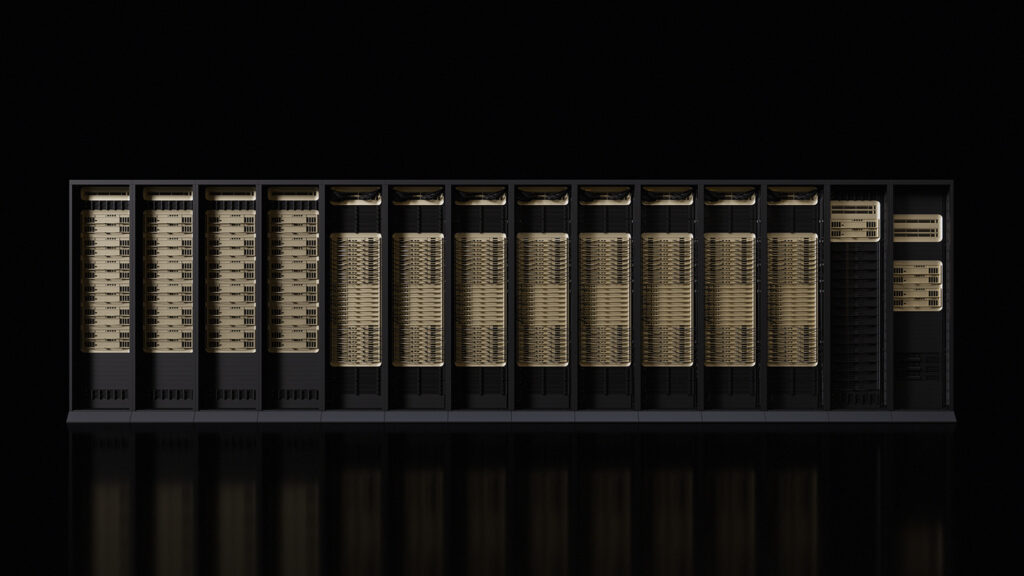
NVIDIA Rubin Platform (Image Credit: NVIDIA)
The global semiconductor landscape has undergone a fundamental transformation. In previous eras, the “compute” part of the equation—the raw processing power of the GPU core—was the primary limiting factor for AI progress. As we move deeper into 2026, that bottleneck has shifted decisively toward memory bandwidth. At the Morgan Stanley Technology, Media & Telecom Conference earlier this month (March 2026), NVIDIA CEO Jensen Huang sent a shockwave through the supply chain with a clear, strategic signal: however much High Bandwidth Memory (HBM) the world’s factories can produce, NVIDIA is ready and waiting to absorb every single unit.
This stance marks a radical departure from typical corporate procurement. While most companies view a component shortage as a threat to their quarterly earnings, Huang has articulated a scenario where scarcity actually accelerates the adoption of NVIDIA’s most advanced, high-margin platforms. By calling the current DRAM shortage “excellent news,” he highlighted a unique market reality: when data center resources like power and space are limited, customers are forced to bypass mid-range hardware and move directly to the most efficient, high-density solutions available.
As the industry prepares for the GTC 2026 keynote, this “flight to quality” is driving a rapid transition to the upcoming Vera Rubin platform. For global memory leaders like Samsung, SK Hynix, and Micron, the message from NVIDIA is no longer one of cautious forecasting, but a declaration of the total, unyielding demand fueling the AI Memory Supercycle.
The Strategic Logic: Why Scarcity is a Catalyst
While most CEOs would view a component drought as a cap on revenue, NVIDIA’s leadership characterized the current resource constraints as “excellent news.” This logic is rooted in the high-stakes economics of the modern data center.
Today, the primary bottlenecks for AI scaling are not just the chips themselves, but the physical infrastructure surrounding them: land, high-voltage power, and cooling systems. When these resources are limited, customers cannot afford to be inefficient. If a data center only has the power capacity for a finite number of server racks, the operator is incentivized to ignore mid-range or budget-friendly hardware. Instead, they move directly to the most powerful, high-density solutions available—NVIDIA’s flagship GPUs—to ensure they maximize the “intelligence per watt” of their facility.
This flight to quality ensures that NVIDIA’s premium products remain in perpetual demand. By guaranteeing that every gigabyte of memory produced will be utilized, NVIDIA is effectively de-risking the multibillion-dollar investments required by fabs to scale their production.
Technical Hunger: From Blackwell Ultra to Vera Rubin
The primary driver of this insatiable appetite for DRAM is the generational leap in NVIDIA’s hardware roadmap. The Blackwell Ultra (B300), which began shipping in early 2026, already pushed the boundaries of memory capacity. Featuring 288GB of HBM3e memory across eight 12-high stacks, it offers a staggering 8 TB/s of bandwidth. This allows a single GPU to host a 70B parameter model in FP16 with room to spare for the KV cache.
However, the upcoming Vera Rubin platform—scheduled for late 2026—represents an even more aggressive escalation in memory requirements. The Rubin GPU is designed to work in tight coherence with the Vera CPU, which features 88 custom Olympus cores and 1.5TB of LPDDR5X memory. This “Superchip” architecture is built to eliminate the data movement bottlenecks that currently plague Agentic AI models.
The shift to HBM4 is the critical pivot point. Unlike the 12-high stacks found in the Blackwell generation, the Rubin architecture utilizes 16-layer HBM4 stacks. This transition is not merely an incremental upgrade; it is a significant engineering challenge. To maintain the same physical height for the memory modules, the silicon wafers must be thinned to approximately 30 µm, down from 50 µm in the previous generation. This extreme thinning increases the risk of warpage and structural defects, leading to what industry analysts call a “yield tax.”
Because producing a single usable HBM4 stack now consumes more raw wafer capacity than ever before, the global supply of usable DRAM bits is effectively being squeezed by the very technology designed to expand it.
Why AI is Now “Memory Bound”
The reason NVIDIA GPUs require such massive amounts of HBM4—reaching an aggregate bandwidth of 22 TB/s in the Rubin generation—is found in the nature of next-generation AI agents.
Modern AI is moving away from simple “one-shot” responses toward “reasoning” models. These models must hold trillions of parameters in high-speed memory to perform complex, multi-step tasks without the latency penalties associated with moving data between separate nodes. If the GPU has to wait for data to be fetched from standard system RAM, the entire multi-thousand-dollar compute process stalls. In the Rubin architecture, the memory is no longer just a storage pool; it is the primary highway for the high-speed logic of the NVLink 6 fabric, which allows 72 GPUs to act as a single, massive supercomputer.
Market Dynamics: The HBM-led Memory Supercycle
NVIDIA’s aggressive procurement strategy has triggered what is now known as the HBM-led Memory Supercycle. For the remainder of 2026 and into 2027, the global semiconductor market is expected to be defined by a sharp divide.
On one side, enterprise and AI-grade DRAM prices are projected to stay at historic highs. Memory manufacturers have been reallocating their production lines away from consumer DDR5 and DDR4 to focus on the much higher-margin HBM modules. This “crowding out” effect means that while NVIDIA and hyperscalers secure their supply, the rest of the consumer electronics industry—from high-end PCs to smartphones—is likely to face sustained price inflation and supply constraints.
Major players like SK Hynix and Samsung are currently in a high-stakes race to stabilize their 16-layer yields. While SK Hynix is leveraging its refined MR-MUF (Mass Reflow Molded Underfill) process, Samsung is pushing ahead with hybrid bonding to achieve even higher density, despite current yield rates reportedly being in the single digits for early prototypes.
The Infrastructure Pivot
For data center managers, the transition to the Blackwell and Rubin eras is not just about buying new chips; it is about a complete facility overhaul. The GB300 and Vera Rubin racks consume between 120 kW and 140 kW per rack, requiring a shift to direct-to-chip liquid cooling and a move toward 800V DC power architectures.
Assembly partners like Foxconn, Quanta, and Wistron are now scaling their production facilities to handle these massive, liquid-cooled racks. Because the lead times for these facilities can range from 9 to 18 months, procurement teams are having to make commitments today for hardware that won’t arrive until 2027.
In this environment of capital intensity, the secondary market has become a strategic lever. Many forward-thinking organizations are now looking to liquidate enterprise GPU assets from the Hopper generation (H100/H200). By selling off older units, firms can generate the immediate capital needed to secure their place in the HBM4 allocation queue for the Rubin generation.
Conclusion
The DRAM shortage is no longer a temporary market glitch; it is a structural reality of the AI era. By publicly signaling that NVIDIA will absorb all expanded capacity, Jensen Huang has effectively set a “floor” for the entire memory market. This strategy de-risks the multibillion-dollar investments required by fabs to scale HBM4 production while simultaneously securing NVIDIA’s dominance for the next decade of compute.
As we look toward the GTC 2026 keynote, the industry is bracing for a new reality. The winner of the AI race will not just be the company with the fastest algorithms, but the one that has secured the memory to keep them running. For organizations looking to keep pace with this transition, the first step is often optimizing existing infrastructure. If you are looking to recoup capital from your current hardware to prepare for the Vera Rubin era, now is the time to sell used server memory and decommissioned assets while secondary market demand remains high.
For NVIDIA, the strategy is simple: whatever the world can build, they will take. For the rest of the industry, the race to secure a place in the AI memory supercycle has only just begun.
Appendix: Technical Comparison
NVIDIA Blackwell Ultra (B300) vs. Vera Rubin (R100)
The transition from the Blackwell Ultra to the Vera Rubin platform represents one of the most significant architectural leaps in NVIDIA’s history, primarily driven by the shift from HBM3e to HBM4. While the memory capacity remains consistent at 288GB per GPU, the efficiency and throughput of that memory undergo a radical change.
| Feature | Blackwell Ultra (B300) | Vera Rubin (R100) | Generational Leap |
| Release Window | January 2026 | H2 2026 (Expected) | ~8 Months |
| Compute Architecture | Blackwell (Blackwell Ultra) | Vera Rubin | New Architecture |
| Process Node | TSMC 4NP (Custom 5nm) | TSMC 3nm (N3P) | Full Node Shrink |
| Transistor Count | ~208 Billion | ~336 Billion | +61% |
| FP4 Inference (Dense) | 14–15 PFLOPS | 50 PFLOPS | ~3.5x |
| Memory Type | HBM3e (12-High Stacks) | HBM4 (12/16-High Stacks) | New Standard |
| Memory Capacity | 288 GB | 288 GB | Parity |
| Memory Bandwidth | 8 TB/s | 22 TB/s | 2.75x |
| NVLink Generation | NVLink 5 (1.8 TB/s) | NVLink 6 (3.6 TB/s) | 2x |
| Networking | ConnectX-8 (800G / 1.6T) | ConnectX-9 (1.6T / 3.2T) | 2x |
| TDP (per GPU) | 1,400W | ~1,500W+ (Est.) | Higher Intensity |
Key Performance Takeaways
-
The Bandwidth Explosion: The move to HBM4 isn’t just a minor tweak. By increasing the memory interface width and utilizing 16-layer vertical stacking, Rubin achieves 22 TB/s of bandwidth. This is the “secret sauce” that allows it to feed its massive 50 PFLOPS compute engine without starving for data.
-
Reasoning Efficiency: While the Blackwell Ultra is the current king of “high-value” inference for 70B models, the Rubin architecture is built for Agentic AI—where the GPU must reason across massive context windows (using the 1.5TB of LPDDR5X on the Vera CPU) in real-time.
-
Power Density: Data center managers should note the climb in TDP. Moving from the H100’s 700W to the B300’s 1,400W was a shock; the Rubin era will require even more specialized liquid cooling as power density continues to push toward 150kW+ per rack.