
Meta’s Muse has drawn a lot of attention in September, logging 1.8 million iOS downloads in its first 12 days, which is ahead of ChatGPT’s 1.3 million at the same point. What is Muse? It is an AI agent, which does tasks on a person’s behalf, such as booking travel, filling in web forms or sending emails, etc. Here raises a question: how many more CPUs data centers will need to support this app.
The question arrives when CPUs are already scarce. According to the most recent report, server CPUs now take 25 to 30 weeks to arrive after an order is placed, against 16 to 20 weeks in a balanced market. Intel said this month that Intel overall can currently meet only about half of the processor demand. Of course, Muse did not cause that wait, since it launched only three weeks before the figure was published and a lead time reflects orders placed months earlier. It does show why the demand behind the wait is unlikely to fade quickly.
Lead times have been stretching all year
In February, Intel warned customers in China that delivery times for server products could stretch to six months, with fourth- and fifth-generation Xeon chips especially scarce. In April, a Nikkei report said average lead times had grown to eight to 12 weeks, up from one to two.
None of these reports defines lead time the same way, so the numbers cannot be lined up exactly. Six months is about 26 weeks, though, so the scarcest Xeons were already that slow in winter, and TrendForce’s new range suggests those waits have spread to the market as a whole.
What is squeezing supply
Demand moved first, and faster than the chipmakers planned for. Intel’s finance chief said unit demand surged through the second half of 2025. Part of that came from PC upgrades ahead of the end of Windows 10 support, and part from AI software shifting toward agents, which lean on CPUs to run tools and code. At AMD, Lisa Su said in August that the server CPU supply chain “is tight right now, and it has been tight for the first half of the year because much of this demand was unforecasted.”
Supply could not stretch to meet it. Intel’s CEO said in July that the industry faces one of the most severe supply constraints in its history, across leading-edge wafers, memory and substrates, the base layer each processor is mounted on. AMD described the same pinch on its August call, saying it is working on back-end and packaging capacity and substrates as well as wafers. Component makers have also been giving priority to AI server orders, which leaves general-purpose servers waiting longer for their parts. What the shortage has already done to prices is covered in our June update on server CPU prices.
Why AI agents need so many CPUs
The AI model behind an agent still runs on accelerators, usually GPUs. What an agent adds is the work around the model: opening a browser, filling in forms, running code, and keeping track of files between steps. Much of that work falls to ordinary server CPUs, in environments kept separate from the model. The mechanics, and whether the popular one-CPU-per-GPU rule holds up, are covered in more depth in our August post on why agents lean on CPUs.
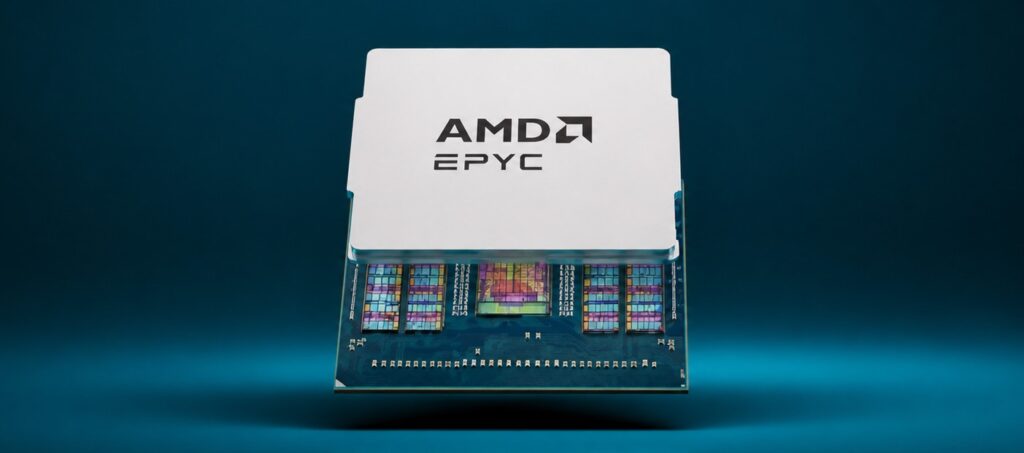
Muse makes the idea concrete. Meta says each person gets a dedicated virtual machine, a small computer carved out of a data center server, which holds the agent and the person’s data. Meta has not published its specs, but users who asked the agent about its own system found two virtual CPUs, about 8GB of RAM and 100GB of storage, on hosts running a 126-core AMD EPYC processor. A virtual CPU is a slice of a physical processor assigned to one machine.
“Dedicated” describes the person’s workspace more than a fixed piece of hardware. The same report saw the virtual machine replaced during an update, with the user’s files reattached to the new one, and notes that virtual CPUs are not necessarily tied to particular physical ones. That flexibility pays off because these machines sit idle most of the time while the model decides the next step. In the sandboxes DeepSeek uses to train its agents, about 90% used 5% or less of the CPU they requested, so a provider can run many users’ machines on each physical core.
How much CPU could agents add?
Meta has not released user numbers, but Similarweb estimated Muse at about 700,000 daily users in late September. Altimeter’s Freda Duan worked out a scenario for 100 million daily users. Assuming about two hours of use per person per day, she put the number of machines live at peak, with headroom, at about 25 million, each using half a physical core. The same assumptions applied to today’s users give the first row below. Both rows are scenario calculations, not a count of actual servers.
| Scenario | Physical CPU cores | 126-core CPUs |
|---|---|---|
| Muse today, ~700,000 daily users (Similarweb estimate) | About 87,500 | About 700 |
| 100 million daily users (Duan’s method) | About 12.5 million | About 99,000 |
The more telling number is the gap between that scenario and the simple one. Giving each of 100 million users two virtual CPUs of their own would take 100 million to 200 million physical cores, depending on whether a virtual CPU counts as half a core or a whole one. Duan’s scenario needs 12.5 million, an eighth to a sixteenth as much, because most users are not online at the same moment and those who are leave the CPU idle much of the time. Estimates that multiply the specs by the user count overstate the build-out by about that margin.
That still leaves a real order. Working from the published figures, 12.5 million cores comes to roughly 50,000 two-socket servers on the same 126-core chip, against about 14.5 million servers of all kinds expected to ship worldwide in 2025. One agent adds a meaningful but modest load; its weight comes from stacking. Meta has already extended Muse to small businesses, and every other agent product built the same way adds another layer of demand. Memory may feel it first. In Duan’s scenario, the 100 million users need 75 to 100 petabytes of DRAM, costing roughly $2 billion, against about $800 million for the CPUs. That lands on a market already in a memory shortage.
What this means for buyers and sellers
For a refresh planned in the next two quarters, orders placed now may still arrive late, so the practical move is to order early and plan for existing servers to stay in service longer. Compatible pulled Xeon and EPYC processors can fill some gaps while new stock is on backorder, which also means processors in servers due for retirement may be worth more than in a normal market. That is worth checking before deciding when to sell server CPUs.
The next signals arrive soon. Intel and AMD report third-quarter results in late October and early November, and AMD has already said it expects 2027 supply to be easier to manage because demand is now better forecast. The test is whether lead times actually fall from today’s 25–30 weeks, not whether executives still call supply tight. If capacity improves while lead times stay well above the 16–20 week norm, that would be strong evidence that agent-driven CPU demand is becoming a lasting part of the market.