
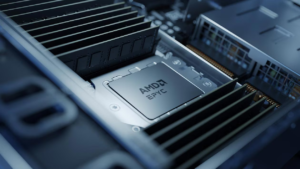
The End of Intel’s Monopoly: How AMD and ARM Are Quietly Redrawing the Data Center Map
For more than two decades, buying a server meant buying Intel. It was less a decision than a default — a reflex baked into procurement checklists, vendor relationships, and enterprise software licensing. Intel’s Xeon processors controlled more than 99% of the server CPU market for much of the 2000s and 2010s, generating operating margins estimated between 60–70% and turning the data center into the most profitable moat in semiconductor history. In 2016 alone, Intel’s Data Center Group generated $17.2 billion in revenue and $7.5 billion in operating income.
That era is now formally ending.
According to Mercury Research’s Q1 2026 data, AMD’s EPYC processors captured 46.2% of server CPU revenue in the first quarter of 2026 — an all-time record. Meanwhile, ARM-based processors — chips designed by cloud providers and chip companies using ARM’s licensed architecture, rather than by ARM itself — now account for an estimated 17–21% of global server CPU shipments, a figure that barely registered five years ago. When you add those numbers together, Intel’s grip on the world’s data centers has slipped to levels that would have seemed impossible during the Xeon’s zenith.
This is not a supply disruption or a product cycle blip. It is a structural realignment — one that has been building quietly for nearly a decade and is now becoming impossible to ignore.
How Intel Built an Unassailable Fortress
Intel’s server dominance was not an accident. It was the product of ruthless vertical integration, an unmatched manufacturing process advantage, and a sales ecosystem that locked in customers at every layer of the stack.
Xeon processors benefited from Intel’s decades-long lead in silicon fabrication. When Intel was on 14nm and competitors were still on 28nm, the performance gap made alternatives genuinely uncompetitive. Software ecosystems — including virtualization platforms, enterprise databases, and HPC workloads — were tuned and certified for Intel architecture. Enterprise procurement teams faced real risk in deviating from the standard.
The result was a compounding moat: performance leadership funded manufacturing investment, which sustained performance leadership, which justified premium pricing, which funded the next generation of manufacturing. AMD was so thoroughly marginalized by the mid-2000s that it was considered a tier-two supplier struggling for survival, not a genuine threat to Intel’s server business.
Intel still outsold AMD 9:1 in servers as recently as a few years ago. That ratio now stands at approximately 2:1 — and on a revenue basis, AMD has already crossed parity.
The AMD Assault: Eight Years of Methodical Pressure
When AMD launched its first-generation EPYC processors in June 2017, the semiconductor industry was politely skeptical. AMD had been largely absent from serious server deployments for years. The first EPYC generation captured roughly 5% of new server deployments — a foothold, not a disruption.
What followed was one of the most disciplined competitive comebacks in technology history.
Under CEO Lisa Su, AMD made a series of architectural bets that would prove prescient. The company adopted chiplet-based design — disaggregating the processor into smaller, more manufacturable tiles — before Intel committed to the approach. This allowed AMD to scale core counts and memory bandwidth at a pace Intel’s monolithic die design struggled to match.
By the time EPYC “Genoa” arrived in late 2022, AMD was offering processors with up to 96 cores per socket and memory bandwidth that made Intel’s comparable Xeons look dated. EPYC “Turin,” the fifth generation, pushed that to 192 cores per socket — 50% more than Intel’s Xeon 6 Granite Rapids at 128 cores — while also delivering a compelling price-performance ratio.
The numbers tell the story directly. AMD’s 192-core EPYC 9965 is priced at approximately $14,813, compared to Intel’s 128-core Xeon 6980P at $17,800. More cores, lower price. For cloud providers operating at hyperscale — where every dollar of compute efficiency translates directly to margin — the calculus became inescapable.
It is estimated that 50–60% of new hyperscale server deployments now use AMD processors, a remarkable statistic given where AMD stood a decade ago. AMD’s data center segment reported $5.8 billion in revenue for Q1 2026 alone, up 57% year-over-year. The company has forecast $120 billion in cumulative server CPU revenue through 2030.
The revenue share figure is especially telling. AMD commands a disproportionate share of high-margin, high-core-count deployments — exactly the segment Intel once owned exclusively. It is not just winning deals; it is winning the most valuable deals.
The ARM Insurgency: When Customers Become Competitors
While AMD was taking Intel’s lunch from one side, an entirely different threat was emerging from another direction: hyperscalers building their own chips.
The shift began quietly. Amazon Web Services introduced the first Graviton processor in November 2018 — an in-house chip, designed by Amazon but built on ARM’s licensed architecture — for its own cloud infrastructure. It was initially treated as a curiosity, a cost-optimization experiment for commodity workloads. Few predicted it would become a structural force. The key distinction matters: ARM Holdings, based in Cambridge, UK, does not manufacture or sell processors. It designs the underlying instruction set and core blueprints, then licenses them to companies who build their own chips. Every “ARM-based” server CPU you hear about — Graviton, Axion, Cobalt — is someone else’s product, built on ARM’s foundation.
By 2026, the picture looks entirely different. AWS Graviton5 features 192 Neoverse V3 cores on TSMC’s 3nm process, representing performance that competes directly with x86 at the highest end. Google has deployed its Axion processor, porting more than 30,000 internal applications to ARM — including YouTube, Gmail, and BigQuery — with another 70,000 Google applications currently in the conversion pipeline. Microsoft’s Cobalt 100 has been powering Azure workloads at scale since its general availability in October 2024, with the next-generation Cobalt 200 — built on the more powerful Neoverse V3 design — now rolling out through 2026.
The implications of this trend are profound and often underappreciated. When a hyperscaler builds its own CPU, it does not just switch vendors — it exits the merchant silicon market entirely for those workloads. Every server running Graviton, Axion, or Cobalt is a server that will never run a Xeon or an EPYC. The addressable market for x86 server chips shrinks structurally, not cyclically.
ARM-based server shipments are projected to grow from 13.4% of the server CPU market in 2025 to 23.1% by 2028, with the overall server CPU market itself expanding from $27.7 billion to $56.2 billion over the same period. ARM is not just gaining share — it is growing into a larger pie that Intel helped create and is now losing its claim on. ARM itself targeted 50% of compute shipped to top hyperscalers in 2025, a bold number, but one that reflects genuine momentum even if the exact figure is contested by analysts.
Intel’s Triple Problem: Execution, Architecture, and Timing
Intel’s loss of server market share is not simply a story of competitors improving. It is equally a story of Intel’s own compounding failures.
Manufacturing slippage. Intel’s manufacturing roadmap — the bedrock advantage that sustained Xeon’s dominance — began falling behind TSMC around 2020. While AMD was fabbing chips on TSMC’s leading-edge nodes, Intel was struggling with yields and delays on its own processes. The company’s 18A process node, central to its comeback plans, has yield rates lower than initially hoped, with Intel’s CFO acknowledging yields are “not where we need them to be in order to drive the appropriate level of margins.”
Product delays. Intel has cancelled its mainstream next-generation Xeon server processors outright. The Xeon 7 Diamond Rapids flagship has been pushed back to mid-2027. The Clearwater Forest chip, originally slated for late 2025, arrived behind schedule and into a market where AMD’s advantage is already well-established. Every delay is an opportunity for AMD and ARM deployments to deepen their roots in infrastructure that will remain in service for years.
AI accelerator misstep. Intel cancelled its Falcon Shores AI GPU program, a decision that significantly weakened its competitive posture for AI infrastructure buildout — precisely the workload category driving the current surge in data center spending. While NVIDIA dominates AI training and AMD’s Instinct accelerators are gaining meaningful traction with hyperscalers, Intel is largely absent from the most lucrative new category in the market.
The cumulative effect is a company that cannot win on manufacturing, cannot win on architecture in the near term, and cannot win on AI acceleration. Its installed base — enormous as it is — is now its primary asset, not its product roadmap.
Why This Time Is Different
Skeptics will note that Intel has faced competitive pressure before and survived. AMD challenged Intel with the Athlon and Opteron processors in the early 2000s, briefly winning benchmarks and some market share before Intel responded with the Core architecture and reasserted dominance. Could history repeat itself?
The structural conditions today are materially different, for three reasons.
First, the migration is now multi-front. In the early 2000s, Intel only had to fight AMD on x86 turf. Today it faces AMD taking server revenue share from the left while ARM-based custom silicon takes hyperscaler deployments from the right. These are two distinct competitive dynamics requiring two entirely different strategic responses simultaneously.
Second, the hyperscaler silicon investment is irreversible at scale. When Google ports 100,000 applications to ARM, that is not a temporary experiment — it is a multi-year infrastructure commitment that will not reverse on a product cycle. These customers are not switching back to x86 regardless of what Intel ships next.
Third, Intel’s manufacturing recovery, even if successful, arrives into a different competitive landscape than the one it left. By the time Intel’s 18A process matures and Diamond Rapids ships, AMD will have Turin successors in the field and hyperscalers will have their fifth-generation custom chips deployed. The window for Intel to recapture momentum with a single product leap has probably closed.
The Outlook: A Three-Player Equilibrium
The most likely outcome over the next three to five years is not Intel’s disappearance — its installed base is too large and its enterprise relationships too deep for a rapid collapse — but rather the normalization of a three-player data center CPU market where no single vendor commands a dominant share.
AMD appears well-positioned to hold its revenue share leadership through 2027 at minimum. With 5th Gen EPYC already accounting for more than 50% of AMD’s server revenues and a generation of hyperscaler deployments committed to EPYC infrastructure, the revenue share lead is unlikely to erode quickly.
ARM’s trajectory is more variable. The 50% hyperscaler prediction looks ambitious against current data, but growth from 13% to 23% market share by 2028 seems credible and perhaps conservative. Every major cloud provider is now invested in ARM silicon development, and the economics of vertical integration — owning your own silicon — are compelling at hyperscale.
Intel’s path forward likely depends on whether its manufacturing resurgence can arrive before its customer base fully migrates. If Diamond Rapids and its successors deliver strong performance on 18A in 2027–2028, Intel has a realistic case for stabilizing enterprise share. But “stabilizing enterprise share” is a very different story than “dominating the server market” — the era it is defending ended before the replacement was announced.
What This Means for Enterprise IT Today
For IT teams and procurement managers, this transition creates a practical and immediate decision point: what to do with aging Intel Xeon infrastructure in the middle of a platform shift.
The data center refresh cycle is compressing. Organizations that deployed Xeon-based servers in 2019–2022 are now evaluating AMD EPYC or ARM-based alternatives as their next generation. The economics are genuinely compelling — not as marketing positioning, but as verifiable total cost of ownership. In many configurations, a single-socket EPYC system replaces a dual-socket Xeon configuration with lower power consumption and better performance.
That transition naturally surfaces a question that many IT departments are only beginning to think through: those aging Intel servers still hold residual value — value that diminishes the longer the migration is delayed. Selling Intel Xeon servers, CPUs, RAM, and storage components into the secondary market now, while enterprise demand for legacy x86 infrastructure remains active, is a materially better outcome than depreciation to zero.
For organizations navigating mid-transition asset disposition, BuySellRam.com offers competitive buyback pricing across server CPUs, RAM, SSDs, networking equipment, and complete server systems through its Sell CPU and IT hardware recovery services — providing a structured way to recover capital from aging Intel infrastructure and redirect it toward next-generation deployments.