
Why DDR5 Retail Prices Are Dropping Despite the AI Infrastructure Boom
The memory market has entered a period of unprecedented divergence as of late March 2026. For nearly a year, IT departments and hardware enthusiasts have been battered by the “Rampocalypse,” a sustained period of skyrocketing DRAM costs that saw some modules triple in price. However, the tide is finally turning—at least in the retail sector. While consumers are seeing the first significant DDR5 price drops in months, the enterprise side of the house tells a very different story.
Navigating this market requires a deep understanding of why retail “spot” prices are cooling while enterprise “contract” prices remain stubbornly high. By analyzing the massive investments from players like OpenAI, the shift toward memory-efficient AI models, and the liquidation of stockpiled inventory, we can build a clearer picture of what the next year hold for the hardware industry.
The Current State of the DRAM Market: Retail Relief vs. Legacy Scarcity
To understand the current price movement, one must look at the growing disconnect between the retail “spot” market and the enterprise “contract” market. While individual buyers are seeing some relief, the foundational supply remains under immense pressure.
The DDR5 Retail Correction
In March 2026, the retail market for DDR5 saw its first meaningful downward trend in nearly nine months. After hitting record highs in January, mainstream DDR5 modules have begun to see price cuts ranging from 6% to 10% across major global retailers. According to recent market data cited by TrendForce, average DDR5 retail prices in certain regions fell by 7.2% this month alone.
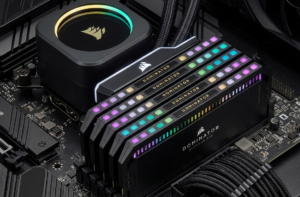
Real-world examples of this shift are evident in flagship products: high-performance 32GB kits, such as the Corsair VENGEANCE DDR5, have dropped to approximately $379, a significant correction from their February peaks of nearly $490. This trend is largely driven by a cooling of consumer demand and a temporary surplus in retail channels as speculative distributors begin to flush their inventory.
The DDR4 Scarcity Premium
Surprisingly, the older DDR4 standard has not followed the same downward trajectory. Because the world’s major semiconductor fabricators have reallocated nearly all their wafer capacity to High Bandwidth Memory (HBM) and DDR5, the supply of DDR4 has effectively shriveled.
For organizations maintaining legacy server fleets or older workstations, DDR4 remains a “scarcity” item. In a rare “legacy price inversion,” DDR4 spot prices have hit approximately $2.10 per gigabit, making older memory technically more expensive than some higher-volume enterprise alternatives. This structural undersupply ensures that while DDR5 retail prices might dip, the floor for DDR4 remains stubbornly high due to the total lack of new production.
Contract Prices: The Enterprise Surge
While the retail market shows signs of cooling, the enterprise contract market—where cloud giants and data centers procure memory—continues to surge. The primary reason for this resilience is the massive, non-stop build-out of AI infrastructure.
A perfect example of this is OpenAI’s recent $122 billion funding round, aimed specifically at accelerating global AI infrastructure. With capital of this magnitude being deployed by OpenAI, Microsoft, and Amazon, the world’s leading fabs (Samsung, SK Hynix, and Micron) are focusing almost exclusively on high-margin HBM and server-grade RDIMMs. As long as these “token factories” are under construction, the underlying RAM shortage will persist. Consequently, while a consumer might find a deal on a single module today, enterprise contract prices are still projected to rise by 58% to 63% QoQ, as the demand for AI-centric silicon continues to swallow the global supply.
Why Are Prices Moving Now? Analyzing the “Correction”
Is this the beginning of a bear market, or just a temporary breather? The sudden drop in retail DDR5 prices is not a random anomaly. Rather, several factors have converged to create this retail price drop, driven by a combination of natural market cycles, distributor psychology, and unexpected technological breakthroughs.
Natural Market Resistance
Simply put, memory reached a price point that broke the consumer’s back. After months of relentless increases, retail demand finally hit a hard ceiling. High component costs have fundamentally altered PC building and purchasing cycles for early 2026. According to projections by Gartner, soaring memory costs are expected to reduce global PC shipments by 10.4% this year. When end-users stop buying, the pressure inevitably travels up the supply chain, causing retail prices to buckle.
Inventory Flushing by Mid-Tier Distributors
During the massive price hikes of late 2025, many mid-tier hardware distributors and speculative traders stockpiled massive amounts of DRAM, betting that prices would climb indefinitely. However, as consumer demand hit the “Gartner ceiling” in March 2026, these traders found themselves holding expensive inventory that was no longer moving. Fearing a broader market downturn, these distributors began aggressively clearing their stock in major hubs like Shenzhen and Hong Kong. This desperate rush to lock in gains flooded the retail market with surplus modules, driving down spot prices in a classic natural correction.
The Impact of AI Efficiency Gains
Beyond market economics, a major catalyst for the recent spot price drop is the rapid advancement in AI memory optimization. In mid-March, Google’s introduction of technologies like TurboQuant fundamentally changed how AI models utilize VRAM and system memory during the inference phase (check Will Google’s TurboQuant AI Compression Finally Demolish the AI Memory Wall?). By drastically increasing memory compression and allowing massive models to run on significantly smaller hardware footprints, these software-side efficiencies temporarily eased the desperate “panic buying” of RAM by smaller AI startups and research labs. This shift in demand raised a sobering question for speculators—Do we actually need as much RAM as we thought?—which effectively cooled speculative buying and helped stabilize the retail sector.
Forward Outlook: 2026–2027 Forecast
If you are waiting for a return to “2024 prices,” you may be waiting a long time. However, the market is shifting:
Short Term (Q2 2026): Expect continued spot market volatility. If you are an individual user, this is a “buying window.” If you are a business looking to offload surplus, now is the time to sell memory before retail prices slide further.
Mid-Term (Late 2026): Relief is expected to broaden. TrendForce’s base case suggests that price declines will normalize by Q3 2026 as production efficiencies catch up.
Long Term (2027 and beyond): Major new fabrication capacity from Micron and Samsung won’t hit the market until late 2027. Until then, the market will remain “structurally tight,” though the era of 300% annual gains is likely over.
The Bottom Line for Businesses: Capitalize on the Enterprise Premium
Do not mistake this retail price dip for a market crash—it is a temporary correction masking a massive, ongoing structural shortage. While consumer prices soften, the multi-billion-dollar AI infrastructure race continues to swallow enterprise silicon at an unprecedented rate, keeping contract price floors exceptionally high. For IT asset managers and data center operators, holding onto surplus or legacy hardware during this peak is a costly mistake. The smartest financial move you can make this quarter is to capitalize on these inflated enterprise valuations. Whether your organization needs to sell processors, liquidate high-demand GPUs, or clear out SSD storage, executing your ITAD strategy today ensures maximum ROI before the market finds its next equilibrium. Turn your idle hardware into immediate liquidity while this premium window remains open.