
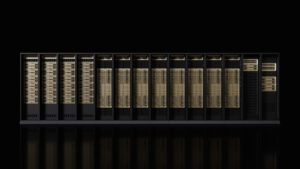
NVIDIA Rubin Platform (Image Credit: NVIDIA)
The timeline for next-generation AI infrastructure is accelerating, with NVIDIA’s flagship liquid-cooled rack, the Vera Rubin NVL72, projected to enter production in the latter half of 2026. For enterprise infrastructure planners navigating capital allocation, the physical footprint remains reassuringly familiar: the architecture utilizes the same Oberon chassis form factor, retaining a density of 72 GPUs and 36 CPUs. Yet, from a budgetary standpoint, the landscape has fundamentally shifted.
Bottom-up bill of materials (BOM) estimates released by Morgan Stanley Research indicate that a single Vera Rubin rack will cost approximately $7.8 million. Compared to the preceding Grace Blackwell GB200 NVL72 systems, which commanded between $3.5 million and $4 million, procurement costs have effectively doubled in a single hardware cycle.
Crucially, this price inflation did not stem from expanding the rack size or increasing silicon volume. Instead, capital requirements have intensified entirely within the underlying component architecture.
High-Density Architectural Cost Evolution
| Component / Metric | Grace Blackwell NVL72 | Vera Rubin NVL72 | Generation Delta |
| GPU Configuration | 72 × Blackwell B200 | 72 × Rubin VR200 | No volumetric change |
| Estimated Price Per GPU | ~$35,000 | ~$55,000 | +57% price premium |
| GPU Subtotal Per Rack | ~$2.5 Million | ~$4.0 Million | +$1.5 Million |
| HBM Allocation Per GPU | 192 GB HBM3e | 288 GB HBM4 | +50% capacity expansion |
| Memory Bandwidth Per GPU | 8 TB/s | 22 TB/s | ~2.75× bandwidth scaling |
| System LPDDR5X Per Rack | ~17 TB | 54 TB | ~3.1× capacity scaling |
| Aggregate Memory Cost Share | 5% – 10% of total BOM | 25% – 30% of total BOM | 435% cost explosion |
| Total Estimated Rack BOM | $3.5M – $4.0M | ~$7.8M | ~2× budgetary increase |
(Data derived from Morgan Stanley supply chain tracking and official NVIDIA Vera Rubin NVL72 platform specifications.)
Dissecting the $3.9 Million CapEx Increase
An itemized analysis of the hardware supply chain reveals exactly where capital is accumulating within the chassis. While silicon scaling accounts for a predictable portion of the premium, structural cost shifts occurred across three core layers:
-
GPU Silicon Premiums: Individual processor costs are climbing from roughly $35,000 to $55,000. Across a 72-GPU cluster, this scaling accounts for a $1.5 million shift, moving the total accelerator budget to nearly $4 million per rack.
-
Substrate and PCB Overhauls: High-density interconnect requirements forced a massive upgrade in fabric complexity. Supply chain surveys compiled by analysts point to a 233% surge in printed circuit board (PCB) costs, driven by the transition to 26-layer compute trays, 32-layer switch trays, and an entirely new 44-layer midplane PCB missing from legacy platforms.
-
The Memory Allocation Inversion: The most profound variance occurs in the memory subsystem. High-bandwidth memory (HBM4) and system LPDDR5X allocations escalated from an aggregate of $374,000 per rack up to $2.0 million.
In absolute financial terms, the dollar increase attributed to the memory architecture exceeds the price jump of the processors themselves. This structural inversion marks the first time in modern enterprise computing that memory components dictate a rack’s macroeconomic profile to this degree.
Performance Architecture: Engineering for Agentic Inference
The raw silicon computing power of a GPU remains constrained if the memory pipeline cannot sustain high execution rates. The Rubin platform addresses this bottleneck by boosting individual memory bandwidth from 8 TB/s up to 22 TB/s per chip. Without this corresponding performance leap, high-performance FP4 silicon blocks would sit idle during enterprise processing routines.
Vera Rubin NVL72 Workload Evolution
-
Grace Blackwell NVL72 Baseline: Optimized primarily for large language model (LLM) training and traditional high-throughput batch inference workloads.
-
Vera Rubin NVL72 Transition: Re-engineered from the substrate up for autonomous agentic AI pipelines and low-latency deep reasoning tasks.
-
The Operational Result: A massive ten-fold reduction (1/10th the cost) in operational token expense on deep reasoning workloads, achieved entirely via aggressive memory bandwidth and capacity scaling.
While the architecture maintains robust training capabilities, the design leans heavily toward agentic AI and deep-reasoning execution models. On highly interactive, multi-step agent workflows, NVIDIA identifies a ten-fold reduction in operational cost per million tokens compared to Blackwell. This fundamental shift in workload orchestration, analyzed in detail within the companion brief, Behind NVIDIA’s Vera Launch: How AI Agents Are Reshaping Data Center CPUs, demonstrates why managing these intricate, latency-sensitive agent calls demands unprecedented data throughput—a structural reality that explains why the surrounding fabric, fabric switches, and core system memory pools were so aggressively scaled.
The Memory Hyperinflation Vectors: HBM4, LPDDR5X, and Enterprise NAND
Two synchronous market dynamics produced the $2 million memory line item. First, the physical requirements per rack multiplied across every tier of the memory hierarchy. Each Rubin GPU scales to 288 GB of HBM4, elevating total rack HBM to 20.7 TB. Concurrently, the 36 Vera CPUs leverage specialized SOCAMM2 modules to deploy 1.5 TB of LPDDR5X per processor, expanding total system memory from 17 TB on Blackwell up to 54 TB. Furthermore, contemporary tracking indicates that NVIDIA integrated more than $1 million worth of high-density 3D NAND storage directly into each rack architecture (source), an asset category that was virtually absent in standard Grace Blackwell baselines.
Second, the structural nature of HBM4 manufacturing places severe strain on global fabrication capacity. Producing a high-bandwidth stack consumes approximately three times the raw silicon wafer volume of standard DDR5 server RAM. As leading-edge fabs dedicate significant wafer allocations to premium HBM production, supply constraints ripple through standard enterprise memory categories, compounding price pressures.
Operational Risk Warning: The hyper-concentration of foundry capacity on advanced HBM4 stacks acts as an inflationary multiplier across the entire hardware lifecycle. As production lines optimize for high-margin AI substrates, capacity for conventional enterprise components contracts, locking data center operators into high hardware procurement cycles across all infrastructure tiers.
Structural Downstream Impacts on Enterprise Hardware Lifecycles
This component crunch cannot be viewed as an isolated issue confined to hyperscale AI clusters. The reallocation of foundry lines directly disrupts the supply of conventional enterprise hardware. Contract pricing for server DRAM and NAND flash platforms has experienced severe upward adjustments, with high-density server configurations seeing double-digit quarter-over-quarter price growth.
Managing this infrastructure crunch requires a balanced assessment of data center operational lifecycles. While engineering teams grapple with the complexity of onboarding high-density liquid-cooled systems, enterprise procurement managers frequently overlook a major asset value blind spot: leaving decommissioned, legacy infrastructure platforms to sit dark on warehouse shelves while component valuations are peaking.
As enterprise fleets undergo generational refreshes to accommodate intense thermal and budgetary shifts, the residual value of legacy server memory and enterprise flash storage moves from an afterthought to a core recovery asset. Organizations can actively exploit these structural supply shortages by leveraging IT Asset Disposition (ITAD) pathways to sell memory RAM and monetize decommissioned corporate memory banks. Simultaneously, auditing storage infrastructure allows organizations to sell SSD hard drives at peak valuations, recapturing capital from legacy storage arrays to offset next-generation infrastructure costs.
Ultimately, while the GPU silicon commands center stage during keynotes, the actual budgetary variable dictating this generational hardware transition is memory. Navigating this tight market requires systematic asset recovery strategies—ensuring that organizations safely decommission, sanitize, and sell computers, laptops, and data center servers to maximize capital recovery in an inflationary hardware era.