
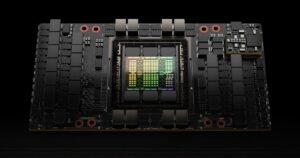
NVIDIA A100, H100 & H200 Cluster Liquidation: Maximize ROI and Asset Recovery ( Image Credit: NVIDIA )
The current paradigm of artificial intelligence infrastructure is defined by a rapid generational churn that has effectively collapsed the traditional fiscal logic of data center management. As enterprises accelerate their transition to the NVIDIA Blackwell architecture, the imperative to offload previous-generation Ampere and Hopper assets has shifted from a routine hardware refresh to a critical strategic maneuver for maintaining liquidity and computational efficiency. For organizations managing high-density environments, engaging in bulk GPU buyback services is no longer merely a disposal option but a sophisticated mechanism for cost recovery that facilitates the heavy capital expenditures required for next-generation systems.
This shift is driven by a fundamental realization: the “AI Transition” is not just about adopting faster chips; it is about managing the financial and physical displacement of extremely valuable but rapidly aging silicon. The secondary market for H100, H200, and A100 clusters is currently experiencing unprecedented volatility as supply constraints ease and the massive performance deltas of the B200 platform begin to exert downward pressure on the resale value of existing inventory.
Architectural Displacement: The Blackwell Performance Leap and Its Impact on Asset Value
The primary catalyst for the current wave of GPU cluster liquidation is the massive architectural leap represented by the NVIDIA Blackwell (B200/B100) platform. For the first time in the history of the data center GPU market, a new generation is not just incrementally faster but fundamentally alters the unit economics of AI training and inference. Research indicates that the B200 provides up to 150% increase (2.5x) in throughput for model training compared to the H100 when batch sizes are optimized to leverage the B200’s expansive 192GB HBM3e memory footprint. This performance gap creates an immediate “compute debt” for any organization continuing to operate older clusters, as the time-to-market for new models becomes a competitive disadvantage.
The B200’s design represents a departure from traditional monolithic chip design, utilizing a dual-chip architecture that functions as a single unified GPU with 208 billion transistors—roughly 2.6 times the total transistor count of the H100. This density allows for the native handling of models with 200+ billion parameters without the overhead of model sharding, a capability that immediately relegates the 141GB H200, the 80GB H100 and A100 units to mid-tier tasks. Consequently, data center managers are seeing the “utility value” of their H100 clusters diverge sharply from their “market value.” While an H100 cluster remains a powerful asset for mid-range inference, its value as a frontier training tool is being eroded by the B200’s superior throughput-to-power ratio.
Generational Technical Benchmarks: Displacement Drivers
For data center managers, the transition to Blackwell is further incentivized by the dramatic reduction in operational expenses (OpEx). Analysis of self-hosted B200 clusters suggests they can be up to 10 times cheaper to operate than renting equivalent capacity from hyperscale cloud providers. This creates a powerful financial feedback loop: by liquidating A100 or H100 clusters through enterprise AI hardware buyback programs, managers can recoup significant capital (CapEx) to fund the purchase of Blackwell systems, which then lower ongoing OpEx, accelerating the overall return on investment (ROI). The break-even point for a self-hosted B200 cluster, assuming a one-time CapEx of approximately $400,000 for an 8-GPU node, is achieved rapidly when compared to cloud rental rates that range from $17,000 to $70,000 per month for H100 instances.
Thermodynamic Limits and Infrastructure Obsolescence: The Physical Catalyst for Liquidation
While performance deltas provide the carrot for upgrading, infrastructure limitations provide the stick. The transition to Blackwell represents a thermal and power crisis for existing data centers. A standard rack of H100 or A100 systems typically operates within a power envelope of 20kW to 40kW per rack. In stark contrast, NVIDIA’s GB200 NVL72 configuration requires between 120kW and 140kW of cooling and power capacity per rack. This represents a 3-6x increase in density, a jump that makes over 95% of existing global data center facilities incapable of supporting Blackwell without a total facility overhaul.
This “Readiness Gap” is forcing many IT managers to liquidate their previous-generation clusters simply to free up the physical footprint and power capacity required for the next generation. The laws of thermodynamics dictate that air cooling is no longer viable for these densities; liquid cooling (Direct-to-Chip or Immersion) has become a mandatory requirement for Blackwell deployments. Managers are essentially forced into a “GPU cluster liquidation” strategy because they cannot add Blackwell capacity alongside their existing H100s without exceeding the facility’s power draw or thermal limits.
Power and Cooling Density Evolution Comparison
The following table illustrates the escalating infrastructure requirements that drive decommissioning decisions for older AI hardware.
Sources:
The implications of this shift are profound for asset recovery. Because older data centers cannot be easily retrofitted for 140kW racks, there is a secondary market “push” as large enterprises move their operations to “AI-ready” colocation facilities, leaving behind fully functional but infrastructure-constrained H100 clusters. This creates a liquidity window where the value of H100 clusters remains high because they can still operate in standard air-cooled environments, unlike the newer Blackwell systems.
Secondary Market Economics: Deciphering the Depreciation of AI Silicon
The resale value of NVIDIA GPUs in early 2026 is characterized by a significant divergence between retail “sticker” prices and secondary market clearing rates. While the MSRP for a new H100 remains elevated, typically between $25,000 and $40,000, the used market is experiencing steep depreciation as the supply constraints of 2024 have fully eased.
Analysis of resale trends indicates that H100 units do not follow a smooth linear depreciation curve. Instead, they experience “step-change” resets triggered by architectural releases. For example, a two-year-old H100 typically retains approximately 61% of its original value, but this drops sharply to the 45-55% range by the three-year mark—a phenomenon known as the “Mid-Life Cliff”. This acceleration occurs as the hardware transitions from “Frontier Training” (Years 1-2) to “Standard Inference” (Years 3-4) and finally to “Batch Workloads” (Years 5-6).
Estimated Secondary Market Valuation (Q1 2026)
A critical insight for data center managers is the “Refurbished Premium.” Certified refurbished units consistently command a 15-25 percentage point premium over used units with unknown provenance. This premium reflects the secondary market’s desire for risk mitigation, particularly regarding thermal fatigue. GPUs used for constant AI training are subjected to extreme heat cycles, leading to higher-than-average failure rates (roughly 9% annually for GPUs vs. 5% for standard CPUs). Therefore, providing a documented “chain-of-custody” and service records during the GPU cluster liquidation process significantly increases the final buyout offer.
Technical Decommissioning: The Physical and Logical Challenges of Cluster Liquidation
Liquidation of a modern AI cluster is far more complex than a standard server decommission. The high value of individual components—where a single 8-GPU tray can exceed $200,000—demands “white-glove” logistical handling to prevent physical damage or electrostatic discharge (ESD). Professional buyback services must manage several critical technical steps that differentiate AI hardware from traditional IT assets.
The first major challenge is the de-integration of high-speed fabrics. H100 and A100 clusters are not just collections of servers; they are unified compute fabrics linked by NVLink switches and InfiniBand networking. Proper decommissioning requires the careful removal and labeling of these switches and proprietary cables, which retain significant residual value on the secondary market. Managers who treat these components as “commodity cabling” lose thousands of dollars in potential recovery value.
Liquidation Workflow and Risk Management
| Decommissioning Phase | Primary Task | Key Risk Factor | Mitigation Strategy |
| Phase 1: Planning | Inventory & Asset Tagging | Ghost assets/missing units |
Triple-documentation audit |
| Phase 2: Power-Down | Synchronized shutdown | Data corruption/surge |
Proper OEM power-down protocols |
| Phase 3: Extraction | De-racking & SXM removal | ESD / Physical drop | Certified technicians / specialized lifts |
| Phase 4: Data Erasure | NIST 800-88 / IEEE 2883 | Model IP leakage | Certificate of Data Destruction (CDD) |
| Phase 5: Logistics | Anti-static packaging | Transit vibration / Theft | Insured, climate-controlled freight |
Furthermore, the shift toward liquid cooling adds a layer of hazardous material management. Decommissioning a liquid-cooled H100 cluster requires draining CDUs (Coolant Distribution Units) and disposing of coolants that may contain biocides or PFAS (per- and polyfluoroalkyl substances). Failure to handle these fluids correctly can lead to environmental fines or catastrophic water damage during the removal of manifolds and quick-disconnect couplings.
Data Sovereignty and Sanitization Standards for AI Hardware
In the age of generative AI, the data residing on decommissioned clusters is not just “customer data”—it is often the result of millions of dollars in model training. High-bandwidth memory (HBM) and the localized NVMe storage found in AI servers can retain fragments of weights, proprietary datasets, and inference logs. Standard “deletion” is insufficient; only certified data sanitization ensures that this information is unrecoverable.
The industry is currently transitioning from the legacy NIST 800-88 guidelines (published in 2006) to the modern IEEE 2883-2022 standard for data sanitization. The newer standard is designed to address the unique storage architecture of modern AI hardware, including wear-leveling algorithms in SSDs and the persistent nature of high-performance memory modules. Data center managers should mandate that their buyback partner provides a Certificate of Data Destruction (CDD) that references these modern standards to ensure compliance with GDPR, HIPAA, and corporate security policies.
Comparative Data Sanitization Standards
The risk of improper disposal is not purely theoretical. The secondary market for used GPUs is global, and hardware that is not properly wiped can end up in regions with limited intellectual property protections. By ensuring a secure “chain-of-custody” from the rack to the destruction facility, managers protect their organization’s most valuable asset: its AI intellectual property.
Strategic Recovery Models: Buyback, Consignment, and Trade-In
The financial structure of a GPU cluster liquidation can vary significantly based on the organization’s need for immediate cash versus maximum ROI. There are three primary models for asset recovery in the 2026 market.
The Direct Buyback model is the most common for high-value H100 and A100 clusters. In this scenario, a specialized buyer provides a market-rate valuation based on current demand and pays for the assets within a 5-day window. This model is ideal for IT managers who need to clear their balance sheets and fund the “Blackwell CapEx” immediately. It also eliminates the cost and liability of warehousing old equipment.
The Consignment and Revenue Split model offers the potential for a higher total recovery but carries significant market risk. The vendor takes possession of the hardware, refurbishes it, and sells it to a network of buyers, splitting the proceeds with the original owner. While this can yield a “higher percentage” of the sale price, the rapid depreciation of AI hardware—where values can drop 10-20% in a single quarter—means that delayed sales often result in lower net returns than a quick direct buyback.
Model Comparison for IT Financial Planning
The Internal Redeployment option, while seemingly cost-free, is often a hidden liability. Moving H100s from a training role to a general-purpose inference role requires significant engineering labor, re-cabling, and power allocation. Given that a single B200 node can replace multiple H100 nodes for inference tasks, the TCO of “free” older hardware is often higher than the cost of new systems due to electricity and maintenance overhead.
Global Macro-Trends and Geopolitics: The Liquidity Windows
The secondary market for AI hardware is heavily influenced by global supply chains and geopolitical tensions. Export controls enacted in 2022 and 2023 restricted the shipment of advanced chips like the A100 and H100 to China and other sensitive regions. This created an “artificial” floor for the value of H100s in the Western market, as global supply was partitioned.
However, the introduction of “China-specific” Blackwell variants, such as the rumored B20 or equivalent sanctioned variants, may cause a sudden shift in global hardware flow. If Chinese enterprises can access Blackwell-equivalent performance through sanctioned channels, the demand for “grey-market” H100s will collapse, leading to a glut of supply in the secondary market and a corresponding price drop for Western sellers.
Additionally, the cost of the hardware itself is inextricably linked to the High-Bandwidth Memory (HBM) market. Memory accounts for approximately 50% of the manufacturing cost of an NVIDIA AI chip. With DRAM prices surging 60% in late 2025 and projected to double by mid-2026, the residual value of the components within an H100 server (the HBM chips themselves) provides a “hard floor” for valuation. Even if the GPU core becomes obsolete, the high-performance memory modules can be salvaged for use in secondary industrial applications, ensuring that “GPU cluster liquidation” always retains a base residual value.
Conclusion: Navigating the Liquidity Trap of the Blackwell Transition
The “AI Transition” is a period of immense opportunity and significant risk for data center managers. The performance deltas of the Blackwell architecture are so extreme that they effectively render H100 and A100 clusters obsolete for frontier training tasks well before their traditional five-year depreciation cycle has ended. Organizations that fail to recognize this shift risk holding “stranded assets”—hardware that is physically functional but economically unviable compared to newer architectures.
By choosing to sell high end GPUs, data centers can proactively exit their Hopper and Ampere positions while the secondary market remains liquid. The key to successful asset recovery lies in timing the “Mid-Life Cliff,” maintaining impeccable service records to capture the “Refurbished Premium,” and adhering to modern data sanitization standards like IEEE 2883-2022 to protect corporate IP.
The future of the data center is defined by density, liquid cooling, and 18-36 month refresh cycles. In this environment, the ability to rapidly liquidate old clusters is just as important as the ability to deploy new ones. IT leaders who master the “circular economy” of AI hardware will not only maximize their recovery value but will ensure their infrastructure remains at the cutting edge of the generative AI revolution. As the market moves toward the 2026-2027 refresh cycle, the window for capturing top-dollar for H100 inventory is narrowing; strategic liquidation today is the primary funding mechanism for the Blackwell deployments of tomorrow.
Quantitative Analysis Supplement: Total Cost of Ownership and Residual Value Models
To provide a precise financial framework for peers, we can model the effective annual cost of an H100 HGX system under different liquidation scenarios. These calculations assume a standard data center operating environment with a power cost of $0.12/kWh.
Scenario A: The 2-Year Strategic Exit
-
Initial CapEx: $300,000
-
Residual Value (Used – 61%): $183,000
-
Lifespan: 2 Years
-
Annual OpEx (Power/Cooling): $40,000
-
Effective Annual Cost: $98,500
Scenario B: The 4-Year Full-Depreciation Hold
-
Initial CapEx: $300,000
-
Residual Value (Used – 25%): $75,000
-
Lifespan: 4 Years
-
Annual OpEx (Power/Cooling): $40,000
-
Effective Annual Cost: $96,250
While the “Full Hold” scenario appears slightly cheaper on paper, it fails to account for the Opportunity Cost of Compute. In Scenario A, the manager has $183,000 in liquid capital at year 2 to reinvest in Blackwell hardware, which provides 2x the throughput for the same OpEx. When measured as Cost per Unit of Throughput, the 2-year strategic exit is significantly more efficient, reducing the effective cost per trained parameter by over 40% compared to the 4-year hold. This mathematical reality is what drives the current market trend toward compressed lifecycle management and aggressive secondary market participation.