
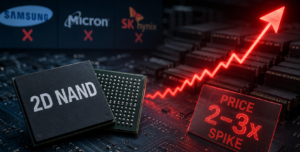
2D NAND Prices Spike 2–3x as Samsung, Micron, and SK Hynix Walk Away
While the AI super-cycle keeps DRAM, HBM, and 3D TLC NAND in the headlines, a quieter — and arguably more violent — squeeze is unfolding in the corner of the memory market that almost nobody outside of embedded design houses talks about: planar 2D NAND, especially MLC and SLC. Prices on some part numbers are now running 2–3× their late-2025 levels, lead times are stretching past a year, and the few remaining suppliers have moved to monthly contract pricing because quarterly resets can’t keep up.
For IT asset managers, OEM procurement leads, and anyone who runs industrial, networking, automotive, or medical hardware, this matters more than the DDR5 / HBM headlines suggest. Here is what is actually happening, why it is structural rather than cyclical, and how the residual-value picture is shifting for legacy gear.
What Is 2D NAND, and Why Did the Big Three Walk Away?
Planar (2D) NAND is the pre-V-NAND generation of flash. It is slower and lower-density than today’s 3D NAND, but it has a critical advantage for embedded designs: very high reliability per cell, mature firmware, and predictable behavior over a decade-plus of industrial life. SLC and MLC variants of 2D NAND sit inside automotive ECUs, factory PLCs, network switches, set-top boxes, medical devices, and countless industrial gateways.
By volume, 2D NAND is now barely a rounding error — roughly 1% of total NAND output — but the systems that depend on it are anything but a rounding error.
The structural break came when the three biggest NAND players decided their wafer capacity was worth more elsewhere:
- Samsung announced MLC NAND end-of-life in March 2025, with final shipments scheduled for June 2026. The company is reportedly converting its last 2D NAND line at Hwaseong Line 12 — about 80,000–100,000 wafers per month — over to 1c DRAM, where margins are a different universe.
- Micron has narrowed legacy NAND output to existing strategic customers and announced it is winding down its consumer-facing Crucial brand to focus capacity on data-center and AI customers.
- SK hynix and Kioxia have likewise capped legacy MLC output at “service-the-existing-book” levels.
TrendForce now projects worldwide MLC NAND capacity will fall about 41.7% year-over-year in 2026. In a market where the systems on the demand side cannot simply re-spin to 3D NAND without re-qualifying firmware, board layout, and — for automotive and medical — entire safety certifications, that is the textbook setup for a price spiral.
The Numbers: From Tight to “Spiraling Shortage”
The phrase “spiraling shortage” is not marketing language — it is the headline DigiTimes ran on May 8. What it looks like in practice:
- MLC NAND contract prices rose roughly 20–30% in April 2026 alone, with some part numbers up 2–3× versus year-end 2025 as panic-buying hit.
- Macronix has moved customers off quarterly pricing onto monthly resets — a clear signal management does not believe today’s price is tomorrow’s price.
- Distribution-channel pricing has trailed contract pricing only by a few weeks.
This is happening on top of — not instead of — the broader memory super-cycle. DDR4 32 GB consumer kits that traded at $60–90 in October 2025 were marked at $150–180 by January 2026 (Tom’s Hardware), and TrendForce reported conventional DRAM contract prices up 90–95% QoQ and NAND contract prices up 55–60% QoQ in Q1 2026.
We covered the macro picture in The 2026 Global Memory Shortage: Why RAM and SSD Prices Are Surging and Samsung NAND Prices Jump 100% in Q1 2026. The 2D NAND story is the same super-cycle viewed from its narrowest, least-elastic corner.
The Specialists Filling the Vacuum
With the big three stepping back, two Taiwan-based specialists have effectively inherited the niche.
Macronix has been the most visible beneficiary. Q1 2026 consolidated revenue hit NT$10.469 billion (+71% YoY), gross margin expanded 16.6 percentage points to 40.8%, net profit reached NT$1.779 billion, and EPS came in at NT$0.90 — a swing back to profitability after a soft 2025. NAND’s share of the company’s revenue jumped from 21% to 30% in a single quarter, with NAND revenue up 90% QoQ and 382% YoY. April followed with a record NT$5.91 billion monthly print, up 153.7% YoY . Chairman Miin Wu told analysts to expect “each quarter better than the last.”
Winbond is taking a slightly different path — concentrating on SLC NAND (the highest-reliability flavor, used in code-storage and automotive) plus a refreshed NOR Flash roadmap. The board approved a record NT$42.1 billion 2026 capex to expand CMS memory, NOR, and SLC NAND capacity, and management has publicly told analysts that DRAM and SLC NAND capacity is booked through 2027 with prices expected to reach roughly 4× 2025 levels by mid-2026.
The takeaway for designers: where 2D NAND is the only qualified part on a long-life product, Macronix and Winbond are now the supply chain — and they know it.
Why the AI Super-Cycle Is Causing the Legacy Squeeze
It is tempting to treat the legacy 2D NAND shortage as a separate story from the AI memory boom. It isn’t. The mechanism is direct:
- HBM3e, HBM4, and DDR5 server DIMMs carry margins that legacy planar nodes cannot touch. We unpacked that economics in The Rise of High Bandwidth Memory (HBM): Revolutionizing GPU Performance.
- Every fab dollar that can shift toward HBM and advanced DRAM, does. Micron alone is committing ~$9.6 billion to a new HBM-focused fab in Hiroshima, Japan, with construction starting in May 2026 and shipments around 2028 (Tom’s Hardware). Its U.S. footprint — the Idaho fab targeting first wafers in mid-2027 and the New York “megafab” now slipped to late 2030 for first output — is similarly aimed at high-end DRAM and HBM (Tom’s Hardware).
- Capacity that gets reallocated to HBM/DRAM cannot be reallocated back. Tooling, masks, and qualifications are different.
- Older planar lines, once shut, are not re-opened. Samsung is reportedly converting Hwaseong’s 2D NAND line straight to 1c DRAM.
Stated bluntly: every gigabit of HBM3e Nvidia, AMD, and the hyperscalers buy is, indirectly, a gigabit of MLC NAND that will not be made for an automotive ECU or a network switch in 2026. We previously framed this trade-off in DRAM Supply Crunch Continues — Prices Won’t Return to Normal in 2026, and the legacy NAND data is the cleanest evidence yet that the trade-off is real.
What This Means for IT Asset Managers and ITAD
This is where the picture gets practical for anyone managing a fleet of older industrial, networking, or enterprise hardware.
Residual values are inverting expectations. Decommissioned switches, storage controllers, automation gear, test instruments, and embedded systems built between roughly 2014 and 2022 frequently contain MLC/SLC 2D NAND, mature DDR3/DDR4 SODIMMs, and older NOR flash. Until recently, those parts were assumed to depreciate steadily. In 2026, they are increasingly the path of least resistance for design teams that simply cannot wait 50+ weeks for new-build inventory. Equipment that would have been a candidate for shred is now, in many cases, a candidate for harvest, test, and resale.
“Just-in-case” spares strategies are back. Procurement teams that spent the last decade trimming spare-parts inventory are quietly reversing course. If you are operating long-life equipment that depends on legacy NAND, recovering and certifying spares from your own retired fleet is now a credible cost-avoidance strategy.
Disposition timing matters more than usual. Liquidating older racks, networking gear, and lab equipment in a rising-component-price environment is materially different from doing it in a falling one. Waiting six months to “clear it out at year-end” can cost real money if your disposition partner is paying based on harvested component value.
A few practical paths if you are sitting on this kind of inventory:
- Server, networking, and storage hardware: request a quote on server RAM, SSDs and hard drives, and enterprise networking gear before disposing of older pulls.
- Lab and engineering equipment: test equipment (oscilloscopes, signal generators, network analyzers) often contains exactly the kind of long-life embedded NAND that is now scarce, and resale demand is correspondingly firm.
- End-user fleets: retired laptops, desktops, and tablets — and Apple devices — still carry component value that is being reset upward by the broader memory cycle.
- Discrete components: if you have surplus DDR3/DDR4 RAM, CPUs, or GPUs sitting in storage, this market is unusually friendly to sellers.
For broader context on how this cycle has changed the playbook, our prior coverage in The 2026 RAM and SSD Outlook: A Comprehensive Data-Driven Market Overview and Memory Prices Expected to Surge Again in Q1 2026 is a useful starting point.
Outlook: When (and Whether) This Eases
Three things would need to happen for the 2D NAND squeeze to ease in any near-term sense:
- New planar capacity from the specialists actually ramping. Winbond’s K5 expansion and Macronix’s reactivated capex point to phased capacity additions through 2026 and into 2H 2026, but these are dense, mature-node lines with long qualification cycles for automotive and industrial customers.
- Designers re-spinning legacy products onto 3D NAND or alternative architectures (UFS, eMMC). Some are already doing this — but the engineering cost, requalification time, and certification overhead make it a 12–24-month exercise at best, not a Q3 fix.
- The AI-driven pull on advanced-node DRAM/HBM cooling. Nothing in the current order books suggests this is imminent. Phison and Micron have publicly said 2026 NAND production is effectively booked, and HBM at all three major suppliers is sold out into 2027.
The realistic base case: 2D NAND remains tight and expensive through at least the end of 2026, with episodic acute spikes whenever a single large buyer comes to market. For embedded buyers, that means design-in decisions made today will live with elevated BOM costs for the next two product cycles. For IT asset managers, it means the residual-value math on aging fleets is the most favorable it has been in years — and that is unlikely to last forever once new capacity normalizes.