
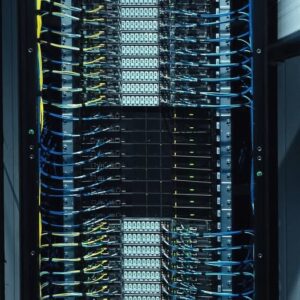
Dell’s AI Server Orders Just Jumped 757% (Image Credits Dell)
On May 29, 2026, Dell Technologies stock closed up about 32% — its biggest single-day gain ever. The reason: AI-optimized server revenue had just grown 757% year-over-year to $16.1 billion, and the AI hardware backlog stood at $51.3 billion. That backlog matters more than the quarterly pop. It tells you this isn’t a one-quarter spike — it’s at least a year of orders already in hand.
The 757% is real. But it’s also a little misleading if you read it as “everything Dell sells is on fire.” It isn’t. One very specific product family is doing nearly all the heavy lifting. Understanding which one — and why — explains both Dell’s stock pop and a quieter shift happening in the secondary market for the rest of Dell’s catalog.
The 757% is essentially one product: PowerEdge XE9712
Almost all of Dell’s incremental AI revenue right now flows through a single SKU family: the PowerEdge XE9712, sold as a fully integrated, liquid-cooled rack — the Dell Integrated Rack Scalable System (IRSS).
Inside the rack is NVIDIA’s reference design:
- GB200 NVL72 — 72 Blackwell GPUs plus 36 Grace Arm CPUs, lashed together by NVLink switch trays. More than 1 exaflop of dense AI compute and up to 40 TB of fast memory per rack (TweakTown coverage of the XE9712 launch).
- GB300 NVL72 — the Blackwell Ultra refresh. Dell shipped the industry’s first GB300 NVL72 to CoreWeave, with NVIDIA citing roughly 50× higher AI reasoning inference output and 5× throughput vs. the prior-generation Hopper (H100) architecture.
The GPUs, Grace CPUs, NVLink switches, and the NVL72 reference architecture are all NVIDIA. But NVIDIA doesn’t ship finished racks at volume. Dell does — rack integration, liquid cooling loops, power distribution, network fabric, factory burn-in, on-site install, iDRAC management, warranty. Supermicro and HPE build the same NVIDIA reference design under their own brands, which is why all three stocks moved together on Dell’s earnings day.
Who’s actually buying these racks
AWS, Google, Microsoft, and Meta are not the main buyers of Dell’s NVL72 racks. The hyperscalers design their own servers, often under the Open Compute Project standards Meta open-sourced. They have them built by pure ODMs like Foxconn, Quanta, Wistron, and Inventec. And they increasingly use their own AI silicon — Google TPU, AWS Trainium/Inferentia, Microsoft Maia, Meta MTIA — to sidestep NVIDIA where they can.
Dell’s AI customers come from three different buckets:
The first and largest is the neoclouds — CoreWeave, Nscale, Lambda, Crusoe, Nebius. These are GPU-focused cloud operators that need racks delivered, plumbed, and supported. They don’t have thousand-engineer hardware teams. CoreWeave alone is on track for tens of billions in 2026 capex, and its multi-year supply agreement with Dell is a major reason Dell’s backlog looks the way it does.
The second is enterprise on-prem AI — banks, pharma, automakers, defense, government. Workloads they can’t put in a public cloud for compliance, latency, or IP reasons. Dell packages this as the “Dell AI Factory.”
The third is sovereign AI and tier-two clouds — national programs in France, India, Saudi Arabia, and the UAE; universities; research consortia.
In practice, neoclouds are buying as fast as Dell can ship, and enterprise on-prem AI is catching up behind them.
The rest of the catalog: a quick PowerEdge tour
PowerEdge is Dell’s enterprise server brand. The full lineup is six product families, each pointed at a different workload — the 1U/2U rack server is just the most visible one.
PowerEdge R series — mainstream rack servers. The workhorses. R640, R740, R750, R760, R770 — 1U and 2U dual-socket Intel Xeon or AMD EPYC machines that run virtualization, databases, VDI, file/print, and most general-purpose enterprise workloads. If your data center has 200 Dell servers in it, 150 of them are probably R series. This is the bulk of what gets refreshed every four to six years and the bulk of what flows into the secondary market.
PowerEdge T series — tower servers. R-class internals in a tower chassis, for branch offices, small businesses, and any environment without a proper server room. T350, T550, T560. Often the first real server in a small company, or a quiet ML/dev box under someone’s desk.
PowerEdge C series — high-density compute. Multi-node 2U chassis (C6520, C6620) that pack four independent server nodes into one shared 2U enclosure. Built for web-scale, HPC, and rendering farms where rack density and power efficiency matter more than per-node flexibility. In some ways the C series was Dell’s pre-AI answer to “I need a lot of compute per rack U.”
PowerEdge XR series — rugged and edge. XR4000, XR5610, XR7620, XR8000. Short-depth chassis, extended temperature tolerance, sometimes MIL-STD-810 hardening — designed to sit in a cell tower hut, a retail back office, a factory floor, a military vehicle, or a 5G base station. Edge AI inference workloads live here.
PowerEdge MX series — modular / composable. The MX7000 chassis is Dell’s blade-server replacement, but the underlying idea — “kinetic infrastructure” — is that compute, storage, and fabric are independently swappable resources you compose on the fly. Targeted at private clouds that want fewer islands of hardware.
PowerEdge XE series — accelerated and AI. This is where the 757% lives. XE7100, XE7740, XE8640, XE9640, XE9680, and the XE9712. Built around dense GPU configurations and, increasingly, liquid cooling. The XE9680 was the workhorse 8-way H100/H200 system that filled most enterprise AI buildouts in 2024 and 2025. The XE9712 is the rack-scale Blackwell flagship driving the current numbers.
A practical way to read the lineup: R, T, C, XR, and MX are the existing data center. XE is the new wing being built next to it, and almost none of the existing wing migrates over — different chassis, different power, different cooling.
Why the AI boom also matters for non-AI servers
When a Fortune 500 IT org commits to a Dell AI Factory buildout, two things happen at the same time.
First, the AI buildout is incremental: new floor space, new power feeds, new liquid cooling loops. It doesn’t replace the existing R-series fleet.
Second, the general-purpose refresh cycle accelerates anyway. The same capital cycle that funds AI also funds the Windows Server 2016 → 2022/2025 refresh, the VMware-to-alternative migrations driven by Broadcom licensing changes, and the routine 5-year hardware swap on R640/R740/R750 fleets that hit end-of-life around now. Dell’s Client Solutions Group — laptops and desktops — also grew 17% this quarter on a Windows 11 and AI-PC refresh tailwind. That suggests the broader IT capex thaw is real, not just an AI line item.
The result is a noticeable bump in decommissioned R-series inventory hitting the secondary market in 2026 — exactly the gear that’s still useful for SMB virtualization, dev/test labs, MSPs, and emerging-market deployments. The headlines are about XE9712 racks; the quieter reality on the loading dock is pallets of R740xd and R750 being pulled out of production.
What an IT manager should take away
There are three practical reads from the 757% number.
Don’t expect XE9712 economics on old R-series fleet. AI racks and general-purpose racks live in different supply-and-demand worlds. A retired R740 is not a discounted XE9680.
The refresh window is real. R740 and R750 units with current-gen Xeon Scalable and DDR4/DDR5 are at their highest residual value right now. Every quarter you wait, depreciation compounds and the next generation pushes prices down a step. If you’ve been planning a refresh in 2026 or 2027, the financial case for moving sooner is stronger than it looks on paper, because the trade-in side is also stronger than usual.
Components often beat the whole box. Especially on older units, the DDR4/DDR5 memory, Xeon CPUs, and enterprise SSDs inside an R740 can be worth more than the chassis sold as a complete server, because component-level demand pulls from a wider buyer pool. The same logic applies to GPUs pulled from older XE chassis.
A practical closing thought.
The AI cycle isn’t going to lift the residual value of every PowerEdge in the rack — XE9712 economics don’t transfer to R-series gear. But the same capex cycle pulling new AI infrastructure in is also accelerating the retirement of perfectly serviceable R640, R740, and R750 units. Those units have their highest residual value right now, not later. Whichever ITAD path makes sense for the organization, the move worth making is to get a quote sooner rather than later — and to ask for a parted-out comparison alongside the whole-fleet number. The two often diverge more than people expect.
Whatever Dell does on its next earnings call, the servers already in the rack still have a number on them. The trick is reading that number while it’s still moving in the right direction.