
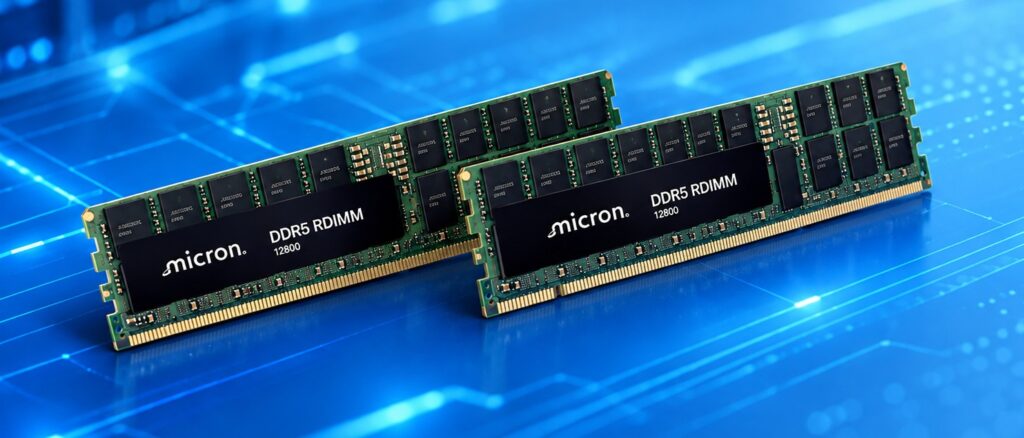
Micron has announced a “world first” 512GB DDR5 RDIMM rated at up to 9,200 MT/s in this week. Fill all 24 slots of a dual-socket server with it and the machine holds 12TB of memory. One module also draws 16.0W against 44.2W for four 128GB modules holding the same amount. Meanwhile, both AMD and Intel are validating it for their next server platforms, and Micron is aiming for volume production in the second half of 2027.
The same capacity has been done before. Samsung showed a 512GB DDR5 module back in March 2021, rated for DDR5-7200 and also built with stacked chips. Samsung’s never reached volume production, and Micron’s claim rests on demonstrating the module running on real server platforms. What Micron adds is a faster rating and a visible route into shipping servers.
| Item | Micron’s stated figure |
|---|---|
| Capacity | 512GB DDR5 RDIMM |
| Data rate | Up to 9,200 MT/s |
| Construction | Stacked DRAM dies joined by TSVs |
| System capacity | Up to 12TB, 24 slots, 2 sockets |
| Power | 16.0W per module |
| Production | Volume in 2H 2027 |
MT/s means millions of transfers per second. Micron has not announced a price.
How Micron fits 512GB on one stick
Micron stacks DRAM dies on top of each other and connects them with through-silicon vias (TSVs), which are tiny vertical wires running straight through the silicon. High-Bandwidth Memory (HBM) on GPUs uses the same basic idea of stacked dies joined by TSVs, though its interface and packaging are very different.
Stacking is critical because a motherboard’s slot count is fixed the day the board is designed. To add DRAM on the CPU’s own memory channels without changing the board, the gigabytes behind each slot have to go up. Capacity can also be added over Compute Express Link ( CXL ) technology on platforms that support it, but that memory sits further away than a DIMM in a slot.
What doubles and what doesn’t
A 24-slot server full of 256GB modules holds 6TB. Swap them for 512GB modules and it holds 12TB, same chassis and same slots. This changes where a workload has to go. An in-memory dataset of 8TB does not fit in the 6TB machine, so it gets split across two servers or pushed partly onto SSDs. In the 12TB machine it stays in one box. The same room helps an in-memory database keep more indexes hot, or lets a virtualization host run more VMs before it runs out of RAM.
Core counts make the extra memory easier to use up than it sounds. Take a dual-socket server with two 192-core processors. At 6TB, each core averages about 16GB. At 12TB it gets about 32GB. That is a rough average, not a Micron-tested setup, but it shows why the memory-per-core ratio keeps falling behind as CPUs gain cores.
Speed does not double along with capacity. Server processors talk to memory over channels. On a dual-socket platform with 12 channels per CPU, a 24-slot design puts one DIMM on each channel, which is the layout behind Micron’s 12TB figure. Other platforms populate two DIMMs per channel and have different slot counts.
A bigger module holds more data on the same channel. It does not add a channel. Total memory throughput still depends on how many channels are filled and what speed the processor and board will actually run, so the 9,200 MT/s figure is a ceiling. The speed a given server runs these modules at gets settled once validation is finished, and it may be lower.
Why a single module has to hold 512GB
Most AI hardware coverage is about GPUs, but agents in production put their weight on the CPU side of the server: retrieval indexes, databases, caches and the services around the model. Micron names CPU-side inference for large language models and agent workloads as demand drivers, next to in-memory databases and virtualization.
What makes that demand different is how it grows. The memory these services need scales with the number of sessions running at once, not with the size of the model. A characterization of ten agentic applications measured sandbox working sets peaking at 28GB per session. A hundred concurrent sessions is 2.8TB, before the indexes, caches and databases on the same machine.
The slot count does not grow with the traffic. A dual-socket server has 24 slots, and a machine under that kind of load has them full, so the only way to raise local memory is to put more gigabytes behind each slot. That is what stacking dies with TSVs buys.
Capacity can also come over CXL, and that memory answers more slowly: roughly 115 nanoseconds for local DDR5 against 230 to 270 for a CXL expander. A denser DIMM keeps the extra capacity on the CPU’s own channels at DIMM latency, which is the argument for putting 512GB on one stick.
Reading the power and benchmark numbers
The power figure checks out. 16.0W is about 64% less than 44.2W, which matches Micron’s “more than 60%” claim. It compares modules at equal capacity, not two servers configured the same way. Dropping from four modules to one also gives up the channels those four sat on, and with them some memory throughput. The comparison a buyer needs is a full server on twenty-four 256GB modules against the same server on twenty-four 512GB modules, and Micron’s announcement does not include it.
Micron also reports up to 1.4 times the throughput on a Spark support vector machine job compared with 256GB DDR5 configurations and says RocksDB and Redis benefit too. The announcement leaves out the test setup, so there is no way to tell how much came from the extra capacity and how much from the faster rating. Read it as evidence that a memory-bound workload improved on Micron’s configuration. It says little about workloads that already fit in RAM.
Who should wait for these
The clear candidates are servers already out of memory: large in-memory databases, big caches, dense virtualization hosts, analytics clusters, and inference services with large retrieval sets. For them, 12TB in one box can mean fewer servers, fewer network ports and fewer per-socket software licenses.
A workload that already fits in 128GB or 256GB modules gains nothing from 512GB except headroom it will not use. With no price announced and production more than a year out, there is not much to plan around yet either.
Upgrades that do go denser can leave working 128GB and 256GB DDR5 RDIMMs spare. Whether those modules go back into another machine depends on the platform they came from, but there is an active market, and operators can sell used server memory instead of leaving them in a storage room.