
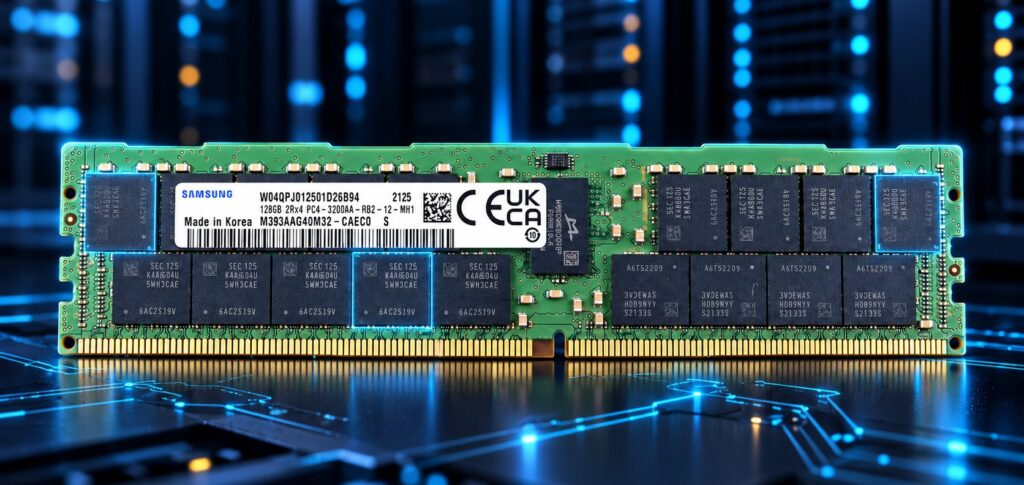
As AI data centers expand rapidly, demand for server memory is straining supply, and high-capacity modules can carry steep price tags. For example, Memory Clearance listed a refurbished Samsung 128GB DDR5-4800 (PC5-38400) server RAM at $5,380.65 and a new Samsung 128GB DDR4-3200 (PC4-25600) module at $2,791.80 (October 8 price). These are asking prices for those specific parts. For the latest memory-pricing trends and market figures, see the RAM Market Update for October.
That raises a practical question: when a single server RAM module costs several thousand dollars, is a failed one worth repairing? At ResolderWorks, a South Korean DIMM repair lab, the published reference prices of $14 for diagnosis plus $63 for DRAM-replacement labor add up to $77 before parts and shipping. Comparing $77 with a $5,380 replacement makes professional diagnosis worth considering for an isolated fault, before deciding whether to pay for the repair.
Establishing what actually failed
For removable DDR4/DDR5 server DIMMs, start by confirming the module type and part number and saving memory-event logs. PassMark explains that memory testing also exercises the CPU, caches, and motherboard. A failed test can therefore also point to the CPU or motherboard. Incompatible configurations can cause errors; reseating sometimes clears errors caused by dirty contacts.
Follow the server’s event-specific service instructions before moving modules. Dell’s 14th-generation DDR4 PowerEdge guidance says to leave a DIMM in place when its reported event calls for row repair on the next reboot. Let that process run before moving the module, unless Dell support directs otherwise. When the vendor recommends a controlled swap, it can show whether an error follows the module or stays with its slot or channel.
Faults and their possible remedies
A DIMM contains DRAM chips, solder joints, a printed circuit board (PCB), and supporting electronics. Repairing a connection is a different job from replacing defective silicon.
| Fault or symptom | Possible remedy | Important limit |
|---|---|---|
| Poor contact or incompatible configuration | Vendor-directed reseating or configuration correction | There may be no defective hardware to repair. |
| Transient bit error | Error-correcting code (ECC) corrects supported data errors | ECC does not fix a persistent hardware fault. |
| Persistent, localized DRAM row fault | Supported post-package repair substitutes a spare row | Requires platform support and spare resources. |
| Failed solder connection | Joint rework or reballing | Fresh solder cannot repair defective silicon. |
| Failed DRAM chip | Replace the chip | A suitable replacement chip is required. |
| Failed supporting component | Component replacement or configuration recovery | The affected component or configuration data must be isolated. |
| Deep PCB damage or extensive corrosion | Case-specific board repair or retirement | Buried layers may be inaccessible; widespread damage may be uneconomic. |
Supporting components can fail while memory cells remain intact. As Rambus explains, DDR5’s power-management IC (PMIC) regulates power; serial presence detect (SPD) stores identification and configuration information; the registering clock driver (RCD) buffers clock and command/address signals on registered DIMMs.
Reballing replaces the solder balls connecting a chip to the board. Buried PCB traces can make recovery impractical even when the damage is identifiable.
Built-in row repair
ECC corrects supported errors in data as it is read. A transient error need not mean a permanently damaged cell. Post-package repair (PPR) handles some persistent defects by substituting a spare DRAM row.
Intel documents permanent DDR4 hard PPR for production use on specified platforms; Cisco describes DDR5 repair features on its M7/M8 servers. PPR has finite spare resources and addresses row faults. A failed power regulator, broken board, or broadly defective chip needs another remedy.
Repair costs and service options
Start with the server vendor or original supplier for warranty service, supported recovery, or return merchandise authorization (RMA). Micron’s instructions send authorized-distributor customers to their seller; customers who purchased directly contact their Micron sales representative. This route may provide a replacement rather than repair the original module.
For component work, ResolderWorks in South Korea publishes reference prices of $14 for diagnosis, $63 labor for DRAM/RCD replacement, $38 for PMIC/SPD replacement, and $15 for reflow. Final quotes follow diagnosis; parts and international shipping are extra. Confirm support for the exact module and send its part number, server model, logs, and damage photos.
The provider advertises about one week for simple repairs and up to four for complex work requiring special parts. Its self-reported 72% success rate has no defined case mix or success criterion. Its 90-day warranty covers the specific repair, excluding unrelated faults. Under its full-diagnosis service, an unsuccessful repair incurs the diagnosis fee but no labor or parts charges; customer-specified repairs follow different terms.
The $77 diagnosis-and-labor sum is also small beside the $2,791.80 DDR4 asking price. Before shipping, request an all-in quote and testing details. Compare the total with a compatible replacement, including tested used memory. A production database may need immediate replacement while a spare or lab module can wait. If another failure would interrupt an essential service, that risk can outweigh the savings.
Testing and disposition
A repaired 128GB module showing its full capacity at boot means the server can see it. Run multiple memory-test passes in the intended server at supported speed, then try representative workloads. Check repeated boots and review ECC logs for recurring errors. Keep the lab’s diagnosis, repair report, and test results together.
For retired equipment, compare repair spending with the value of selling reusable RAM and request a server RAM quote before authorizing work. Separate working modules from failed units. Identify repaired modules explicitly and attach repair and test reports so the buyer can assess their condition.