
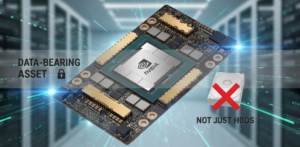
Does GPU VRAM Pose a Security Risk? What Enterprises Need to Know Before SellingIn the rapidly evolving landscape of AI infrastructure, the lifecycle management of High-Performance Computing (HPC) assets has moved from the basement to the boardroom. For the modern CTO, decommissioning a cluster of NVIDIA H100s or A100s is no longer a simple logistics task; it is a high-stakes compliance event. While most enterprise security protocols are laser-focused on hard drives and solid-state media, a dangerous blind spot has emerged: the Graphics Processing Unit (GPU).
As you look to sell GPUs in bulk securely, understanding the intersection of silicon architecture and regulatory mandate is the difference between a successful asset recovery and a catastrophic data breach.
The Myth of the “Stateless” GPU
For years, the prevailing wisdom in IT Asset Disposition (ITAD) was that GPUs were “stateless” devices—volatile components that lost all data the moment power was cut. In the era of modern AI, this is a dangerous oversimplification. Unlike consumer-grade cards, enterprise GPUs are complex systems-on-a-chip with their own firmware, telemetry logs, and sophisticated memory management layers.
The risk of data center decommissioning compliance failure begins with the hardware’s architecture. Recent research has debunked the idea that GPU memory is a “clean slate” upon process termination. The discovery of the “LeftoverLocals” vulnerability (CVE-2023-4969) proved that uninitialized GPU local memory could leak significant amounts of data—up to 181 MB per LLM query—across user boundaries [Source: Trail of Bits]. While this vulnerability is often discussed in the context of active multi-tenant environments, it highlights a fundamental truth: GPUs retain artifacts of the workloads they process.
-
Residual VRAM Artifacts: Bits of machine learning models, weights, and even sensitive training data can persist in memory buffers if not explicitly cleared by a sanitization kernel [Source: AI Journal].
-
Persistent Configuration: Modern enterprise GPUs store persistent telemetry and configuration data in their BIOS and onboard flash memory [Source: NVIDIA DGX A100 Guide].
-
Firmware Vulnerabilities: Malicious actors can theoretically “brick” or compromise a GPU by flashing specialized, persistent firmware that survives a standard system reboot [Source: AMD Security Bulletin].
Why “Clear” is Not “Sanitized”
When liquidating assets, many organizations fall into the trap of “Clearing” rather than “Purging.” According to NIST Special Publication 800-88 Revision 1, “Clearing” is a level of sanitization that protects against simple non-invasive data recovery techniques. However, for high-value AI assets that have processed proprietary IP or PII (Personally Identifiable Information), NIST recommends a more rigorous “Purge” or “Destroy” approach.
A professional liquidation partner doesn’t just pull the cards from the rack. They execute a multi-layered sanitization protocol that mirrors the security demands of the data center. This includes:
-
Memory Sanitization Kernels: Running specialized CUDA or OpenCL scripts that overwrite the entire VRAM space with random patterns to eliminate any possibility of data remanence [Source: Massed Compute FAQ].
-
Firmware Re-Imaging: Flashing the GPU BIOS back to factory-signed defaults to remove custom undervolting profiles, overclocking settings, or potential persistent malware [Source: NVIDIA Security].
-
Cryptographic Erasure: For newer generations that support it, utilizing the hardware’s internal encryption keys to render any residual data instantly unreadable [Source: Blancco NIST Guide].
The Regulatory Hammer: GDPR, HIPAA, and the $60M Lesson
Risk-averse CTOs know that the cost of a breach far outweighs the value of the hardware. Regulatory bodies like the FTC and European DPAs no longer differentiate between a hard drive and a “smart” component like an AI accelerator. A failure to document the sanitization of a GPU cluster can be viewed as a violation of the “Security by Design” and “Right to Erasure” principles.
The stakes are real. In recent years, companies have faced fines as high as $60 million for failing to properly manage the decommissioning of data-bearing assets through uncertified vendors. If your GPUs were used to train models on healthcare data (HIPAA) or financial records (PCI DSS), the “chain of custody” must be unbroken from the moment the rack is unlocked to the moment the Certificate of Sanitization is issued.
Secure ITAD for GPUs: Identifying a Professional Partner
When evaluating a partner for GPU liquidation, you must look for certifications that go beyond basic electronics recycling. A “parts flipper” will offer you a high price but zero protection. A professional ITAD provider offers a defensible audit trail.
-
R2v3 Certification: This is the gold standard for responsible recycling. It requires the vendor to demonstrate a rigorous “downstream” due diligence process, ensuring that if a GPU is eventually scrapped, it doesn’t end up in an unregulated landfill.
-
NAID AAA Certification: This proves the vendor has undergone unannounced audits to verify their data destruction and sanitization processes are physically and logically secure.
-
Serial-Level Tracking: Every GPU should be scanned and tracked by its unique serial number, with a corresponding report showing exactly when and how it was sanitized.
The Financial Upside of Professionalism
Beyond risk mitigation, there is a significant financial argument for choosing a high-end B2B professional over a generic liquidator. High-performance GPUs like the NVIDIA A100/H100 or the AMD Instinct series maintain incredible resale value. However, that value is only realized if the cards are handled with care.
Improper de-installation—such as static discharge from improper handling or physical damage to the delicate PCIe connectors—can turn a $20,000 asset into a paperweight. A partner who understands the hardware doesn’t just protect your data; they protect the physical integrity of the asset, ensuring you receive the maximum recovery value. Furthermore, a GPU with a “Certificate of Sanitization” and verified factory firmware is more attractive to secondary market buyers, as it removes the burden of security verification from them [Source: AI Journal].
Your Reputation is the Ultimate Asset
In the AI era, hardware is the new software. The GPUs in your data center have processed the “crown jewels” of your organization—your intellectual property, your customer data, and your competitive advantages. Treating their retirement as a trivial matter is a gamble with your brand’s reputation.
By insisting on secure ITAD for GPUs and adhering to NIST-compliant disposal, you aren’t just checking a box for the auditors. You are demonstrating a maturity of leadership that understands that security doesn’t end when the “Off” switch is flipped.
Ready to upgrade your infrastructure without the compliance headache? We specialize in high-recovery, security-first liquidations that protect your brand and your bottom line. Sell GPUs in bulk securely with our NIST-compliant decommissioning team and receive a comprehensive audit trail for every asset.
Related pages:
10 Best Places to sell GPU for cash for the Most Returns – BuySellRam
Sell GPUs in Bulk – Get Cash for Graphics Cards | BuySellRam