
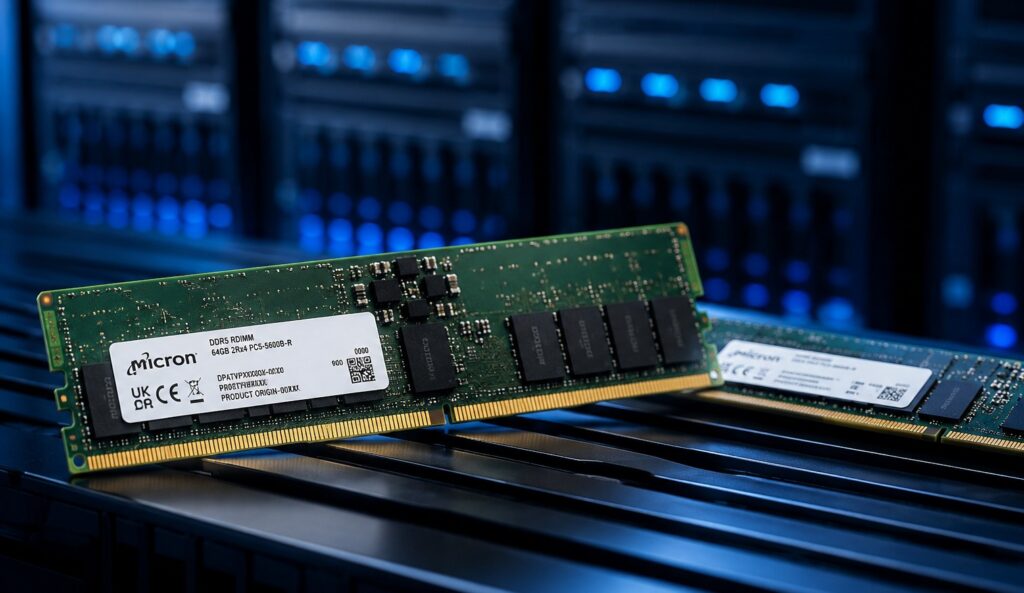
DRAM Market Update: supply stays tight as Micron can’t keep up and SK Hynix shifts to DDR5
Micron just turned in the memory market’s headline quarter. In its fiscal third quarter, reported after the close on June 24, revenue reached a record ~$41.5 billion on a record gross margin near 85%, with DRAM alone accounting for about $31.3 billion, roughly three-quarters of the total. Both figures are company records, and both sit well above a year ago.
The growth came almost entirely from pricing, not volume. DRAM average selling prices jumped into the low-60% range from the prior quarter while bit shipments rose only low single digits. That gap is the point. Prices are climbing because there aren’t enough bits to ship, and CEO Sanjay Mehrotra said on the call that Micron can fill only about half to two-thirds of customer demand in the medium term, with tight conditions past calendar 2027. The shortage is the story.
Micron isn’t alone. SK Hynix is redirecting wafer capacity toward DDR5, chasing the tightest demand rather than easing the broader shortage, even as it keeps advancing its HBM roadmap. Samsung, the volume leader, has made no fresh move this week, but its capacity is effectively sold out too. Three makers, one direction.
Together they point to a shortage that won’t clear quickly. So why can’t three makers running flat out just add capacity and catch up? Part of it they can’t fix fast. Part of it they’re in no rush to. Three forces, all on the supply side, keep conventional DRAM short.
HBM is throttling bit-supply growth
Even the capacity the makers already run produces fewer usable bits than it once did. High-bandwidth memory (HBM), the stacked memory that feeds AI accelerators, is silicon-hungry. It takes roughly three times the wafer area per gigabit of DDR5, and closer to four times for HBM4.
As HBM’s share of DRAM wafers climbs, total bit output sags. Industry forecasts put 2026 DRAM bit-supply growth at only around 16%, well below the historical 20–30% range, even with fabs running hard. And HBM stays the priority for the capacity the makers do run, so conventional DRAM keeps getting whatever’s left. More wafers spinning, fewer bits of conventional memory coming off them. It’s the same squeeze behind the broader 2026 shortage pushing up RAM and SSD prices.
Greenfield capacity arrives after the shortage, not during it
The textbook fix for short supply is to build, and the makers are building. New fabs just don’t help in the window that matters.
Micron’s first new U.S. plant, in Idaho, isn’t expected to start wafer output until the second half of 2027, and its New York fabs land around 2029 to 2030. A memory fab runs well over two years from groundbreaking to real volume, and the advanced lines for AI-grade memory take longer still. Whatever relief that capacity brings arrives after this shortage, not during it.
What gets made is already pre-sold
The supply that does exist is increasingly committed before it ships. The Micron–Anthropic agreement is the clearest case: a multi-year commitment across HBM, DRAM, and SSDs, paired with joint work on memory design. And it isn’t a one-off. All three big memory makers are now supply partners in the same AI buildout. These are long-term allocations that pull volume off the open market for years at a time.
Where this likely heads
Micron itself put tight conditions past calendar 2027, with supply improving only gradually in 2028. None of the three makers has signaled a fast expansion of conventional DRAM, and the wafer math doesn’t allow one as long as HBM keeps soaking up capacity.
Memory is still a cyclical business, and tight markets do eventually loosen. The turn tends to come fast, usually once new capacity finally lands or AI demand for HBM cools. The signal to watch is HBM allocation. When the makers stop steering wafers toward HBM, conventional bit growth recovers and used pricing softens with it. A running DRAM and HBM market trend monitor tracks those shifts as they land.
Why pulled server memory is now real supply
Put it together. HBM is eating the bit growth, new fabs are years out, and much of what’s produced is pre-sold to hyperscalers. For a mid-size data center, a reseller, an integrator, or an IT team running a refresh, the new-supply line is short and increasingly reserved for someone else.
That pushes real demand into the secondary market. The DDR4 and DDR5 already installed in servers being retired today doesn’t wait for a 2027 fab, and it isn’t locked behind a multi-year contract. It’s available now. In a market like this, pulled enterprise memory carries real value: for a lot of buyers, it’s one of the few sources of conventional DRAM they can actually get hold of.
What that means for the memory in retired racks, concretely:
- DDR5 RDIMMs lead the way: they command more than DDR4, and high-density modules (64GB, 128GB) more than 16–32GB sticks.
- Server ECC / registered memory holds value best: the buyers are enterprises and integrators, not hobbyists.
- Matched lots beat loose singles: uniform pulls from one fleet move faster than a mixed bag.
- Timing favors selling sooner: resale prices track the shortage, so the edge is strongest while supply stays tight.
The practical read
Prices are high because supply is structurally short, not because of a passing spike, and that won’t unwind quickly. For organizations retiring servers, pulled memory is sellable inventory at a genuine peak rather than a box to shelve and forget.
BuySellRam pays for pulled server and desktop RAM, DDR4 and DDR5, registered and unbuffered, and handles the data-bearing side of a decommission properly. For teams weighing the options first, where to sell used computer RAM walks through it. Server pulls (ECC, RDIMM, LRDIMM) can be quoted on the sell server RAM page; desktop and laptop modules on the sell memory RAM page.
Market conditions and pricing change quickly. Figures cited reflect reporting as of late June 2026; check the linked sources for the latest.