
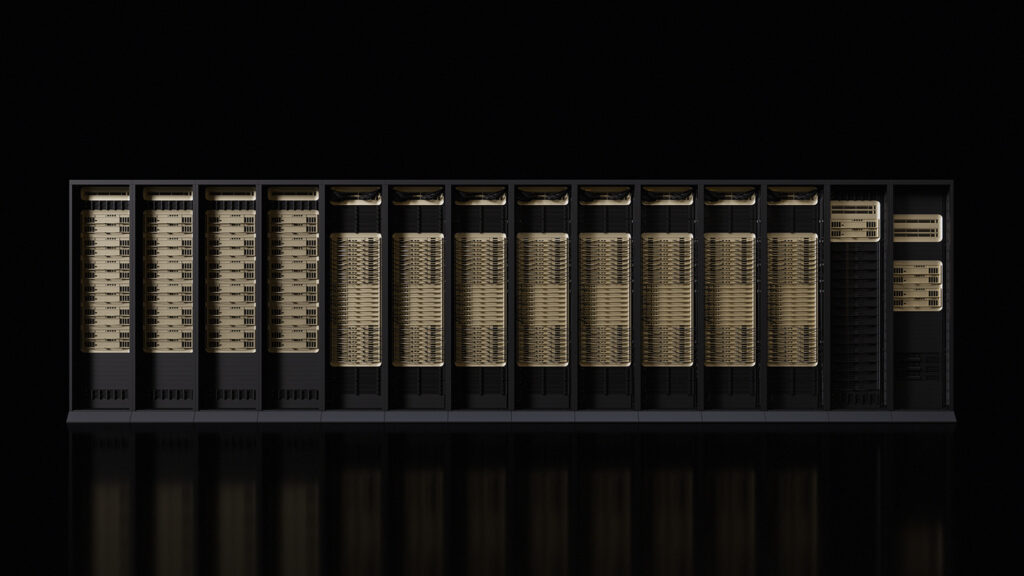
NVIDIA Rubin Platform (Image Credit: NVIDIA)
The GTC 2026 keynote in San Jose marked a fundamental pivot in the history of computing. Jensen Huang didn’t just announce a faster GPU; he announced the end of the “Chatbot” phase of artificial intelligence and the official commencement of the Agentic AI Era.
For the last three years, the industry’s focus was singular: Training. Success was measured in H100 clusters, exaflops, and the ability to pour massive datasets into increasingly large models. But as the “Rubin” architecture (R100) enters full production, the metric of dominance has shifted. We are now in the Inference Era, where the value of a system is measured by its “reasoning loops,” its ability to call tools autonomously, and its capacity to manage massive, persistent context memory.
To understand why the Rubin platform is fundamentally different from the Blackwell or Hopper architectures that preceded it, we must first understand the unique hardware demands of an AI Agent.
Part I: What is Agentic AI? (Moving from System 1 to System 2)
In cognitive psychology, “System 1” thinking is fast, instinctive, and emotional, while “System 2” is slower, more deliberative, and logical. Most LLMs to date have acted as System 1 engines—predicting the next token based on pattern recognition.
An AI Agent, however, operates in System 2. It doesn’t just “talk”; it plans, acts, and validates. If you ask an agent to “research a competitor’s patent filing and draft a summary,” the agent must:
-
Plan: Break the task into sub-tasks.
-
Act: Open a browser, navigate to a database, and run a Python script to parse the data.
-
Reason: Analyze the results against the original goal.
-
Correct: Re-run searches if the initial data is insufficient.
This “loop” is the core of Agentic AI. For hardware, this creates a massive bottleneck. Standard GPUs are designed for massive parallel throughput—perfect for training a model. But an agent constantly hitting a “thinking loop” requires extreme low-latency inference, rapid memory access for tool-calling, and high single-thread CPU performance to orchestrate the software environment (the “sandbox”) where the agent lives.
Part II: The Rubin Architecture — Built for the Reasoning Loop
NVIDIA’s Rubin platform is the first “full-stack” response to these agentic requirements. While previous generations were “GPU-first,” Rubin is “System-first,” comprising six interconnected chips designed to function as a singular, deterministic AI supercomputer.
1. The R100 GPU: Breaking the “Reticle Wall”
The heart of the platform is the Rubin R100 GPU. Built on TSMC’s 3nm N3P process, it contains a staggering 336 billion transistors. However, the transistor count is secondary to the breakthrough in memory architecture.
For an AI agent to perform complex reasoning, it must maintain a massive context window. If the agent “forgets” the beginning of a document while drafting a summary of the end, the reasoning loop breaks. The R100 solves this with the debut of HBM4 (High Bandwidth Memory 4).
-
Memory Bandwidth: The R100 delivers 22 TB/s of memory bandwidth, a nearly 3x increase over the Blackwell generation (8 TB/s).
-
Inference Performance: It reaches 50 PFLOPS of FP4 inference, making it 5x faster than Blackwell.
-
The Memory Wall: By providing 288GB of HBM4 per GPU, NVIDIA has effectively ended the “Memory Wall” for trillion-parameter models, allowing them to run entirely within a single NVL72 rack without the latency of multi-node distribution.
2. The Vera CPU: The Orchestrator of the Sandbox
Perhaps the most significant architectural change in 2026 is the role of the CPU. In the Hopper and Blackwell eras, the CPU was a “host”—feeding data to the GPU. In the Rubin era, the CPU is the Orchestrator.
Agents run code. They execute SQL queries. They perform “sandboxing” to ensure their autonomous actions are safe. These are sequential, logic-heavy tasks that GPUs cannot handle. The NVIDIA Vera CPU features 88 custom “Olympus” cores designed to bridge this gap.
Spatial Multithreading (SMT)
Traditional CPUs use “time-sliced” multithreading, where threads take turns using core resources. Under heavy load, this creates “jitter” (latency spikes) that can kill an agent’s reasoning loop. Vera introduces Spatial Multithreading, which physically partitions the core’s resources. This ensures:
-
Deterministic Performance: Each agent environment (sandbox) gets a dedicated, isolated resource block.
-
1.2 TB/s Memory Bandwidth: Vera delivers 3x the per-core bandwidth of traditional data center CPUs, ensuring that data-heavy tasks like ETL and real-time analytics don’t stall.
-
50% Faster Throughput: Compared to traditional x86 or standard Arm-based CPUs, Vera is 50% faster at running agentic environments and twice as energy-efficient.
3.The “Inference Factory” — Integrating Groq LPUs and BlueField-4
At GTC 2026, NVIDIA confirmed a strategic partnership that many in the industry didn’t see coming: the integration of Groq 3 LPUs into the Rubin rack-scale systems. According to reports from CRN, this heterogeneous approach is designed to solve the “Decode Bottleneck.”
Groq 3 LPU: The Latency Specialist
While GPUs excel at the “prefill” phase (understanding a large prompt), they can struggle with the “decode” phase (generating the actual words/tokens) at extreme speeds.
-
SRAM vs. HBM: The Groq 3 LPU uses SRAM, providing a mind-bending 150 TB/s of bandwidth—7x faster than even HBM4.
-
The “LPX” Rack: A specialized rack containing 256 Groq LPUs can be paired with the Rubin NVL72. Together, they can boost the throughput of a 1-trillion parameter model by 35x compared to a Blackwell-only system.
BlueField-4 DPU: The Agent’s Long-Term Memory
The BlueField-4 DPU has evolved into the “Infrastructure OS” of the AI factory. Its primary new feature is Inference Context Memory Storage (ICMS). In the Agentic Era, agents must “remember” conversations and context over days or weeks. BlueField-4 offloads this “KV Cache” management from the GPU to a dedicated storage tier at the rack level. This allows agents to resume complex tasks instantly without re-reading the entire history, saving massive amounts of compute and power.
4. Rack-Scale Engineering — The NVL72 and NVLink 6
NVIDIA is no longer selling individual chips; they are selling logical supercomputers. The Vera Rubin NVL72 rack integrates 72 Rubin GPUs and 36 Vera CPUs into a single liquid-cooled fabric.
-
NVLink 6: This sixth-generation interconnect provides 3.6 TB/s of all-to-all bandwidth per GPU.
-
A Single GPU: Through NVLink 6, the entire rack behaves as a single logical GPU with 20.7 TB of HBM4 memory.
-
ConnectX-9 SuperNIC: For scaling out to massive AI factories, the ConnectX-9 provides 1.6 Tb/s of networking throughput per GPU, feeding into Spectrum-6 Ethernet switches that use silicon photonics to reduce power consumption by 5x.
Part III: The Transition to the Inference Factory
We are witnessing a shift in the unit of value for data centers. In 2024 and 2025, the goal was TFLOPS for training. In 2026, the goal is Tokens-per-Second-per-Watt for inference.
Why Inference Efficiency is the New ROI
NVIDIA claims that the Rubin platform delivers a 10x reduction in inference cost per token compared to Blackwell. In a world where companies like Salesforce, Microsoft, and Meta are deploying autonomous agents to millions of users, the cost of “thinking” becomes the primary line item on the balance sheet.
The Rubin platform achieves this efficiency through two new technologies:
-
NVFP4 (4-bit Floating Point): A new numerical format that allows for 50 PFLOPS of inference on a single R100 GPU. This allows models to run at higher precision than older 8-bit formats while consuming half the memory and power.
-
CMX (Context Memory Storage): For the first time, NVIDIA has introduced a dedicated storage tier for KV Cache (the “memory” of an active AI conversation). By offloading this memory to BlueField-4 DPUs and specialized storage racks, Rubin allows agents to maintain “persistence”—they can “remember” a conversation from three weeks ago and resume it instantly without re-processing the entire history.
Part IV: The Hardware Lifecycle and the Secondary Market Ripple
For IT managers and infrastructure leads, the arrival of Rubin creates a strategic dilemma. The annual release cadence (Hopper → Blackwell → Rubin → Feynman) has compressed the hardware lifecycle from 5 years down to 18–24 months.
The “Legacy” Status of Hopper and Blackwell
The performance delta is now so great that a single Rubin NVL72 rack can outperform four Blackwell-based racks in agentic workloads. This doesn’t mean that H100 and H200 (Hopper) or B100/B200 (Blackwell) units are obsolete—it means their role is changing.
-
Tier 1 (Frontline Reasoning): Occupied by Vera Rubin. These are the “Inference Factories” running real-time, high-value autonomous agents.
-
Tier 2 (Domain-Specific Training & Fine-Tuning): Occupied by Blackwell. These systems remain the workhorses for companies training their own proprietary models on private data.
-
Tier 3 (Commodity Inference & Research): Occupied by Hopper. The H100 and H200 remain excellent for high-throughput, non-agentic tasks like batch processing, video transcoding, and standard chatbot deployments.
Strategic Asset Rotation
As hyperscalers rush to secure Rubin allocations for H2 2026, we are seeing a “liquidation wave” of earlier-generation hardware. Forward-thinking data center managers are using this as an opportunity. By divesting from Hopper clusters now, while secondary market demand remains high from mid-market enterprises and sovereign AI initiatives, organizations can generate the liquidity needed to fund their Rubin transition.
This rotation is no longer a sign of failure or “decommissioning”; it is a tactical move in the “Inference Arms Race.” Managing the hardware lifecycle is now as critical a skill for a CTO as choosing the right model architecture.
Conclusion: The Rubin Mandate
The Vera Rubin platform is the most complex machine ever built by human beings. It integrates 3nm silicon, HBM4 memory, custom ARM-based CPUs, and photonics-ready networking into a single fabric.
For the reader, the takeaway is clear: the AI boom is not a bubble; it is a transition to a new type of compute. Whether you are building an agentic swarm or managing the hardware assets of a Fortune 500 data center, the Rubin era demands a new perspective. We are no longer just “stacking GPUs.” We are building the brains of the next industrial revolution.
Technical Comparison: The Generational Leap (2024–2026)
| Metric | Hopper (H100/H200) | Blackwell (B200) | Vera Rubin (R100) |
| Primary Workload | LLM Training | Trillion-Param Training | Agentic Inference |
| GPU Architecture | Hopper | Blackwell | Rubin |
| Memory Tech | HBM3 / HBM3e | HBM3e | HBM4 |
| Memory Bandwidth | 3.3 – 4.8 TB/s | 8.0 TB/s | 22.0 TB/s |
| Inference Precision | FP8 | FP8 / FP4 | NVFP4 |
| Interconnect | NVLink 4 | NVLink 5 | NVLink 6 |
| Host CPU | x86 / Grace | Grace | Vera (Olympus) |
| Low-Latency Support | N/A | N/A | Groq 3 LPX |
| Cost per Token | Baseline | 0.2x Baseline | 0.1x Baseline |
To maximize the ROI on your infrastructure and navigate the Rubin transition, visit our GPU Buyback service and Sell CPU in bulk service for up-to-the-minute valuations on Hopper and Blackwell clusters.
Related Posts:
NVIDIA’s Vera Rubin — The Beginning of AI as Infrastructure – BuySellRam
NVIDIA GPU Cluster Liquidation: Maximize ROI and Asset Recovery – BuySellRam
NVIDIA Next-Gen Feynman: Beyond Training, Toward Inference Sovereignty – BuySellRam
The Rise of High Bandwidth Memory (HBM): Revolutionizing GPU Performance – BuySellRam
10 Best Places to sell GPU for cash for the Most Returns – BuySellRam
NVIDIA GPU Cluster Liquidation: Maximize ROI and Asset Recovery – BuySellRam