
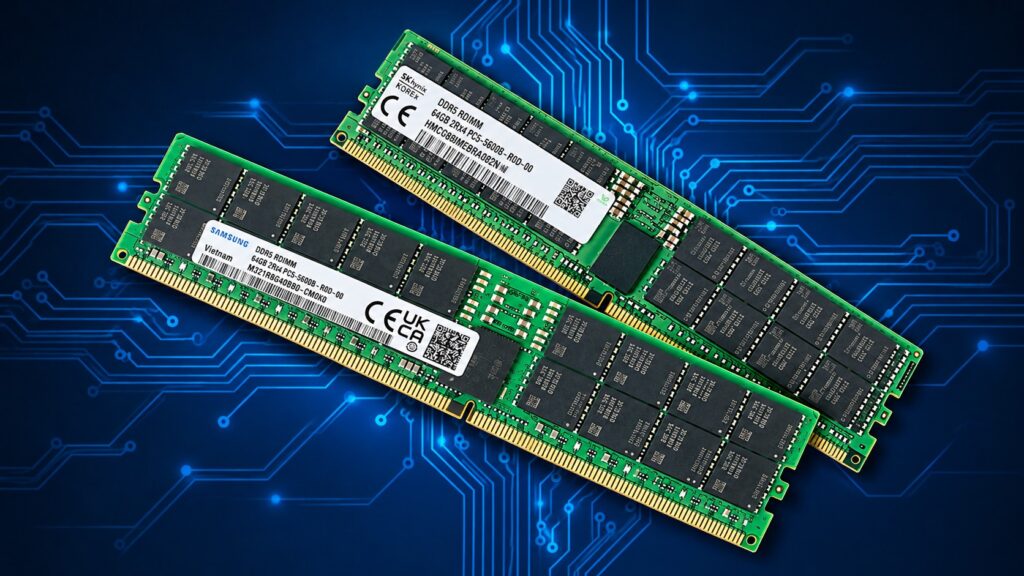
Samsung and Hynix DDR5 RAM Modules.
TL;DR: Samsung and SK hynix both posted record third quarters, with SK hynix earning an 80% operating margin. This article looks at what the Q3 2026 results of Samsung and SK hynix show about where AI memory is heading. The clearest difference is HBM4: Samsung makes the logic chip at the base of each stack itself, while SK hynix has TSMC make it. Less obvious is how far ordinary server memory has caught up. By TrendForce’s estimate, 64GB DDR5 RDIMMs now earn more per wafer than HBM, and both companies treat enterprise SSDs as AI memory, so the shortage now reaches ordinary data centers.
Samsung Electronics reported operating profit of about $80 billion for the third quarter of 2026, and more than 99% of it came from its chip division. A day earlier, SK hynix reported operating profit of $62.8 billion, an operating margin of 80% on a business that sells almost nothing but memory.
Both are winning from AI demand, but their earnings calls show them building AI memory in different ways. Samsung makes more of the parts itself, while SK hynix buys a key HBM chip from TSMC and talked more about software that decides where AI data should live. Where they agree is supply. Samsung said it expects tight supply conditions to continue in 2028, and SK hynix said the shortage is projected to continue through 2030.
Two record quarters, side by side
Third-quarter changes are against the second quarter and the fourth-quarter outlook against the third, as each company gave them. Average selling prices also move with product mix. Dollar figures use about 1,326 to 1,335 won per dollar, the rates in coverage of the results.
| Samsung | SK hynix | |
|---|---|---|
| Operating profit, Q3 2026 | About $80 billion, of which about $79.8 billion from chips | $62.8 billion, an 80% margin |
| DRAM average selling price, Q3 vs Q2 | Up about 20% | Up in the high 20s % |
| NAND average selling price, Q3 vs Q2 | Up in the high teens % | Up in the mid 20s % |
| Q4 DRAM shipments vs Q3, by capacity | Up mid-to-high teens % | Up mid-20s % |
| Who makes the HBM4 base die | Samsung, on its own 4nm process | TSMC |
| Multi-year supply contracts | 10 signed, 10 more in talks | 14 customers, over half of 2027–28 capacity |
| Supply outlook | Tight in 2028 | Short through 2030 |
HBM4: in-house base die or TSMC
HBM is the stacked memory beside an AI GPU, and HBM4, now shipping in volume, replaces HBM3E. HBM and server DRAM come from the same wafers, so how each company builds HBM affects how much capacity is left for server memory. At the bottom of each stack sits a base die, the logic chip that links the memory layers to the GPU. HBM4’s base die needs a modern logic process, and the two companies chose opposite ways to get one.
Samsung makes it on its own 4nm logic process, the same line that serves outside foundry customers, so HBM4 now competes for Samsung’s 4nm capacity. Its foundry head claimed “industry-leading base die yields” on the Q3 call, “although we are still early in mass production.” HBM4 sales more than tripled from the second quarter to 60% of Samsung’s HBM sales, and Samsung says its HBM market share now matches its overall DRAM share. It sampled HBM4E, the faster follow-on, in early May and targets mass production in the first half of 2027.
SK hynix has TSMC make its base die under a 2024 agreement, reportedly on a 12nm-class process. An August report said those dies could cost three to four times as much as SK hynix’s own memory dies; SK hynix said only that “some of the reports are not true.” Its HBM4 shipments began in earnest in the third quarter with yields above plan and should overtake HBM3E in the fourth. Its HBM4E samples went out in the second quarter.
The most revealing part of SK hynix’s call was about stack height. Some customers are moving from 12-high HBM4, with 12 memory chips per stack, to 8-high HBM4E. SK hynix called this a response to the shortage. Customers want “more than double” what it can supply, shorter stacks yield more finished stacks from the same memory, and denser HBM4E chips recover much of the lost capacity. The extra stacks need more base dies and back-end testing, which SK hynix says it has planned for. AMD’s upcoming MI400 accelerator was reported in June to come in 8-high and 12-high versions, also tied to available supply. Neither SK hynix nor that report mentioned heat.
The two companies are closer than their messaging suggests. Both sampled HBM4E in the second quarter, both sell enterprise SSDs into the same AI storage tier, and both write software to move AI data between memory tiers. The base die is the real difference. Samsung controls cost and schedule across the stack but must make a new 4nm chip yield well at scale. SK hynix shares that work with the world’s largest foundry but pays a supplier and depends on its capacity.
Server DRAM and HBM profits
Ordinary DRAM had a strong quarter too. Samsung’s average DRAM selling price rose about 20% while its bit shipments (total capacity shipped) grew by low-to-mid single digits. SK hynix shipped about 10% more bits at an average selling price up in the high 20s %, with server DDR5 shipments up more than 40%.
SK hynix’s CFO said next year’s HBM volumes and prices are settled with major customers and expects the profit gap between HBM and conventional DRAM to “narrow meaningfully” in 2027, even as HBM profit grows. TrendForce goes further. Per wafer, it estimates that 64GB DDR5 RDIMMs overtook HBM in revenue in the first quarter of 2026, and that HBM’s profitability has trailed since. It still expects HBM to crowd out more conventional DRAM capacity in 2027, with suppliers setting the split according to HBM pricing.
That weakens the old assumption that HBM always wins the wafer. If server DDR5 keeps earning as much per wafer, makers have less reason to shift wafers away from it, though signed HBM contracts, qualification schedules and Samsung’s larger future HBM dies pull the other way. New fabs take years to build, so the shortage remains.
Samsung will increase high-speed server DDR5 supply in the fourth quarter and pointed to 2027 demand for DDR5 at 8,000 MT/s and above. SK hynix will keep its current 6F² cell layout (a measure of the area each cell takes) “to the extent possible” before moving to the denser 4F² or to 3D DRAM, which stacks cells vertically as NAND does. That keeps its existing lines useful for longer.
NAND and enterprise SSDs
Samsung’s NAND bit shipments rose by mid-single digits in the third quarter, with its average selling price up in the high teens, and it expects mid-teens growth in the fourth. Its V10 TLC NAND, built with wafer bonding (memory cells and control circuits made on separate wafers, then joined), is production-ready. Its biggest bet is a 256TB enterprise SSD based on V9 2-terabit QLC chips, planned for early next year. QLC stores four bits per cell instead of TLC’s three, which makes it denser and cheaper per terabyte but slower to write.
SK hynix will move more than half of its Korean NAND capacity to its 321-layer process in the fourth quarter. In the third, its NAND bit shipments fell slightly as it “adjusted sales to focus on high value-added products,” while its average selling price rose in the mid 20s %, helped by a larger share of SSDs. QLC did not come up on its call, but SK hynix announced its own QLC enterprise SSD line, the PS1101, in August, with samples planned for major cloud customers, and its US subsidiary Solidigm already ships the 122.88TB D5-P5336, a QLC drive.
SSDs as an AI memory tier
When an AI model answers, it keeps a KV cache, a working memory of the conversation so far, so it doesn’t reprocess the whole history for every new word. The cache grows with longer conversations and more users. Serving systems configured for it can move cache that isn’t needed right now from the GPU’s HBM into server DRAM or onto local or networked storage, then copy it back when needed. That adds capacity, but each trip back costs time, so it pays off only for cache that gets reused. A BuySellRam explainer on the GPU memory hierarchy covers these tiers.
Samsung said KV cache requirements are “growing exponentially” as agentic AI, meaning AI that carries out multi-step tasks for a user, spreads. It tied surging QLC SSD demand to cloud AI agent services that give each user a dedicated virtual machine, saying customers prefer QLC to reduce latency and improve throughput. Its answer on the call was hardware: PCIe Gen6 TLC SSDs (the newest, fastest SSD interface) that “improve KV cache utilization,” plus the 256TB QLC drive.
SK hynix’s answer leaned on software and new kinds of memory. SALT-KV is software that places each piece of the cache in HBM, DRAM or SSD, based on how likely it is to be reused and what each tier costs. CMM-Hybrid, a CXL memory module (CXL lets a server add memory beyond the CPU’s own slots), keeps the full cache on SSD and preloads the parts likely to be needed into DRAM; SK hynix demonstrated it running an AI agent service in August. Further out, SK hynix plans high bandwidth flash (HBF), stacked flash meant to sit between HBM and SSDs, for which Sandisk is targeting samples in 2027.
The split is one of emphasis more than capability. Samsung has published work on moving KV cache into a pool of CXL memory, including its own changes to the Linux kernel and the LMCache software, and SK hynix sells high-capacity SSDs too. Either way, enterprise SSDs are now part of AI memory planning, and TrendForce expects them to be the only memory category whose price increases speed up in the fourth quarter.
Long-term contracts and new fabs
Both companies are locking customers into multi-year supply contracts, or long-term agreements (LTAs). Samsung has signed 10 major accounts, is in talks with 10 more, and aims to put 60% to 70% of its mid- to long-term capacity under such contracts. SK hynix has signed 14 customers covering more than half of its 2027–2028 capacity, typically for five years, with prices moving inside an agreed range and deposits against cancellation. It calls its DRAM and HBM “effectively sold out” through 2029, a figure that counts demand still under discussion as well as signed volume. Such contracts shift price increases onto buyers.
New capacity is coming, but slowly. Samsung expects capital spending of about 84.4 trillion won in 2026, roughly $63 billion at 1,335 won per dollar, about 90% of it in the chip division, and expects spending across the industry to rise significantly in 2027. SK hynix expects its own spending to rise significantly in 2027 as its new Yongin fab cluster near Seoul starts full operation. That output serves HBM and server DRAM first, as an earlier look at the new Samsung and SK hynix fabs found.
Servers already in use
For companies running their own servers, the two strategies point the same way. Both makers treat server DDR5 and enterprise SSDs as AI products, and much of the new supply is already spoken for. TrendForce’s initial estimate, published in July, is that 2027 RDIMM bit supply will grow by only 15% to 20%, well below the expected growth in server CPU shipments, and it reports that most of the QLC enterprise SSD capacity suppliers are adding is already committed.
That can support demand for installed hardware, since DDR5 RDIMMs or high-capacity NVMe drives freed up in a refresh enter a market where new parts are hard to get. How much it helps any one module or drive depends on its model, compatibility and condition, and on how much similar hardware other data centers are retiring. Used prices have also risen more slowly than new ones, at least for enterprise SSDs, as an earlier look at what used enterprise SSDs are worth found from one appraiser’s data. Older DDR4 sits further from the AI story. TrendForce’s spot price for mainstream DDR4 chips (1Gx8, 3200 MT/s) rose 0.84% in the week reported on October 20, while DDR5 suppliers were reluctant to sell. That is chip pricing, not used-module value, but it shows DDR4 under far less pressure.
Memory is still a cyclical business. In July, a Bloomberg Opinion columnist argued that the shortage had likely peaked and that the market could swing to oversupply by 2028. This week, Reuters reported, citing two people familiar with the matter, that Chinese DRAM maker CXMT plans limited HBM3E production within two months, with yields those people put at about 20% to 30%, against around 70% at SK hynix. For anyone planning to sell RAM or or sell SSDs from a refresh, the shortage can help, but each module or drive is still priced on its own details.
What to watch next
Stack height is the first thing to follow. SK hynix calls the move to 8-high stacks a way to get more stacks out of scarce supply. If customers keep choosing shorter stacks after supply loosens, other explanations come into play, such as heat and power limits in dense racks, cost or yield. GPU makers’ own design notes and power figures for their next accelerators would show which one is driving it.
On the storage side, the test is whether Samsung’s 256TB QLC drive launches early next year as planned and whether cloud providers really put PCIe Gen6 SSDs into their inference systems as a KV cache tier. SK hynix has already shown CMM-Hybrid working, so the next step there is customers qualifying and deploying it on real workloads.
The hardest test is HBM4E. Samsung’s announced target is mass production in the first half of 2027, and SK hynix has had samples out since the second quarter. Shipping on schedule into a major GPU at sustained volume would show a company can execute, though GPU makers’ launch dates set the timing. It would not settle whether making the base die in-house beats buying it from TSMC. That needs comparable figures on cost, yield, volume and delivery, and so far each company describes only its own progress.