
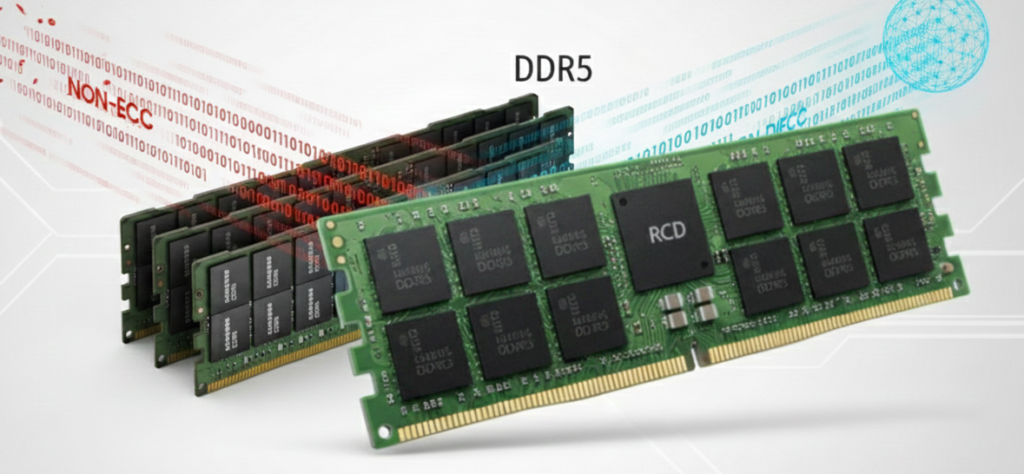
TL;DR: Used 64GB DDR5 server modules rose about 310% in the year to August, according to one appraiser’s resale data, while used server CPUs and GPUs were mostly flat or lower and a widely used enterprise SSD rose about 60%. This article explains why memory pulled ahead and what that means for a server refresh. TrendForce estimates that 64GB DDR5 RDIMMs now earn their makers more per wafer than HBM. In a general-purpose server, used server RAM value now outweighs the CPUs, so the memory is the part to price first, though GPU servers are a different case and resale values are not buyback quotes.
Start with one module
On DataCenterDisk, a retail price tracker that follows four 64GB DDR5 RDIMMs, the cheapest in-stock listing in early November was $2,245, a Samsung DDR5-4800 module. A Micron DDR5-5600 module on the same page was $2,953. A current two-socket server takes sixteen or more of these.
A retail listing is not the value of a used module, and this article keeps the two apart. Retail prices, contract prices (what large buyers pay memory makers under supply deals) and used prices are three different markets, measured on different dates. The used market has its own figures, and they are high too. AMCompute, an appraiser that publishes values built from completed resale transactions, puts a used 64GB DDR5 RDIMM at $890 to $1,200, up about 310% over the 12 months to August.
Two otherwise identical servers show what that means in practice. They have the same model, the same CPUs and the same badge on the front. One holds sixteen 16GB DDR5 modules and the other sixteen 64GB modules, so on a spec sheet they look like the same asset. At those ranges, the first server’s memory is worth $3,360 to $5,120 and the second’s $14,240 to $19,200. Working from the published ranges, that is about four times as much.
Where the value sits in a server
No public source gives one figure for how much of a server’s value is memory, because it depends on the build. Those resale values make the pattern clear, though. The table below prices four example builds. The configurations are this article’s choice, and the dollar figures are the appraiser’s used ranges multiplied out.
| Example build | Memory | Processors or GPUs |
|---|---|---|
| 2× Xeon Gold 6230 (Cascade Lake), 12× 32GB DDR4 | $1,200–1,800 | $64–78 for both CPUs |
| 2× Xeon Gold 6430 (Sapphire Rapids), 16× 64GB DDR5 | $14,240–19,200 | $2,200–2,800 for both CPUs |
| 2× EPYC 9654 (Genoa), 24× 64GB DDR5 | $21,360–28,800 | $3,800–4,800 for both CPUs |
| GPU server with 8× H100 SXM | Not counted here | $80,000–112,000 for the GPUs |
Older processors are worth very little. A Xeon Gold 6230 is valued at $32 to $39, and a GPU such as a 16GB V100 SXM2 at $97 to $120. Recent processors are worth real money, and an EPYC 9654 is valued at $1,900 to $2,400. But a two-socket server has two of them and sixteen to twenty-four memory slots, so in a general-purpose server the memory usually outweighs the CPUs. Adding four 3.84TB Samsung PM9A3 SSDs at $440 to $620 each to the Sapphire Rapids build, memory makes up roughly three-quarters of what the three parts are worth together, working from the midpoints. A server with current data center GPUs is the exception, because eight H100s outweigh any memory configuration.
The trend over the year points the same way. Across these CPUs and GPUs, most values over the 12 months to August were flat or lower, with a few small gains. Memory roughly quadrupled.
These are resale values, and they describe what tested parts sell for. They are not what an ITAD or a broker will pay for a decommissioned lot. An offer for a lot sits below resale value, because the buyer pays for testing, freight, data handling on drives, units that fail and its own margin, and the offer also depends on quantity, condition and whether matched sets are intact. The figures show where the value in a server sits. They are not a price to hold a buyer to.
Server memory out-earns HBM
The usual explanation for the shortage is that AI accelerators are taking all the memory. They take plenty, but there is a less obvious fact underneath. TrendForce, a market research firm, estimates that 64GB DDR5 RDIMMs overtook HBM in revenue per wafer in the first quarter of 2026, and that HBM’s per-wafer profitability has trailed since. HBM is high-bandwidth memory, the stacked DRAM packaged next to AI GPUs.
SK hynix describes a similar trend from the inside. After settling next year’s HBM volumes and prices with major customers, its CFO said he expects the profitability gap between HBM and conventional DRAM to “narrow meaningfully.” The two measures differ, because the research firm’s figure is profit per wafer while the company is describing its own margins, where a gap still exists. For server buyers they point the same way. A memory maker no longer needs an AI customer to justify putting a wafer into server DRAM, because server DRAM is already one of the best uses of that wafer.
That is why the shortage reaches buyers who have nothing to do with AI. Much of the coming supply is already committed. SK hynix has signed long-term agreements with 14 customers covering more than half of its 2027–2028 capacity, typically for five years. It says its DRAM and HBM volumes are “effectively sold out” through 2029, a figure that counts demand still under discussion as well as signed contracts. Samsung has signed ten major accounts and is in talks with ten more. Our look at both companies’ Q3 results covers those contracts in detail.
The supply that is coming also grows more slowly than the servers that use it. The same firm’s initial estimate is that RDIMM bit supply will grow only 15% to 20% in 2027, “significantly lagging” projected growth in server CPU shipments. Current server processors have eight or twelve memory channels, so at one module per channel each new socket needs eight to twelve DIMMs. When the number of sockets grows faster than the memory to fill them, the shortage does not ease on its own.
Forecasts have followed that arithmetic all year. In May, Citi projected that 64GB DDR5 RDIMM contract prices would climb from $873 in the first quarter to about $1,586 by the fourth, according to a report on the note. That is a contract-market forecast, so it cannot be compared directly with a retail listing or a used value.
What used modules actually fetch
New prices can soar while used prices barely move, and the SSD section below shows exactly that. So the used market needs its own evidence. The appraiser’s figures cited above are the clearest public set. Over the 12 months to August, used DDR5 RDIMMs rose by about 225% to 315% depending on capacity, from $210–320 for a 16GB module to $1,900–2,700 for a 128GB one. They are one company’s ranges, built from its own resale data, and they end in August.
A refurbished-parts seller quoted in our SSD guide says used drive prices “are set by the supply of decommissioned hardware,” and the same logic likely applies to memory. The first DDR5 servers, built on AMD’s Genoa and Intel’s Sapphire Rapids processors, shipped from late 2022 and early 2023. A likely explanation for high used DDR5 prices is that relatively few of those servers have reached the used market yet, while buyers who cannot get new modules on time compete for what does. No public figure on DDR5 server retirements confirms this, so it is a reading of the evidence rather than a measured fact.
Where a given lot lands depends on capacity, speed bin, brand, form factor, and whether a current server platform still uses the part. Our guide to what drives server memory resale value covers those variables. High-density DDR5 sits at the top. Matched sets help too. Sixteen identical modules pulled from one server are easier for a buyer to test, price and resell than the same number of mixed modules, and a set that gets split up loses that advantage.
DDR4: up sharply over the year
DDR4 needs its own section, because it has not behaved like a retired generation. On the same figures, a used 64GB DDR4 RDIMM is valued at $250 to $370, up about 285% in the year to August, and a 32GB module at $100 to $150, up about 335%. DDR3 shows where an old generation usually ends up: a used 16GB DDR3 RDIMM is worth $13 to $17.
DDR4 held up because the Cascade Lake, Ice Lake, Rome and Milan servers that use it are still in production service. Those fleets still need memory for upgrades and spares, while the memory makers have cut DDR4 output to make room for DDR5 and HBM. On the spot market, where chips are sold day to day outside contracts, a 16Gb DDR4 chip still costs more than a 16Gb DDR5 chip. On November 11, spot quotes showed 79.87 for DDR4 against 60.23 for DDR5, which works out to about a third more. That inversion has lasted since 2025. It has narrowed this autumn, from about 70% at the end of August on this blog’s earlier figures, but it has not closed.
Those spot prices have moved little in recent weeks. The mainstream DDR4 chip rose 0.84% in the week to October 20 and 0.55% the week after, while DDR5 suppliers were “clearly reluctant to sell,” according to the weekly spot report. That describes chips rather than modules, and the public module data stops in August, so it shows only that the input cost has stopped climbing fast. For anyone retiring a DDR4 fleet, the past year’s gains are real. What supports them, though, is an installed base that shrinks every year as those servers retire, so modules pulled now are worth identifying properly before anyone tries to sell DDR4 RAM from them.
SSDs follow a different rule
It would be tidy to say the same about every component in the rack. The SSD data says otherwise, and it is the best available warning against pricing a used part off a headline.
Chaining the published quarterly forecasts, contract prices for new enterprise SSDs will end 2026 at roughly four times their end-2025 level if the estimates hold. Used prices did nothing of the sort. In the same resale data that shows used 64GB DDR5 up about 310%, a used 3.84TB Samsung PM9A3 rose about 60%, to $440–620. In October, IT resellers listed the same drive new at prices from about $935 to $2,442. Model by model the spread is wider still: a 3.84TB Kioxia CM6-R rose about 180% in a year, while a 7.68TB Kioxia CD6-R rose about 5%.
The likely reason is the same supply rule seen from the other side. Enterprise SSDs have been coming out of retired servers and storage arrays for years, and buyers price each drive by model rather than by this quarter’s NAND contracts. Wear and sector format decide something more basic, which is whether a drive can be tested and resold quickly at all. Drives pulled from storage arrays often show up as 0 GB until they are reformatted. Our guide to what a used enterprise SSD is worth works through those numbers model by model.
So in a mixed retirement this year, the memory carries the pricing power, and each SSD is priced on its own model and condition.
Slower increases are not a turning point
The rate of increase is coming down. The research firm cited earlier forecast a 58–63% rise in conventional DRAM contract prices for the second quarter and 10–15% for the fourth. It expects server DRAM contract prices to keep rising every quarter through the second half of 2027, by a little less each time. The cheapest listing on the retail tracker cited above has barely moved over the past month, which is a pause at a high price rather than a decline.
Buyers do not expect relief soon. Apple, one of the largest memory buyers, said in late October that it expects memory prices to keep rising after December. Among the 20 forecasts this blog collected on when the memory shortage ends, the price forecasters point to 2027. Citi expects prices to peak in the second quarter of 2027, and Gartner said in April that “any meaningful pricing relief is not expected until late 2027.” The memory makers point to 2028 or later before supply catches up.
Both views can be right, because a price peak and the end of a shortage are different events. For used modules, the turning point likely depends on supply more than on contract prices. The window for sellers starts to close when refreshed DDR5 fleets reach the used market in volume. The first Genoa and Sapphire Rapids servers are approaching the age at which fleets are usually refreshed, but a shortage gives their owners every reason to run them longer, which would push that supply further out.
So before a retired server is sent off for recycling as a whole unit, the useful document is the DIMM population of the fleet it came from. That means capacities, speed bins and part numbers, kept together as matched sets and listed while the platform they came from is still current. It is the list a buyer can actually quote against, and in a general-purpose server it is where most of the value sits. With that list in hand, anyone can ask to sell server RAM and compare real offers, which will sit below the resale values cited here. A count of chassis is where the conversation usually starts, but the memory list is where the money is.
Where the prices and values in this article come from, and when: new retail listings are from one tracker in early November 2026. Used values for memory, CPUs, GPUs and SSDs are AMCompute’s resale ranges for the 12 months to August 2026. Contract-price forecasts and DRAM spot prices (as of November 11, 2026) are TrendForce’s, apart from the May 2026 bank forecast, which is as reported. New SSD listings are from October 2026. Resale values are not buyback offers, and numbers this article calculated from those sources are marked as such in the text.