
Why GPU Prices Are Rising in 2026
TL;DR: GPU prices are rising again in 2026—not because of silicon shortages, but because memory has become the dominant cost driver. Rapid increases in GDDR6 and GDDR7 pricing, combined with AI-driven demand for high-bandwidth memory (HBM), are constraining supply across the entire GPU market. Flagship GPUs now sell far above MSRP, mid-range cards face sustained premiums, and manufacturers are responding with price hikes and tighter supply control. As AI infrastructure absorbs a growing share of memory capacity, GPUs are increasingly behaving like scarce financial assets rather than commodity components—creating both risks for buyers and opportunities in the used GPU market.
After several years of volatility, GPU pricing is entering a new phase—one driven less by silicon innovation and more by memory economics. Multiple supply-chain and industry reports published in late 2025 indicate that AMD and Nvidia are preparing GPU price increases in early 2026, with further increases likely throughout the year.
Unlike previous cycles triggered by cryptocurrency booms or short-term shortages, the current GPU price increase reflects a deeper structural shift. VRAM has become the dominant cost component of modern GPUs, while global memory production is increasingly optimized for AI data center workloads rather than consumer graphics cards.
Before examining the underlying drivers behind rising GPU prices, it is worth looking at what the market data already shows.
The Numbers: From MSRP to “Luxury Item”
Recent market data shows GPU pricing remains elevated across both high-end and mid-range models, driven by broader memory cost inflation and constrained supply dynamics.
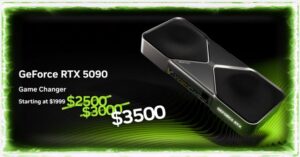
For flagship parts, Nvidia’s GeForce RTX 5090 launched with an MSRP of $1,999 in early 2025. Since then, retail pricing has diverged sharply from official launch levels. Listings and price surveys across major U.S. retailers such as Best Buy and Newegg now commonly show RTX 5090 models priced in the $3,500–$4,000 range, particularly for higher-end board-partner designs, reflecting tightening supply and rising component costs. Industry commentary suggests that, if current memory pricing and allocation trends persist, effective market prices could move closer to $5,000 over the course of 2026. This shift has been widely discussed in English-language hardware media, with analysts noting that high-end PC gaming is facing “major challenges due to significant GPU price hikes,” and that RTX 5090 pricing has remained well above MSRP across both retail and secondary markets (TechRadar, Wccftech).
A similar pricing dynamic is emerging on the AMD side. AMD’s latest flagship Radeon RX 9000–series GPU, positioned as the company’s top consumer offering for 2025, launched with pricing intended to undercut Nvidia at the high end. However, retail listings and channel checks indicate that real-world prices have already begun drifting above launch expectations, particularly for higher-VRAM configurations. Industry reports note that AMD faces the same structural pressure as Nvidia: rapidly rising GDDR memory costs and tightening supply as memory manufacturers prioritize AI workloads. As a result, analysts expect AMD flagship GPUs to see incremental price increases through early 2026, narrowing the historical price gap between Radeon and GeForce products.
Mid-range GPUs are also expected to see meaningful price pressure in 2026, particularly for models with higher VRAM configurations. While these cards have historically occupied the $300–$800 price range, industry pricing analysis indicates that many mid-tier GPUs were already selling at premiums of roughly 25% above MSRP during 2025, even before the full impact of rising memory costs was felt. Looking ahead, market forecasts suggest that continued increases in GDDR pricing will likely translate into additional 10–25% price increases for mid-range GPUs in 2026, with 12GB and 16GB models most exposed to cost pass-through. Analysis from GPU Sniper notes that escalating memory costs are compressing affordability across the mid-range segment, meaning cards that once reliably sold near MSRP are increasingly priced at sustained premiums rather than temporary markups
The Core Driver: Why GPU Memory Costs Are Exploding
At the center of the current GPU price spike is not silicon, but memory.
Over the past two GPU generations, graphics cards have become increasingly defined by VRAM capacity and memory bandwidth rather than raw compute alone. Modern games, professional visualization, and AI-assisted workloads are fundamentally memory-intensive, pushing 12GB and 16GB configurations into the mainstream. As a result, VRAM has shifted from a supporting component to a primary cost driver in GPU manufacturing.
GDDR Prices Are Rising Because Memory Is No Longer a Commodity
Between mid and late 2025, industry pricing data indicates that GDDR6 memory costs rose by roughly 60%, with newer standards such as GDDR7 increasing even more sharply. These increases were not driven by consumer demand spikes, but by structural changes in memory allocation across the industry.
Historically, GPU vendors relied on long-term memory supply contracts that provided stable pricing. By late 2025, many of those contracts expired. When vendors returned to renegotiate supply, they faced a constrained market where pricing was increasingly dictated by spot availability rather than predictable agreements.
Why HBM Matters—Even If Consumer GPUs Don’t Use It
Although consumer GPUs rely on GDDR rather than high-bandwidth memory (HBM), HBM demand has become a major indirect driver of VRAM inflation.
Memory manufacturers such as Samsung, SK Hynix, and Micron operate within shared fabrication, packaging, and engineering constraints. While GDDR and HBM are distinct products, they compete for the same advanced capacity and investment. HBM, which is significantly more complex to manufacture, delivers far higher margins when sold into AI data center contracts.
As hyperscalers and large technology firms secured long-term AI infrastructure agreements throughout 2024 and 2025, memory vendors prioritized HBM3e and future HBM4 production. The result is not that consumer GPUs use HBM, but that HBM demand crowds out GDDR supply, leaving consumer GPU vendors exposed to tighter availability and volatile pricing.
Memory Now Dominates GPU Cost Structures
This reallocation has fundamentally altered GPU economics.
By late 2025, analysts estimated that memory could account for more than 70–80% of the total bill of materials for higher-VRAM consumer GPUs—an unprecedented shift. In practical terms, the cost of 16GB GDDR7 reportedly rose from roughly $65–$80 per card in mid-2025 to over $200 by year-end. GPUs launched at MSRPs based on older contracts quickly diverged from those prices once vendors were forced into spot-market sourcing.
This explains why recent GPU price increases have been abrupt rather than gradual.
AI Infrastructure Is Absorbing Supply Where It Matters Most
AI data center construction has created synchronized demand for GPUs, memory, and high-capacity SSDs—the components most directly tied to AI performance and scalability. CPUs have been less affected, as they rely on more mature processes and are not the primary bottleneck in AI workloads.
As long as AI infrastructure continues to absorb a disproportionate share of advanced memory output, consumer GPUs—particularly higher-VRAM models—will remain structurally expensive.
Vendor Responses: Price Increases and Supply Control
AMD and Nvidia are responding differently, but with similar outcomes.
Supply-chain sources report that AMD plans to begin GPU price increases in January 2026, while Nvidia is expected to follow in February. Initial increases are likely to affect consumer-facing products such as the Radeon RX 9000 and GeForce RTX 50 series, before extending into professional and server GPUs.
At the same time, Nvidia is reportedly preparing to reduce discrete gaming GPU production by 30–40% in the first half of 2026, prioritizing AI and data center products where pricing power is stronger (wccftech). Another notable shift is the reported end of VRAM bundling, where Nvidia previously sold GPU dies together with memory to board partners. Without bundled pricing, manufacturers such as ASUS, MSI, and others must source VRAM independently, often at significantly higher and less predictable rates.
Early Market Signals Are Already Appearing
The downstream impact is already visible across the industry.
Some international retailers have begun limiting purchases of higher-VRAM GPUs, particularly 16GB models, due to constrained supply. OEMs are redesigning product lines to control costs, including the reintroduction of 8GB laptop configurations while raising prices sharply on 16GB and 32GB systems.
Major manufacturers are now openly acknowledging the pressure. ASUS has confirmed price increases effective January 5, 2026, citing rising DRAM and storage costs, while Dell previously announced price adjustments of up to 30% on certain systems.
What This Means for the GPU Market in 2026
The current trajectory suggests that GPU pricing pressure is not a temporary spike but a longer-term revaluation of graphics hardware, driven primarily by memory economics and AI-first allocation. As high-bandwidth memory (GDDR7, HBM3e) costs continue to rise and production is prioritized for AI data centers, GPUs are increasingly behaving like constrained, high-value assets rather than commodity components.
For consumers and enterprises alike, this shift has several important implications:
-
Buyers should act strategically. Delaying GPU purchases may result in materially higher costs over the coming months, especially for high-VRAM cards. Monitoring retail listings and planning acquisitions carefully will help mitigate unexpected price surges.
-
Existing GPUs are becoming valuable assets. Organizations or individuals holding surplus GPUs—whether consumer, workstation, or server models—may find that the residual value of their hardware has increased. This creates an opportunity to monetize idle or underused GPUs in a market where demand continues to outpace supply.
-
The used GPU market is increasingly professionalized. Businesses can now sell GPUs safely and efficiently through specialized IT asset disposition (ITAD) channels. For example, BuySellRam.com provides a platform to liquidate surplus GPUs while maximizing returns, helping organizations convert aging inventory into capital that can be reinvested in new hardware or operational needs.
-
Market timing matters. As GPUs transition from technical components to financial assets, understanding supply trends, memory pricing, and AI adoption cycles will be crucial. In 2026, GPU ownership is not just a technical decision—it is also a financial one. Businesses and individual professionals who actively manage their GPU portfolio can gain a competitive edge, either by securing inventory before price hikes or by selling strategically in a tight market.
Final Takeaway: GPUs Are No Longer Just Hardware
The GPU market in 2026 is being reshaped by forces well beyond gaming demand. Rising VRAM costs, AI-driven memory allocation, and constrained supply chains are transforming GPUs from mass-market components into capital-intensive assets with real financial implications.
For buyers, this means higher prices, tighter availability, and greater importance placed on timing and configuration choices. For organizations holding existing GPUs—whether consumer, workstation, or server-grade—the same forces are increasing residual values and liquidity in the secondary market.
As the used GPU market becomes more structured and professional, platforms like BuySellRam.com play an increasingly important role in helping businesses unlock value from surplus hardware. In an environment where memory economics dictate pricing, proactive GPU asset management is no longer optional—it is a competitive advantage.
Related Blog Post: 10 Best Places to sell GPU for cash for the Most Returns